
Travel guide · Brazil
Rio de Janeiro Travel Guide 2026: Christ and Sugarloaf Tickets, Safety, Visas and Costs
Rio and Corcovado from Sugarloaf Mountain Photo: Wilfredor, CC0
Rio de Janeiro is a city of beaches and granite peaks where two summits, Corcovado and Sugarloaf, decide how most first visits are planned. The choices that matter are how you reach Christ the Redeemer while works halve its capacity until 2027, which beach district you sleep in, and how seriously you take street-level safety. This guide gives the 2026 ticket prices, the visa rules for Americans, a month-by-month climate table and current prices for 1,440 tours and day trips in our catalogue.
Rio de Janeiro at a glance
| Country | Brazil |
|---|---|
| Population | About 6.73 million in the city (2025 estimate), 13.9 million in the metro area |
| UNESCO | Carioca Landscapes between the Mountain and the Sea, inscribed 2012 |
| Founded | 1 March 1565 |
| Main airport | Galeão (GIG), about 16 km from the centre and 24 km from the beaches |
| Christ the Redeemer | R$ 134 by train, R$ 132 by van from Copacabana, R$ 87 from Paineiras — entry included |
| Sugarloaf cable car | R$ 199 standard ticket for foreign visitors |
| Entry | US e-visa US$ 80.90; UK visa-free up to 90 days, passport valid 6 months from arrival |
| Power | 127 V in most buildings, some 220 V; type N and C sockets |
Rio was founded on 1 March 1565 and its setting — mountains dropping straight into the bay and the ocean — is what UNESCO listed in 2012, rather than a single monument. The practical upshot: the best sights are viewpoints, beaches and forest, and most of them cost little or nothing. The two big exceptions are Christ the Redeemer and Sugarloaf, which together cost a foreign adult about R$ 330 before any tour.
Rio de Janeiro in pictures
Tap a photo to enlarge it. Photos: Donatas Dabravolskas, Helder Ribeiro from Campinas, Brazil, Wilfredor, Pierre André, Marinelson Almeida - Traveling through Brazil from Niteroi, Brasil — Wikimedia Commons.
How do you get tickets for Christ the Redeemer and Sugarloaf in 2026?
Christ the Redeemer: there is no ticket without the official train or van
You cannot simply buy entry to the statue. Every ticket bundles the ride up Corcovado with access to the monument, and you choose between the Corcovado Train from Cosme Velho and the official vans run by Paineiras Corcovado. Prices do not change between weekdays and weekends.
| Option | Adult | Child 7–11 | Where you board |
|---|---|---|---|
| Corcovado Train | R$ 134 | R$ 107 | Estação Cosme Velho, Rua Cosme Velho 513 |
| Official van from Copacabana | R$ 132 | R$ 105 | Praça do Lido, about 10 minutes' walk from Cardeal Arcoverde metro |
| Official van from Largo do Machado | R$ 132 | R$ 105 | Largo do Machado, about 2 minutes from the metro |
| Official van from Paineiras | R$ 87 | R$ 60 | Paineiras Visitor Centre, halfway up; no parking |
Under-6s ride the train free on a guardian's lap. The R$ 70 senior fare is only for Brazilians and foreign residents of Brazil. Van prices are from June 2026; confirm on the operator's ticket site.
Verdict: Staying in Copacabana? Take the official van from Praça do Lido: it costs R$ 2 less than the train and starts near your hotel. Choose the train if you want the rack-railway ride through the forest, which takes roughly 15–20 minutes from Cosme Velho. The R$ 87 Paineiras van only saves money if you are already near the visitor centre, because you still need a taxi or app car to get there.
Book a timed slot: works have halved capacity until about May 2027
Since August 2026 the summit area, Alto Corcovado, has been under renovation for new escalators, inclined lifts and better accessibility. Capacity is down by 50% and the works are expected to run until May 2027. Vans board between 07:00 and 18:00 with a fixed number of tickets per slot, so buy online, check the date, time and boarding point, and arrive 15 minutes early.
Demand has not fallen to match: official vans alone carried a record 1 million visitors between January and August 2026. Older guides that say you can turn up and queue were written before the works. On a short trip, book Christ the Redeemer first and fit the rest of the day around your slot.
Sugarloaf: R$ 199 for both cable cars, no booking slot needed
The Sugarloaf cable car has run since 1912 in two stages: 600 m from Praia Vermelha to Morro da Urca (220 m), then 850 m to the summit at 396 m. Each ride takes about three minutes. The standard ticket covers both legs and park access and costs R$ 199 for foreign visitors; Brazilians pay R$ 155, Rio state residents R$ 85, and the half-price ticket is R$ 99.
| Sugarloaf ticket | Price | Who it suits |
|---|---|---|
| Bilhete Bondinho (standard) | R$ 199 | Most foreign visitors |
| Half price (meia-entrada) | R$ 99 | Eligible children, students, seniors and others with proof |
| Acesso Rápido (fast track) | R$ 315 | Sunset on a weekend or holiday, when queues are longest |
| Sunrise ticket (Amanhecer) | R$ 550 | Photographers; departs 03:45, breakfast included |
Opening hours differ between official sources: the purchase page shows 08:30–21:00 daily with last boarding at 19:30, while an older park post gave shorter weekday hours. Plan on the later figure but check on the day. If you are fit, walk to Morro da Urca on the Pista Cláudio Coutinho from Praia Vermelha in about 40 minutes — entry to Morro da Urca is free on foot, and you buy only the upper leg.
Verdict: Do Christ the Redeemer in the morning on a booked slot and Sugarloaf in the late afternoon. The first hours after opening are the calmest at Sugarloaf and sunset is the busiest, so pay for the R$ 315 fast track only if your one free evening falls on a weekend.
Is Rio de Janeiro safe for tourists in 2026?
Street crime in Rio is real, and both the British and US governments spell out where it happens. The US State Department rates Brazil at Level 2, Exercise Increased Caution, because of crime and kidnapping, and tells travellers not to go into favelas. GOV.UK says thefts and pickpocketing are most common around Copacabana and Ipanema beaches, Lapa and Santa Teresa — exactly where most visitors spend their time.
Phones, beaches after dark and drinks are the main risks
- Phones: thieves target them especially between 4pm and 9pm. Step into a shop to check maps, and hand things over without resisting if threatened.
- Beaches: groups sometimes run through crowds grabbing bags and phones (arrastões); reports from July 2026 describe this on Copacabana and Ipanema during a heat wave. Take only what you need and do not go onto city beaches after dark.
- Drinks and dating apps: foreigners have been targeted through apps for drink spiking and robbery. In September 2026 a tourist was drugged, robbed and thrown from a car in central Rio after an app meeting. Buy your own drinks and keep them in sight.
- Spirits: methanol poisoning from adulterated spirits has caused deaths in Brazil; be wary of cheap spirit-based drinks.
- Transport: do not hail taxis on the street. Book through an app, wait somewhere safe and check that the car and driver match.
- ATMs: card cloning is common; use machines inside banks or malls and walk away from anything that looks tampered with.
Favelas and the Corcovado trail: follow the official advice
The catalogue lists 94 favela tours, and they are popular. Both governments advise against them: GOV.UK says to avoid favelas including organised tours, and notes that tourists have been shot after taking a wrong turn into one, so check that GPS routes do not cut through. GOV.UK also reports armed robberies on the Corcovado walking trail to the statue.
Verdict: Ride to Christ the Redeemer rather than hiking up from below, keep your phone out of sight on the street, and treat favela tours as a personal risk decision that both the US and UK governments advise against. The police emergency number is 190.
When is the best time to visit Rio de Janeiro?
May to September is the best time for sightseeing; December to March for the summer scene
Rio has a tropical wet-and-dry climate, and the heavy rain falls mostly from December to March. Long-term averages for central Rio show January to March with highs above 31 °C and around 130–137 mm of rain a month, against 26–27 °C and roughly 42–54 mm from June to September. High season — New Year, summer holidays and Carnival — runs from December to March, when hotels and flights cost the most.
| Month | High / low °C | Rain (mm) | Crowds | What to know |
|---|---|---|---|---|
| January | 32 / 24 | 137 | Very high | High season; hottest and wettest stretch |
| February | 32 / 24 | 130 | Very high | Carnival 2027 parades on 7–9 February |
| March | 31 / 24 | 136 | High | Still hot and rainy; summer crowds thin out |
| April | 30 / 23 | 95 | Lower | Rain easing after the summer |
| May | 28 / 21 | 70 | Lower | Dry, warm days: a good all-round month |
| June | 27 / 19 | 43 | Lower | The driest months begin |
| July | 26 / 19 | 42 | Lower | The driest month |
| August | 27 / 19 | 45 | Lower | Dry and mild; good for hiking |
| September | 27 / 20 | 54 | Lower | Dry, mild; good for hiking |
| October | 28 / 21 | 87 | Lower | Warming up as rain returns |
| November | 29 / 22 | 98 | Lower | Hot, showers more frequent |
| December | 30 / 23 | 134 | Very high | New Year's Eve on Copacabana |
Climate: INMET 1981–2010 averages, Saúde station in central Rio. Crowd levels follow the December–March high season and the main events; they are a guide, not a count.
Carnival 2027 is on 7–9 February; New Year draws millions to Copacabana
The top samba schools parade at the Sambódromo on Sunday 7, Monday 8 and Tuesday 9 February 2027, and the champions return on Saturday 13 February. Grandstand tickets went on sale through Ticketmaster in August 2026 at a fixed R$ 250 per night (R$ 125 half price), four per buyer. New Year's Eve is even bigger: the 2025–26 celebration drew over 5.1 million people across 13 stages, about 2.6 million of them on Copacabana.
Verdict: For a first trip built around views and hiking, choose May to September. Come for Carnival or New Year only if the event is the point of the trip, and book early.
How do you get from the airport and around Rio?
International flights land at Galeão (GIG), about 24 km from the beaches of the Zona Sul. The direct airport coach to Copacabana, Ipanema and Leblon is cheap but runs only five times a day, so most visitors are better off with a fixed-fare airport taxi or a ride-hailing car. Inside the city the metro links the centre with the beach districts and takes contactless bank cards and phone wallets at every station.
| Option | Fare | Notes |
|---|---|---|
| Metro | R$ 7.90 | All 41 stations take contactless cards; fare frozen for 2026 |
| City bus, BRT, VLT tram | R$ 5.00 | Since 4 January 2026 |
| Santa Teresa tram | R$ 20 return | From Estação Carioca; same-day re-boarding included |
| Airport coach to Zona Sul | R$ 24.85 | Galeão–Leblon via Copacabana and Ipanema; 5 departures a day (2025) |
| Express BRT to Centro | R$ 15 | Galeão–Gentileza in 35–40 minutes, then VLT (2025) |
| Airport taxi to Copacabana | R$ 116–141 | Fixed fare, regular taxi (2025) |
| Ride-hailing to Copacabana | around R$ 60 | Estimate for UberX (2025) |
Airport fares are 2025 figures and the airport's operator may change in 2026; check before you fly.
Verdict: From the airport, book an app car or take a fixed-fare airport taxi. In town, use the metro for the long hops and apps at night; never flag taxis on the street.
What are the best things to do in Rio de Janeiro?
Christ the Redeemer on Corcovado Must do· morning, booked slot
The statue is 30 m tall on an 8 m pedestal, with arms spanning 28 m, on a peak of about 700 m inside Tijuca National Park. It was dedicated on 12 October 1931 and voted one of the New 7 Wonders in 2007. Escalators and lifts have reached the platform since 2003 and are now being replaced, which is why capacity is halved until about May 2027.
71 Christ the Redeemer tours tours on Excurgo · from $40, typical $134 per person · rated 4.5 across 2,817 reviews


Sugarloaf Mountain by cable car Must do· late afternoon or at opening
Two cable car legs take you to the 396 m summit, with views over the bay, the beaches and Corcovado. Allow time on Morro da Urca, the halfway hill. A zipline was planned here, but the courts annulled its licence in April 2026 and kept the works suspended in July, so ignore anything that advertises it.
39 Sugarloaf hikes and climbs tours on Excurgo · from $40, typical $113 per person · rated 4.7 across 1,467 reviews


81 Christ and Sugarloaf in one day tours on Excurgo · from $75, typical $174 per person · rated 4.8 across 20,279 reviews



Copacabana, Ipanema and Leblon beaches Must do· daytime only
The beaches are Rio's living room and cost nothing. Since a May 2025 decree, loudspeakers and music groups on the sand, glass bottles and unlicensed stalls are banned on the beachfront, though some rules were later relaxed. Bring only cash for the day and a cheap phone, and leave before dark.
Tijuca National Park and its waterfalls Must do· morning
Most of the park is free: you pay only for the Christ monument and activities such as hang gliding. Highlights include the Vista Chinesa and Mesa do Imperador viewpoints, Cascatinha Taunay, the park's largest waterfall, and Pico da Tijuca, its highest point at 1,021 m. Hire an accredited guide for the harder trails.
92 Tijuca Forest hikes tours on Excurgo · from $49, typical $93 per person · rated 4.7 across 5,176 reviews


Dois Irmãos, Pedra da Gávea and Telégrafo hikes Worth it· early, with a guide
The granite peaks west of Leblon give the most dramatic views of the beaches. They sit in the Pedra da Gávea and Pedra Bonita sector of the national park, where hiring an accredited guide is recommended for the demanding routes. Guided peak hikes in the catalogue usually cost $74.
105 Guided peak hikes tours on Excurgo · from $30, typical $74 per person · rated 4.9 across 3,591 reviews


Selarón Steps, Lapa and the Santa Teresa tram Must do· daytime
Chilean-born artist Jorge Selarón spent from 1990 until 2013 covering 215 steps between Lapa and Santa Teresa with more than 2,000 tiles from over 60 countries. Above them, the yellow tram climbs from Estação Carioca over the Arcos da Lapa; a R$ 20 return lets you hop off and back on the same day. Since July 2026 the restored Silvestre branch also runs four weekday trips.
47 Historic centre walks tours on Excurgo · from $12, typical $86 per person · rated 4.8 across 1,657 reviews


Jardim Botânico Worth it· half a day
The Botanical Garden is best known for its avenue of imperial palms. Foreign visitors pay R$ 80, residents of Brazil R$ 40, and under-5s enter free. The garden's museum and Casa Pacheco Leão are free.
Museu do Amanhã and the port Worth it· rainy day
The Museum of Tomorrow on the waterfront is the best rainy-day choice. It opens 10:00–18:00 with last entry at 17:00, and tickets cost roughly R$ 20–40; sources disagree on which weekday it closes and whether Tuesdays are still free, so check before you go.
A football match at Maracanã Worth it· match days
A Flamengo, Fluminense or Botafogo game is the most Carioca evening you can have. Tours with tickets and transport usually cost $103 and remove the hard parts: buying tickets and getting home safely. Stadium tours run daily and last 40–50 minutes, but stop three hours before kick-off on match days.
25 Maracanã match nights tours on Excurgo · from $20, typical $103 per person · rated 4.7 across 525 reviews


A sunset sail or boat trip in the bay Worth it· late afternoon
Seeing Sugarloaf and Copacabana from the water is a relaxed way to end a day, and shared boat trips are some of the cheaper experiences in the catalogue at around $120.
60 Boat trips in the bay tours on Excurgo · from $54, typical $120 per person · rated 4.9 across 3,220 reviews


Hang gliding or paragliding Worth it· clear, calm day
Tandem hang gliding and paragliding flights take off within Tijuca National Park, where these are among the few paid activities. Expect about $259 for a flight with the catalogue's operators; flights depend on the weather, so keep a spare day.
45 Tandem flights tours on Excurgo · from $80, typical $259 per person · rated 4.9 across 4,158 reviews


Food tours and cooking classes Worth it· any day
A cooking class or market tasting is a safe, sociable evening and a good first-night activity. Typical prices are $105.
50 Food tours and classes tours on Excurgo · from $30, typical $105 per person · rated 4.9 across 2,753 reviews


Worth skipping
- Walking up Corcovado on your own: GOV.UK reports armed robberies on the trail to the statue. Ride up instead.
- The Sugarloaf zipline: it is not open; its licence was annulled in 2026.
- Helicopter flights for most budgets: at a typical $399, a short flight costs more than most full-day tours.
- Sugarloaf fast track on a weekday morning: at R$ 315 against R$ 199, it only pays off at weekend sunsets.
- Favela tours, if you follow official advice: both the US and UK governments advise against them.
What are the best day trips from Rio de Janeiro?
| Destination | Distance | Time each way | Why go | Tours from Rio |
|---|---|---|---|---|
| Petrópolis | 67 km | about 1 h 30 by car | Imperial summer town and the Museu Imperial | $200 |
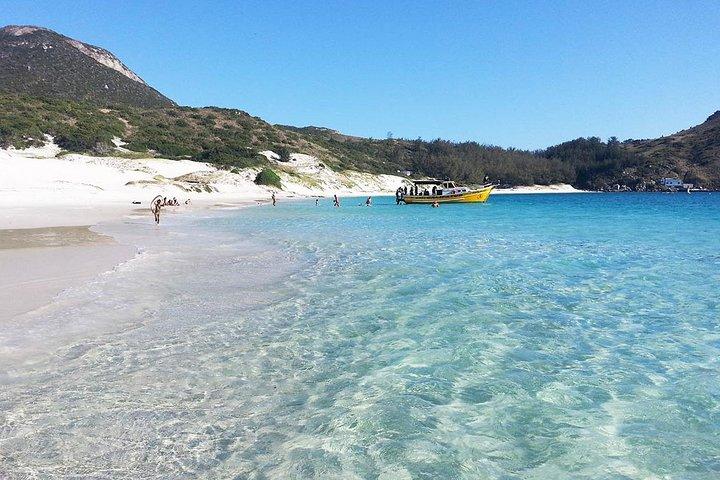
| Arraial do Cabo | 165 km | about 2 h 50 by car, more at weekends | Turquoise water and boat trips | $110 |
| Búzios | 176 km | about 3 h 15 by bus | Resort town and beaches | $111 |
| Angra dos Reis | 160 km | about 2 h 40 by road | Island-hopping boat trips | $103 |
| Ilha Grande | 112 km to Mangaratiba + boat | about 2 h by car + 1 h 30 by boat | No road access; boat only | $103 |
Verdict: Petrópolis is the only easy day trip: about three hours of driving in total. Arraial do Cabo, Búzios and Ilha Grande mean roughly six to seven hours on the road or water for one day; they are better as an overnight stay.
39 Petrópolis day trips tours on Excurgo · from $44, typical $200 per person · rated 4.6 across 1,685 reviews


36 Arraial do Cabo day trips tours on Excurgo · from $57, typical $110 per person · rated 4.3 across 1,122 reviews

How many days do you need in Rio de Janeiro?
Three full days are enough for the essentials. Book your Christ the Redeemer slot first, then build the other days around beaches and forest.
2 days
Day 1: Christ the Redeemer in the morning, Selarón Steps and the Santa Teresa tram, Sugarloaf at sunset. Day 2: Ipanema and Copacabana, Jardim Botânico, a food tour in the evening.
Tickets ≈ R$ 333 + R$ 80 · Christ + Sugarloaf tour ≈ $174
3 days
Add a morning hike in Tijuca Forest or up Dois Irmãos with a guide, and a sunset sail or a Maracanã match.
Tickets ≈ R$ 413 · Tijuca hike ≈ $93
5 days
Add Petrópolis as a day trip and either a tandem flight or a rainy-day visit to the Museu do Amanhã — or spend two nights in Arraial do Cabo or Ilha Grande.
Petrópolis tour ≈ $200 · flight ≈ $259
How much do tours and tickets cost in Rio?
Official tickets are in Brazilian reais: R$ 134 for the Corcovado Train or R$ 132 for the van from Copacabana, R$ 199 for Sugarloaf, R$ 80 for the Botanical Garden, R$ 20 for the Santa Teresa tram. Tour prices below come from our catalogue and update automatically.
| Activity | Tours | From | Typical | Top end |
|---|---|---|---|---|
| Christ the Redeemer + Sugarloaf day | 81 | $75 | $174 | $329 |
| Christ the Redeemer tours | 71 | $40 | $134 | $262 |
| Sugarloaf hikes and climbs | 39 | $40 | $113 | $200 |
| Tijuca Forest hikes | 92 | $49 | $93 | $282 |
| Peak hikes (Gávea, Dois Irmãos, Telégrafo) | 105 | $30 | $74 | $134 |
| Favela tours | 94 | $20 | $62 | $118 |
| Hang gliding and paragliding | 45 | $80 | $259 | $377 |
| Helicopter flights | 29 | $159 | $399 | $1,107 |
| Boat trips in the bay | 60 | $54 | $120 | $925 |
| Food tours and cooking classes | 50 | $30 | $105 | $205 |
| Samba, carnival and night tours | 61 | $7 | $95 | $651 |
| Maracanã match nights | 25 | $20 | $103 | $159 |
| Historic centre walks | 47 | $12 | $86 | $199 |
| Petrópolis day trips | 39 | $44 | $200 | $670 |
| Arraial do Cabo day trips | 36 | $57 | $110 | $989 |
| Angra dos Reis and Ilha Grande | 41 | $40 | $103 | $700 |
| Búzios day trips | 32 | $40 | $111 | $990 |
90% of tours in the catalogue offer free cancellation, which is useful in the rainy December–March season.
Where should you stay in Rio de Janeiro?
Copacabana or Ipanema for a first visit
Copacabana is the practical base: the metro and the Christ the Redeemer van at Praça do Lido are close by. Ipanema and Leblon, further west, put you nearest to the Dois Irmãos and Gávea hikes. Botafogo and Flamengo sit between the beaches and the centre, close to the Largo do Machado van stop and the metro.
Santa Teresa has the character — hillside streets, studios and the tram — but GOV.UK lists it, with Lapa, among the main areas for theft. Lapa and Centro suit nightlife and museums rather than sleeping. Wherever you stay, plan evening returns by app car.
Verdict: First trip: Copacabana for value and transport, Ipanema if the budget allows. Skip Santa Teresa and Lapa as a base unless you already know the city.
Visas, rules and money: what do you need to know?
- US citizens need an e-visa since 10 April 2025: US$ 80.90 at brazil.vfsevisa.com, stays of up to 90 days, and valid for 10 years according to the Brazilian consulate in Boston. Allow up to about five business days; there is no express service.
- UK citizens can visit visa-free for up to 90 days; the passport must be valid for at least six months from the date you arrive.
- Service charge: restaurants and bars may add 10% to the bill, but by Rio state law it is optional; por-quilo buffets cannot charge it.
- Beach rules: since May 2025 loudspeakers, music groups, glass bottles and unlicensed stalls are banned on the beachfront, with fines and seizure of equipment.
- Water: drink bottled or filtered water.
- Power: most buildings use 127 V, some 220 V, with type N and C sockets; check your chargers.
- Emergencies: police 190.
Which mistakes do travellers regret in Rio?
- Flying to Brazil on a US passport without an e-visa. The exemption ended on 10 April 2025.
- Turning up at Corcovado without a slot. Capacity is halved until about May 2027 and slots sell out.
- Hiking up to Christ the Redeemer alone. GOV.UK reports armed robberies on the trail.
- Using a phone on the street in the late afternoon. The 4pm–9pm window is when phone thefts peak.
- Staying on the beach after dark or taking valuables to the sand.
- Hailing a taxi on the street instead of booking through an app.
- Planning Ilha Grande or Arraial do Cabo as a day trip — it means six or seven hours of travel.
- Paying the 10% service charge without checking — it is optional, and not allowed at por-quilo restaurants.
Rio de Janeiro FAQ
How much is a Christ the Redeemer ticket in 2026?
R$ 134 for the Corcovado Train from Cosme Velho, or R$ 132 for the official van from Copacabana or Largo do Machado, both including entry to the monument. The van from the Paineiras Visitor Centre costs R$ 87. Children aged 7–11 pay R$ 107 on the train.
Do I need to book Christ the Redeemer in advance?
Yes, at least until mid-2027. Renovation works that began in August 2026 have cut capacity by 50%, and vans sell a limited number of tickets per time slot. Buy online and arrive 15 minutes early.
How much does the Sugarloaf cable car cost?
The standard ticket is R$ 199 for foreign visitors and covers both cable car legs. Half price is R$ 99, and a fast-track ticket costs R$ 315. You can also walk up to Morro da Urca for free and buy only the upper leg.
Do US citizens need a visa for Brazil?
Yes. Since 10 April 2025 Americans need an e-visa, which costs US$ 80.90 and is applied for online at brazil.vfsevisa.com. It allows stays of up to 90 days and is valid for 10 years. Processing takes up to about five business days.
Is Rio de Janeiro safe for tourists?
It is safe enough with care. The US rates Brazil Level 2 for crime and both the US and UK advise avoiding favelas. Thefts concentrate around Copacabana, Ipanema, Lapa and Santa Teresa, so keep phones out of sight, avoid beaches after dark and use ride-hailing apps.
When is the best time to visit Rio?
May to September for drier, cooler weather, with highs around 26–28 °C and much less rain. December to March is hotter and wetter but is the season of New Year and Carnival, with the highest prices.
When is Rio Carnival 2027?
The main samba school parades at the Sambódromo are on 7, 8 and 9 February 2027, with the champions' parade on 13 February. Grandstand tickets cost R$ 250 per night.
How do I get from Galeão airport to Copacabana?
Most visitors take a fixed-fare airport taxi (about R$ 116–141 in 2025) or an app car (around R$ 60). The direct Galeão–Leblon coach costs R$ 24.85 but runs only five times a day.
Can you drink the tap water in Rio?
Travellers are advised to stick to bottled or filtered water.
Do you tip in Rio restaurants?
Many bills include a 10% service charge, which is the tip. Under Rio state law it is optional, and restaurants that sell food by weight cannot charge it.
Sources and how this guide is made
Written by the Excurgo editorial team with AI assistance. We are a tour comparison site, not a tour operator, and we have not personally tested every tour. Every fact was researched in official and specialist sources and checked against them before publication; prices, ratings and tour counts come from our live catalogue of 1,440 Rio de Janeiro tours. Ratings and review counts are collected by Viator and Tripadvisor. Tours are picked by rating weighted by number of reviews (at least 20); we earn a commission from Viator when you book, and it does not affect the order.
- Trem do Corcovado — official train prices and departure station (Oct 2026)
- Paineiras Corcovado — official van boarding points (Oct 2026)
- Parque Bondinho Pão de Açúcar — Sugarloaf ticket and hours (Oct 2026)
- GOV.UK — Brazil safety and security (Oct 2026)
- GOV.UK — Brazil regional risks (Rio de Janeiro) (Oct 2026)
- GOV.UK — Brazil entry requirements (Oct 2026)
- US Department of State — Brazil travel advisory (Aug 2026)
- Consulate General of Brazil in Miami — e-visa for US citizens (Oct 2026)
- Consulate General of Brazil in Boston — e-visa validity (Oct 2026)
- Jardim Botânico do Rio de Janeiro — admission prices (Oct 2026)
- Prefeitura do Rio — Réveillon 2026 figures (Jun 2026)
- Diário do Rio — Alto Corcovado works and capacity (Sep 2026)
- Agência Brasil — Santa Teresa tram fare and hours (Mar 2025)
- Viaja que Passa — Galeão airport transport and fares (Jun 2025)
- INMET climate normals (via Wikipedia) — monthly temperature and rain (Oct 2026)
Photos come from Wikimedia Commons under free licences (CC BY, CC BY-SA, CC0 or public domain); the author and licence are shown under each one. They show the places described, not the exact tours listed.
Changelog. Guide published; prices and rules checked on 11 October 2026.
Browse every tour: Rio de Janeiro