







W
Views and History
Having a private guide makes all the difference. Spectacular views and the historical background made this tour exceptional
All in one Private Ephesus Tour is a special concept that is created for travelers who are deeply interested in mythological, and historical aspects of Ephesus and surrounding historical sights. Lectures given by tour guides are concentrated on this specific concept. Unlike other Ephesus tour options, Terrace Houses and Ephesus Museum are included in the itinerary. By joining this tour, you’ll have interesting information on topics such as Roman engineering and architecture, civil and public buildings, daily life in Ephesus, Roman mosaics, frescoes and statues, stories behind the mythological figures found in Ephesus, rituals, and practices of pagan worship, imperial cult and so on… This tour is guaranteed Skip-The-Line with pre-purchased tickets. You can always customize your tour with your private guide. The duration of this tour is about 5-7 hours including traveling time and delicious local lunch.
Prices change with the date; the lowest is shown.
Prices are per person when two book together; a solo traveller pays $160.
Larger groups pay less per person.
From the operator’s live schedule on Viator, checked Nov 28.
Visit the House of Virgin Mary.
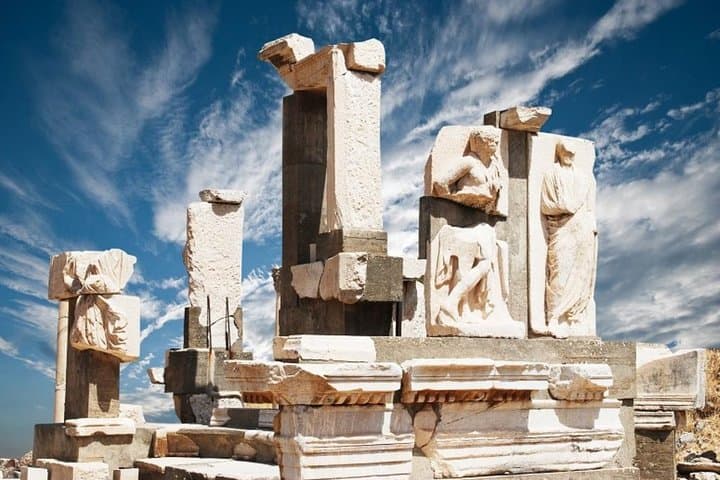
Harbour Street, theatre, the Marble Street, Celcius Library, the gate of Mihridates and Mazues, Commercial Agora, latrina, Hadrian Temple, the Scolastica Baths, Trajan Fountain, Curetes Street, Polio Fountain, Memnius Monument, the Temple of Domitian, the Prytaneion, Odeon and the State Agora are visited.
The agora on the southern part of the Basilica is the State Agora and was built in the Roman Period in the first century B.C. This agora was used not for commerce but for business, it played an important role as a meeting place for governmental discussions. During the excavations in the northeast corner of the Agora were found a great number of graves from the 7th-6th centuries B.C and a stone-paved road, and an archaic sarcophagus of terra cotta. From this, it is understood that in the archaic period this part of the Agora was used as the necropolis of Ephesus. There is a water reservoir at the corner of the Agora, which played an important role in Ephesus. Its water was brought to the city through the Pollio Aqueduct, the remains of the Pollio Aqueduct can be seen 5 kilometers away, along the Selçuk-Aydin highway.
This building has the shape of a small theatre with the stage building, seating places, and the orchestra. It had a double function in use. First, it was used as a Bouleuterion for the meetings of the Boules or the Senate. The second function was the Odeum as a concert hall for the performances. It was constructed in the 2nd century A.D by the order of Publius Vedius Antonius and his wife Flavia Paiana, two wealthy citizens in Ephesus. It had a capacity of 1500 spectators. It had 3 doors opening from the stage to the podium. The podium was narrow and one meter higher than the orchestra section. The stage building was two-storeyed and embellished with columns. The podium in front of the stage building and some parts of the seating were restored. The Odeon used to be enclosed with a wooden roof. Two councils administrated Ephesus. These were Demos or the parliament which was open to the public was taken place in the great theatre and the Bouleia which gathered in this small theatre.
FOR CRUISE PASSENGERS; WE MEET GUESTS AT THE EXIT GATE OF THE IMMIGRATION TERMINAL OF THE CRUISE PORT WITH A BOARD WITH OTTI TRAVEL SIGN ON IT. FOR PICK UP FROM HOTELS, WE MEET GUEST BY THE HOTEL RECEPTION. FOR AIRPORT PICK UP, WE MEET GUEST AT THE EXIT GATE OF THE DOMESTIC TERMINAL WITH A BOARD WITH OTTI TRAVEL SIGN ON IT.
Reviews collected by Viator and Tripadvisor
Excurgo comparison of 1,244 Viator tours, recalculated daily.
For a full refund, cancel at least 24 hours before the scheduled departure time.
NEW: Private The Most Detailed Ephesus Shore Excursion / with Lunch lasts about 5–7 hours. The itinerary has 12 stops.
Prices start at $79 per person for this Kusadasi experience, booked through Viator with the price shown before checkout. That is the per-person price when two book together; a solo traveller pays $160. There are 2 booking options, so the final price depends on the option you choose.
According to the operator’s current schedule, it runs every day, with 14 departures a day between 7:00 AM and 2:30 PM.
Children aged 4–8 pay from $40, adults from $79. Infants go free.
Yes. Cancel at least 1 day before the start for a full refund. Later cancellations are non-refundable.
Yes, pickup is offered. FOR CRUISE PASSENGERS; WE MEET GUESTS AT THE EXIT GATE OF THE IMMIGRATION TERMINAL OF THE CRUISE PORT WITH A BOARD WITH OTTI TRAVEL SIGN ON IT. FOR PICK UP FROM HOTELS, WE MEET GUEST BY THE HOTEL RECEPTION. FOR AIRPORT PICK UP, WE MEET GUEST AT THE EXIT GATE OF THE DOMESTIC TERMINAL WITH A BOARD WITH OTTI TRAVEL SIGN ON IT. Pickup points include Proxima Hotel, Chez Rumi Otel Sirince.
The experience is available in EN.
Reviews collected by Viator and Tripadvisor
Having a private guide makes all the difference. Spectacular views and the historical background made this tour exceptional
Mel was so much fun and so knowledgeable! She was funny and kind and made history easy to understand. The lunch we shared was great as well. She had a lot of pride in her beautiful town.
Nagi and Mehmet were the perfect team to take care of us today. We saw so many beautiful sites, historic and impressive. They were helpful with my friend who has mobility issues and went at a pace that accommodated her nicely. Nagi has a gentle, kind spirit and I thoroughly enjoyed my day with her. I cannot say enough about how wonderful this tour was. I would 1000% do it again.
This is a customizable excursion that allows you to focus on what you want to see rather than a strict itinerary. Our guide, Nora, was so knowledgeable and very familiar with Kusadasi. We had lunch at a farm where women are taught to make rugs. It was very interesting without an aggressive sales push. We also went to a pottery shop. I was so excited about seeing Ephasus, and I was not disappointed. If I could do it again, the only thing I would change is having more information from a biblical perspective.
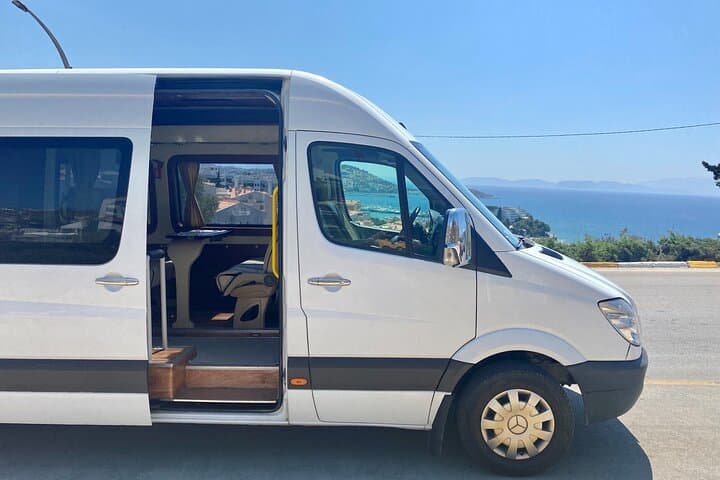
Nagi our tour guide did an incredible job of welcoming us to Ephesus. She had a very comfortable van waiting for us when we arrived in the port. She was accompanied by Mehmet who drove us during the day. Our goal was to visit ancient Ephesus and see the ruins. Nagi filled us in on the history of Ephesus and was able to answer any questions we had. We then viewed the ruins of Artemis. Then we went to the art school where we were able to watch women skillfully weave rugs from wool and silk. We were given a demonstration of how silk was harvested from silk cocoons and then spun into threads. It was fascinating to watch. Members of our family purchased two beautiful rugs from the school. There was no tax on these and they are going to ship them directly to their home in the US. Following that we enjoyed a traditional Turkish lunch and discovered a delicious pomegranate syrup which, when combined with olive oil, made a delicious salad dressing. We were treated to several cups of Turkish tea -a surprise since we have had Turkish coffee back at home but didn’t know that tea was more of a staple throughout the day in that culture. Nagi was able to tell us many stories of life in Turkey. She loves her country and is proud of her heritage. She and Mehmet are wonderful! I highly recommend this tour and ask for both of them as your guides!
This was a great tour! Devon is extremely knowledgeable, speaks very good English, and very easy to understand. He was able to adjust our start time to avoid big crowds and afternoon heat. The Ephesus is a must see! Absolutely incredible!
With one exception, I would give this 6 stars! Selin was amazing! Clear communication for meeting up, overall a lovely experience. Selin was really easy going, let us skip a few things we didn't care to see and was so knowledgeable about Ephesus and the culture . We truly love her and felt like we made a sweet friend! The one thing we did not like, was the unexpected sales pitch at the carpet place. We really enjoyed the tour, and being shown how they make carpets in Turkey, truly amazing to learn and appreciate the art of rug making. But then we were led into a room where we were shown around 50 rugs, by probably a team of 5 or six people, rolling out rugs. They were working really hard to show us all these rugs, and we felt really bad. We felt a little trapped. I get them trying to sell their product, but none of us were in the market for a rug, nor could we afford them... they were too insistent for comfort. Selin also took us to see a leather clothing outlet and a family-owned pottery place. We enjoyed these two places and everyone we met was really lovely. They too were trying to sell us product but we didn't feel the same pressure to buy as we did with the carpet guys. Selin also took us to a market to try Turkish delight and baklava and some other products special to Turkey. The day was full of history and learning about the culture and unique gifts special to Turkey. We really enjoyed the day and would do it all over again. Just make sure to let your guide know if you want to avoid certain sale pitches.
Excellence service and brilliant guide Easy to book and everything was communicated well and on time
Our tour guide Hesna was wonderful. We did a private tour so it was just myself and 3 adult sons. We learned so much history in Ephesus it was breathtaking. The tour was at our pace which we loved.
Our guide Devrim was fantastic! As a PHD in Christian Biblical Archeology (something like that), his knowledge was endless and his English excellent. He brought the entire site alive with his extensive explanations and teaching style. Don't hesitate to ask for him!
| Tour | Duration | Rating | Price | |
|---|---|---|---|---|
 NEW: Private The Most Detailed Ephesus Shore Excursion / with Lunch | 5–7 hours | 4.9 (84) | $79 | |
 Ephesus Small Group - Semi Private Shore Excursion | 4–6 hours | 5.0 (431) | $31 | View |
 ALL INCLUSIVE VIP Shore Excursion Customizable Ephesus with Lunch | 4–8 hours | 4.9 (579) | $151 | View |
 6 Hour Private Shore Excursion To Bodrum with Lunch Included | 6 hours | 4.9 (91) | $376 | View |
 Private Ephesus Shore Excursion from Kusadasi Port | 5h 30min | 5.0 (183) | $21 | View |
| Kusadasi: Private 4-Stop Shore Excursion with Lunch and Tickets | 6–7 hours | 5.0 (38) | $135 | View |
 Kusadasi Shore Excursion: Ephesus Sightseeing Tour with Lunch | 8 hours | 4.5 (146) | $93 | View |
Located at the south end of Domitian Street, it is the first structure in Ephesus known to be dedicated to an emperor. It was built on a high and wide terrace set by 50x100 meters in size, on vaulted foundations. The northern side of the terrace seems to be two-stories high, reached by stairs. The stairs are still visible today. The temple, built in the pro-style plan, had eight columns on the short side and thirteen columns on the long side, and four additional columns in front of the cella. On the northern side, there was an u-shaped altar, which is now displayed in the Izmir Museum. It was in the reign of Domitian that an emperor gave permission to build an Emperor Temple; that is the permission to be the 'neocoros' for the first time, which was a great honor for a city. It was in the reign of Domitian that an emperor gave permission to build an Emperor Temple; that is the permission to be the 'neocoros' for the first time, which was a great honor for a city.
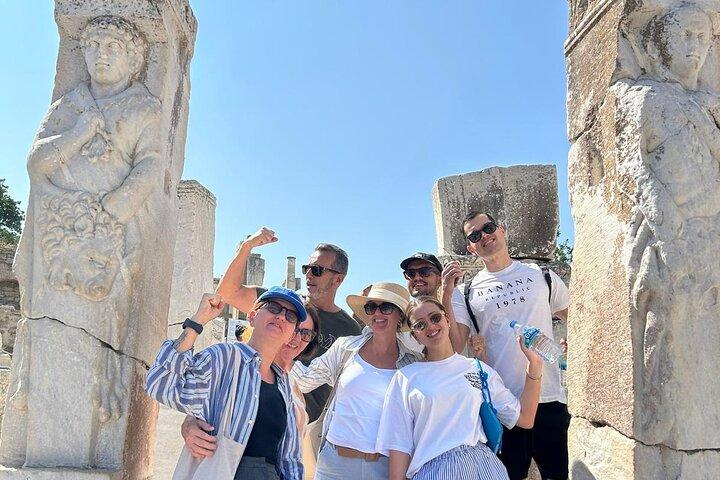
Hercules Gate is located towards the end of Curetes Street, it was called the Hercules gate because of the relief of Hercules on it. It was brought from another place in the fourth century AD to its current place, but the relief on it dates back to the second century AD. Only the two sides of the columns remain today and the other parts of it have not been found. The relief of the flying Nike in the Domitian Square is thought to also be a part of this gate. The Heracles Gate narrowed the access to the street, preventing the passage of vehicles. We can understand that from the Fourth Century, the street had become a pedestrian area.
Temple of Hadrian is one of the best-preserved and most beautiful structures on Curetes Street. It was built before 138 A.D by P. Quintilius and was dedicated to Emperor Hadrian, who came to visit the city from Athens in 128 A.D The facade of the temple has four Corinthian columns supporting a curved arch, in the middle of which contains a relief of Tyche, goddess of victory. The side columns are square. The pedestal with inscriptions in front of the temple is the bases for the statues of the emperors between 293-305 CE, Diocletian, Maximian, Constantius I, and Galerius; the originals of the statues have not been found yet.
Ephesus terrace houses are located on the hill, opposite the Hadrian Temple. Also called "the houses of wealthy Romans", important for the reason give us information about family life during the Roman period. They were built according to the Hippodamian plan of the city in which roads transected each other at the right angles. There are six residential units on three terraces at the lower end of the slope of the Bulbul Mountain. The oldest building dates back to 1C BC and continued in use as a residence until 7C AD. Ephesus terrace houses are covered with protective roofing which resembles Roman houses. The mosaics on the floor and the frescos have been consolidated and two houses have been opened to the public as a museum.
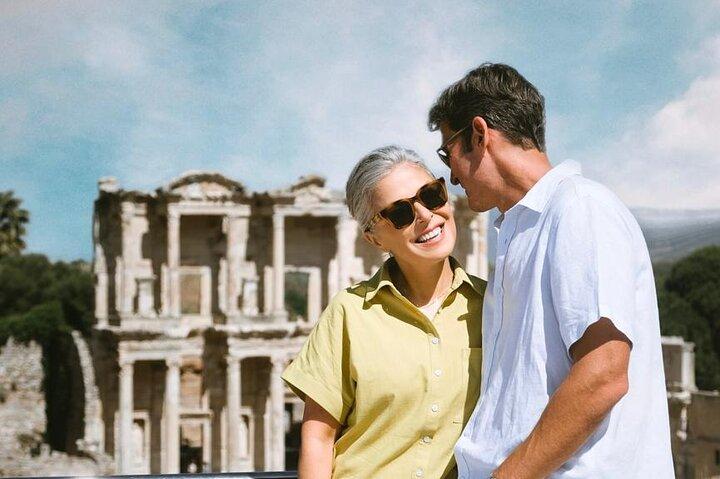
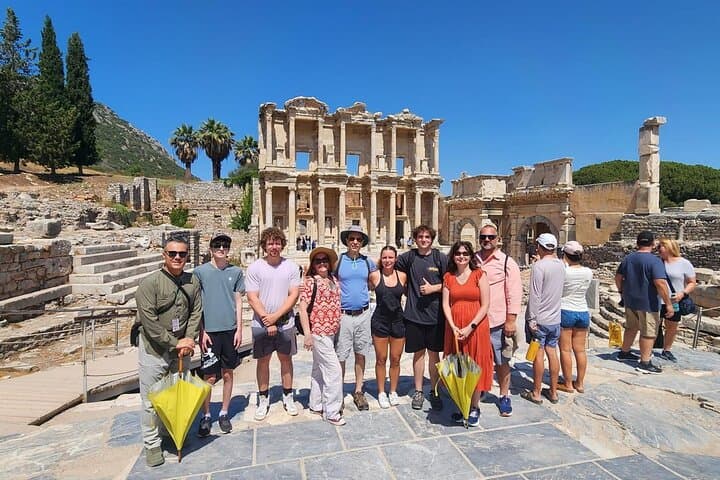
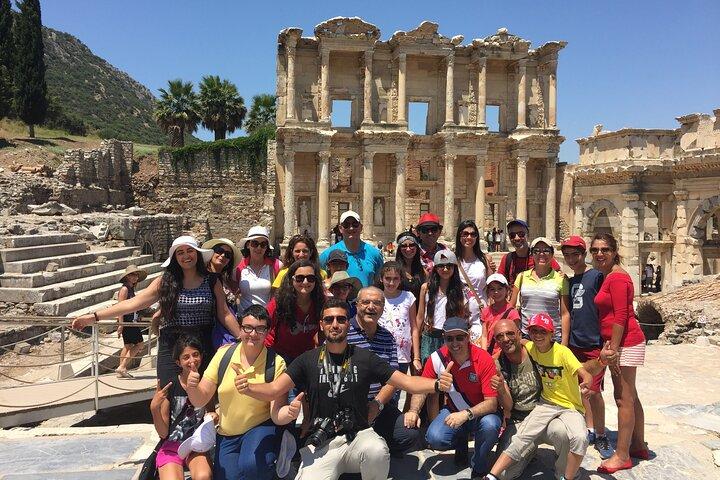
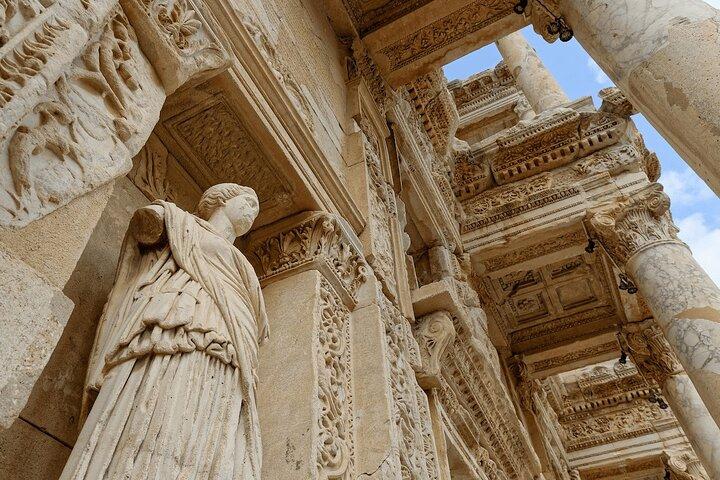
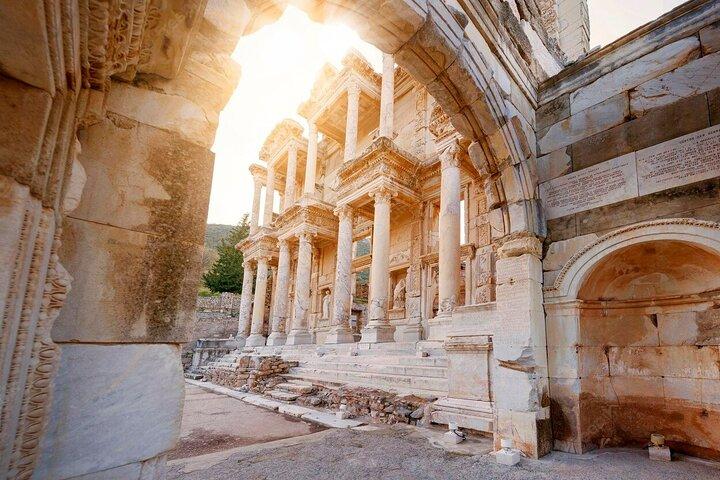
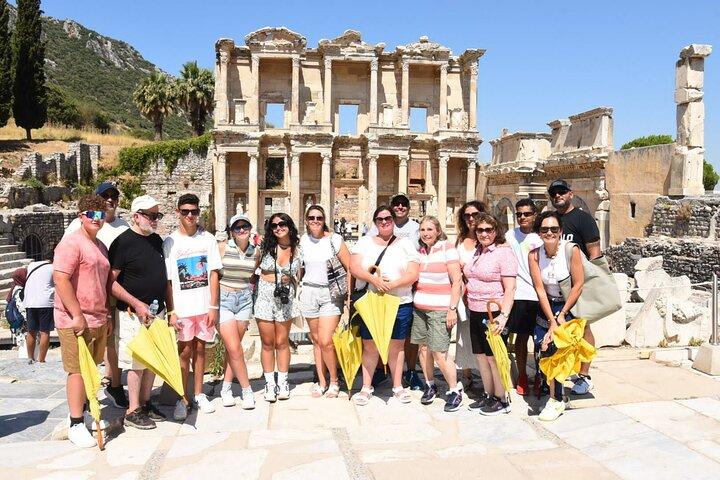
Celsus Library is one of the most beautiful structures in Ephesus. Celcius Library was built in 117 A.D. Celsus Library was a monumental tomb for Gaius Julius Celsus Polemaeanus, the governor of the province of Asia; from his son Galius Julius Aquila. The grave of Celsus was beneath the ground floor, across the entrance and there was a statue of Athena over it. Because Athena was the goddess of wisdom. The scrolls of the manuscripts were kept in cupboards in niches on the walls. There were double walls behind the bookcases to prevent them from the extremes of temperature and humidity. The capacity of the library was more than 12,000 scrolls. It was the third richest library in ancient times after the Alexandra and Pergamum.
Ephesus theatre is the most magnificent structure in the Ephesus ancient city. The Ephesus Great Theatre is located on the slope of Panayir Hill, opposite Harbor Street, and is easily seen when entering from the south entrance to Ephesus. It was first constructed in the Hellenistic Period, in the third century BC during the reign of Lysimachos, but then during the Roman Period, it was enlarged and formed its current style that is seen today. t is the largest in Anatolia and has a capacity of 25,000 seats. The cavea has sixty-six rows of seats, divided by two diazoma (walkway between seats) into three horizontal sections. There are three sections of seats. In the lower section, Marble pieces, used for restoration, and the Emperor's Box were found. The Ephesus theatre was used not only for concerts and plays but also for religious, political, and philosophical discussions and for gladiator and animal fights.
The Temple of Artemis is known as one of the Seven Wonders of the ancient world. It has been built in the areas of Ephesus on a flat area that has over the centuries turned into a swamp. If you visit Ephesus today, you can only see the ruins of the foundations of this marvelous construction of the Hellenistic Age, entirely made of marble and full of sculptured columns' capitals and shafts. The most beautiful remains of this temple are today exhibited in the London British Museum.
It is believed that the evangelist St. John had spent his last years in the region around Ephesus and was buried on the southern slope of Ayosolug Hill. Three hundred years after the death of St. John, a small chapel was constructed over the grave in the 4th century. The church of St John was changed into a marvelous basilica during the region of Emperor Justinian (527 -565 AD). The second half of the first century was full of persecution for the early Christians. Apostle James and Stephen were killed in Jerusalem. Paul was sent to Rome and executed. According to tradition John took The Mother Mary and came to Ephesus. He wrote his Gospel in Ephesus and the Revelation on Greece Island, Patmos in 96AD.
It is a private experience: only your party takes part. Your own group can be up to 14 people on one booking; no other travellers join.
Infants and small children can ride in a pram or stroller Specialized infant seats are available
Wheelchair accessible Transportation options are wheelchair accessible
Yes, bookings are confirmed instantly.