Tahtakaracha Pass30 min
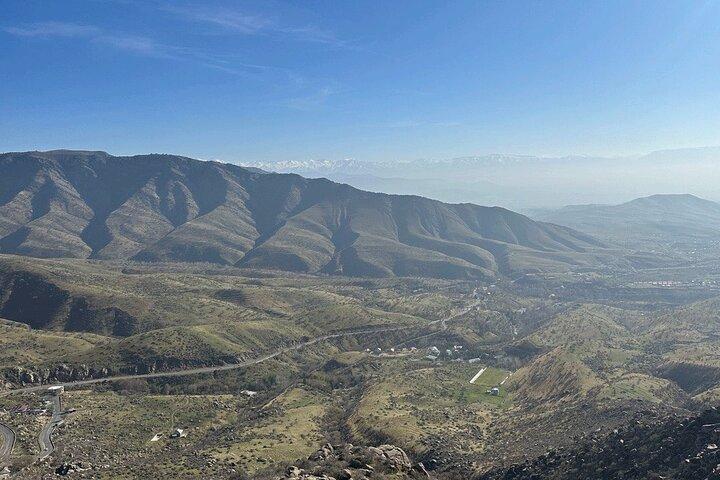
Beyond Samarkand, the road to the south, through Zarafshan Range, a Pamiri spur, towards the Takhtakaracha Pass. Along this major Silk Road branch marched the armies of the Greats, Alexander and Amir Temur, en route to India. Photo stop to capture unusual shape of stones and snow capped mountains (one can see snow from November to March).
Tahtakaracha Pass20 min
You stop on top of Takhtakaracha Pass take picture of local market (the peak of the pass is more than 1620 meters in elevation).
Tahtakaracha Pass20 min
In a clear day after the peak of the pass there is a spot of fine panorama of the town Kitob of Kashkadarya province.
The Palace Complex of Ak-SarayAk Saray Palace (“a white palace” in Uzbek) built in 1380-1404. Amir Temur gathered its craftsmen to his hometown to build his greatest palace, similar in structure to Samarkand’s Bibi Khanum Mosque. The name Ak-Serai (White Palace) symbolizes his noble descent, not the dominant colour, for blue, green and gold patterned the vast mosaics.
Statue of Amir Timur20 min
Statue of Amir Temur— there are three huge statues of Temur: one is in Samarkand, one is in Tashkent and the third is in his hometown Shakhrisabz in standing position. The bronze statue weighs 20 tons and 9 meters high built after the Independence (1991).
Dor Us-SiyodatComplex of Dor-us Siyadat (“place of sadness” in Uzbek) from XIV century. It arose on the death of his eldest and favorite son Jahangir, killed in 1375 (aged only 22). When another son, Umar Sheikh, joined Jahangir in 1394, Temur even built himself a crypt.
Dorut TilovatDor-ut Tilavat (“place of praying” In Uzbek) from XIV-XV centuries, contains the Kok Gumbaz Mosque (1435) built by grandson of Temur Mirzo Ulugbek, the mausoleum constructed by Amir Temur in 1373-1374 for Sheikh Shamseddin Kulyal, a Sufic leader and spiritual advisor of Temur’s father , Taraghay.