If you're looking for a fun and curious way to visit Brindisi, you've come to the right place! With this digital guide created with the support of a local, you will be able to visit all the most important monuments at your own pace. You'll get to know the stories and curiosities of Brindisi! But also you will discover everything about local foods, Italian Aperitivo in authentic local restaurants, and much more!
Prices are per person when two book together; a solo traveller pays $7.
Larger groups pay less per person.
From the operator’s live schedule on Viator, checked Nov 21.
The bastion is dedicated to St. James, the patron saint of Spain and has been used for various purposes over the centuries. After losing its military function, it was used as a public slaughterhouse, oil depot and customs house.
It was built by order of Emperor Frederick II, who created the original nucleus. This building, also called “earth castle”, is the second in chronological order of the four historic castles of Brindisi.
The church of San Giovanni al Sepolcro, or church of the Holy Sepulchre, was built by the religious order of the Canons Regular of the Holy Sepulchre before 1128, the year in which the first document mentioning its existence appears.
The name of the archaeological area derives from the presence, starting from the mid-fifteenth century, of a community of Slavs, mainly Greeks and Albanians, who settled in this area since the sixteenth century and founded a settlement with the church of San Pietro at its centre, of which today no material traces remain.
The construction of the Cathedral symbolized the rebirth of the city, supported by the Normans as part of their expansion towards the east. Brindisi quickly recovered its role as an important commercial hub towards the east, becoming an essential transit point for those traveling from Rome to Jerusalem.
The Provincial Archaeological Museum of Brindisi, named after Francesco Ribezzo, a scholar of the Messapian civilization of the territory, was part of the Library-Museum Center of Brindisi, administered by the Puglia Region and was founded in 1884. The collections on display cover various thematic sections, including antiquarian, epigraphic and statuary, prehistoric, Messapian, Roman and underwater archaeology.
Reviews collected by Viator and Tripadvisor
Excurgo comparison of 148 Viator tours, recalculated daily.
For a full refund, cancel at least 24 hours before the scheduled departure time.
Brindisi Walking Tour with Audio and Written Guide by a Local lasts about 2–3 hours. The itinerary has 10 stops.
Prices start at $7 per person for this Brindisi experience, booked through Viator with the price shown before checkout. That is the per-person price when two book together; a solo traveller pays $7. There is 1 booking option, so the final price depends on the option you choose.
According to the operator’s current schedule, it runs every day.
Children aged 0–9 pay from $3, adults from $7.
Yes. Cancel at least 1 day before the start for a full refund. Later cancellations are non-refundable.
The meeting point is We are going to start from here! However, you can access to the digital guide even before getting to this place! Hotel pickup is not part of this experience.
The experience is available in DE, DE, EN, EN, IT, IT, FR, FR, ES, ES.
Reviews collected by Viator and Tripadvisor
| Tour | Duration | Rating | Price | |
|---|---|---|---|---|
 Brindisi Walking Tour with Audio and Written Guide by a Local | 2–3 hours | 4.4 (36) | $7 | |
 Brindisi Tour : audio guided tour | 2h 30min | 4.5 (4) | $8 | View |
 Private Audio Guided Walking Tour in Lecce | 30 min–1h | 4.0 (7) | $7 | View |
 Bari Rickshaw Panoramic Tour with Audio Guide | 1 hour | 4.8 (8) | $38 | View |
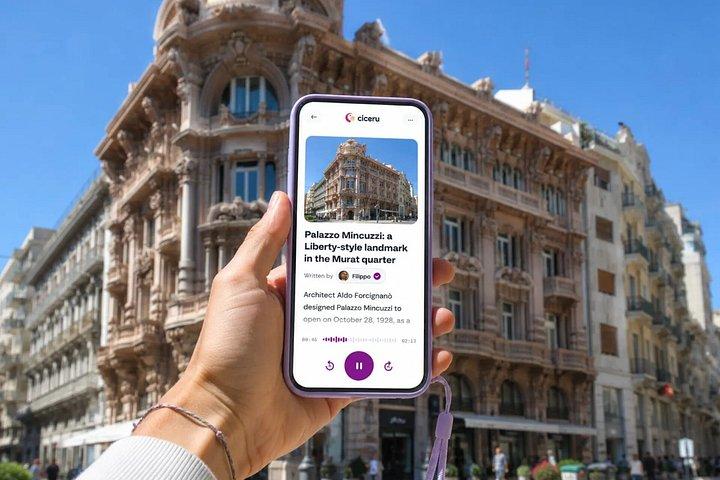 Bari Sel Guided Walking Tour Landmarks with Audio and Quiz | 1h 30min–2h | — | $8 | View |
 Lecce Archaeological and Baroque Tour with Audio Guide eTicket Museum | 2 hours | 3.0 (1) | $17 | View |
 Alberobello Walking Tour with Audio and Written Guide by a Local | 2–3 hours | 4.5 (62) | $7 | View |
The Roman columns of Brindisi are considered one of the symbols of the city. The origins of the Roman columns of Brindisi are the subject of three main hypotheses. The most accredited theory suggests that they were erected around 110 AD at the behest of the emperor Trajan and that they represented the terminals of the historic Appian Way.
This staircase that connects the historic center of the city with the seafront was named after the famous poet Virgil of the 1st century BC. We'll discover the connection between the city and the poet!
The Lungomare Regina Margherita in Brindisi is one of the areas, in my opinion, most beautiful for a walk in the city, offering a panoramic view of the sea and the port.
After the end of the First World War, many Italian cities built monuments to commemorate the fallen soldiers. A monumental celebration was also planned for the sailors, with several cities such as La Spezia, Trieste and Venice that applied to host the work. And what about Brindisi? Let's discover it!
It is a small-group experience with a maximum of 108 participants.
Infants and small children can ride in a pram or stroller
Wheelchair accessible
Yes, bookings are confirmed instantly.


