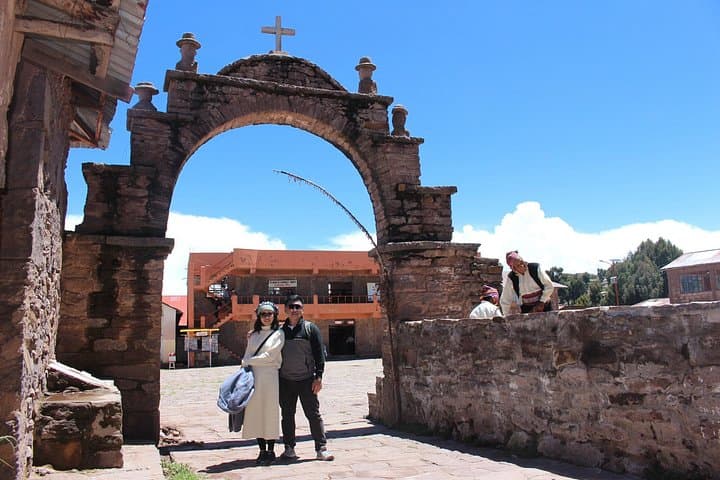
The National Reserve of Titicaca (RNT) is located on the continental waters of Lake Titicaca, the highest navigable lake in the world, in the immediate vicinity of the provinces of Puno and Huancané in the department of Puno, at an average altitude of 3,810 masl. It covers 36,180 hectares. Wild flora and fauna from Lake Titicaca are preserved in the area. The reserve also contributes to the socio-economic development of the region and maintaining alive the traditional cultures of the people that inhabit the area. The communities of Uros and Uros Titino, which inhabit the islands on the vast lake, offer various hospitality options for tourists, providing an excellent opportunity to soak up the local culture.
From the operator’s live schedule on Viator, checked Nov 12.
The nearby lake of Titicaca attracted in the pre-ceramic period nomads living from fish and meat. Original cave paintings are found in the neighborhood. The impressive grave towers of the Kolla-culture in Sillustani are the concrete remains of this period. Later on was the region of Puno and the Titicaca Lake the scenery of important cultures like the Pucara and Tiahuanco.
The National Reserve of Titicaca (RNT) is located on the continental waters of Lake Titicaca, the highest navigable lake in the world, in the immediate vicinity of the provinces of Puno and Huancané in the department of Puno, at an average altitude of 3,810 masl. It covers 36,180 hectares. Wild flora and fauna from Lake Titicaca are preserved in the area. The reserve also contributes to the socio-economic development of the region and maintaining alive the traditional cultures of the people that inhabit the area. The communities of Uros and Uros Titino, which inhabit the islands on the vast lake, offer various hospitality options for tourists, providing an excellent opportunity to soak up the local culture.
The Sillustani towers were constructions belonging to the pre-Inca period. They were built by the Colla culture, an Aymara-speaking indigenous tribe. The Collas dominated the Titicaca region before being dominated by the Incas. The site is composed of different Chullpas.
"What to bring: Weather-appropriate clothing and your passport (required). We recommend comfortable walking shoes and layers for changing mountain weather." You might also want to add: • "Sunscreen and hat recommended for high altitude" • "Small backpack for personal items" • "Camera for stunning photo opportunities"
All sales are final. No refund is available for cancellations.
Unique 2-Day Lake Titicaca from Cusco with Flight to Lima. lasts about 2 days. The itinerary has 8 stops.
Prices start at $847 per person for this Puno experience, booked through Viator with the price shown before checkout. There is 1 booking option, so the final price depends on the option you choose.
According to the operator’s current schedule, it runs every day, starting at 6:00 AM, 6:30 AM, 7:00 AM, and 8:00 AM.
Children aged 5–10 pay from $660, adults from $847.
All sales are final. No refund is available for cancellations.
Yes, pickup is offered. "What to bring: Weather-appropriate clothing and your passport (required). We recommend comfortable walking shoes and layers for changing mountain weather." You might also want to add: • "Sunscreen and hat recommended for high altitude" • "Small backpack for personal items" • "Camera for stunning photo opportunities"
| Tour | Duration | Rating | Price | |
|---|---|---|---|---|
 Unique 2-Day Lake Titicaca from Cusco with Flight to Lima. | 2 days | — | $847 | |
 2 Day Tour from Lima Nazca Lines Flight Paracas and Huacachina | 2 days | 4.8 (773) | $265 | View |
 Lake Titicaca 2-Day Homestay Tour from Cusco | 4 days | 4.7 (81) | $98 | View |
 Lake Titicaca Tour with Amantani Island Homestay (2 Days) | 2 days | 4.9 (47) | $88 | View |
 Lima Machupicchu and Lake Titicaca Tour 9 days | 9 days | 4.9 (117) | $1,945 | View |
 Lake Titicaca 2-Day Tour: Uros, Amantani Homestay and Taquile | 2 days | 4.7 (198) | $89 | View |
 10-day Tour from Lima: Amazon Jungle, Machu Picchu and Lake Titicaca | 10 days | 4.8 (8) | $2,325 | View |
According to various chroniclers, the bold walls of Raqchi were made of stone and adobe during the periods of government of the Incas Viracocha, Pachacutec and Túpac Yupanqui in the fifteenth century. However, ceramic remains belonging to pre-Inca cultures such as Marcavalle, Pucará and Wari were recently found.
The Museo Lítico Pukara (Pukara Lithic Museum) is an archaeological site museum operated by the Peruvian Ministry of Culture, which has a regional office in the nearby city of Puno. It features a number of galleries with stone sculpture, impressive pottery, and other artifacts recovered from the site and neighboring town. The site museum and archaeological site were featured in an episode of Museos Puertas Abiertas, TVPerú (25 minutes). In 2011 a new gallery was opened at the museum– La Herencia Pukara: 3000 Años de Historia y Tradición— that presents information about contemporary crafting practices in Pucará. Potters and weavers from Pucará donated raw materials and finished objects to the gallery, in addition to providing information for the wall texts and photos of their workshops and products. There are also a number of pottery workshops in Pucará where it is possible to buy local handicrafts.
This small, quiet village 45 km from Cusco is home to a church with a simple exterior and unimaginably ornate interior: The Church of Saint Peter the Apostle. As soon as they cross the threshold, visitors are overwhelmed by an explosion of gold, woodcarvings, paintings and baroque decoration. This church forms part of the Andean Baroque Route, which also includes the Chapel of the Purified Virgin in Canincunca, and the Church of Saint John the Baptist in Huaro. Anothern essential attraction in Andahuaylillas is its beautiful main square, surrounded by coral and palm trees.
The experience is available in PT, EN, IT, ES.
It is a private experience: only your party takes part. Your own group can be up to 30 people on one booking; no other travellers join.
Yes, bookings are confirmed instantly.