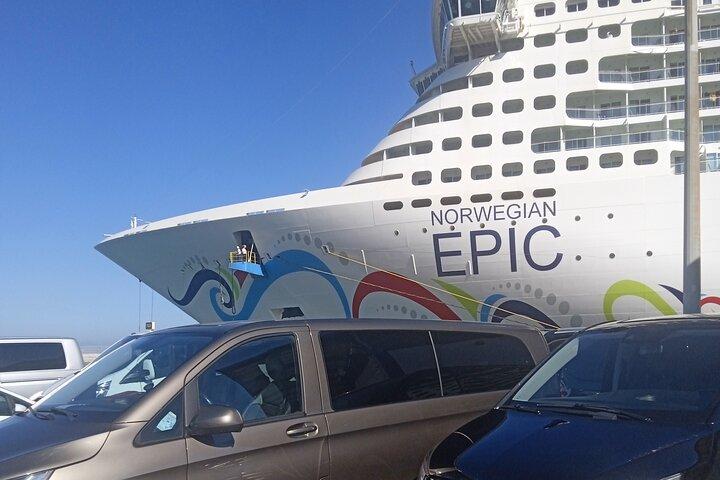
Civitavecchia PortAdmission not included10 min
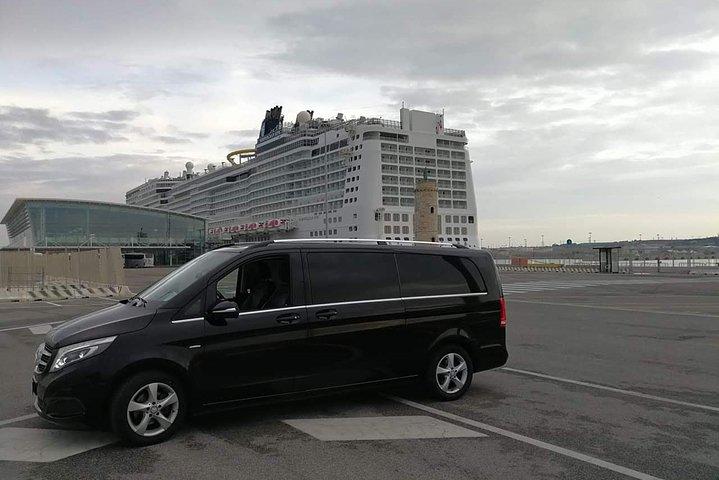
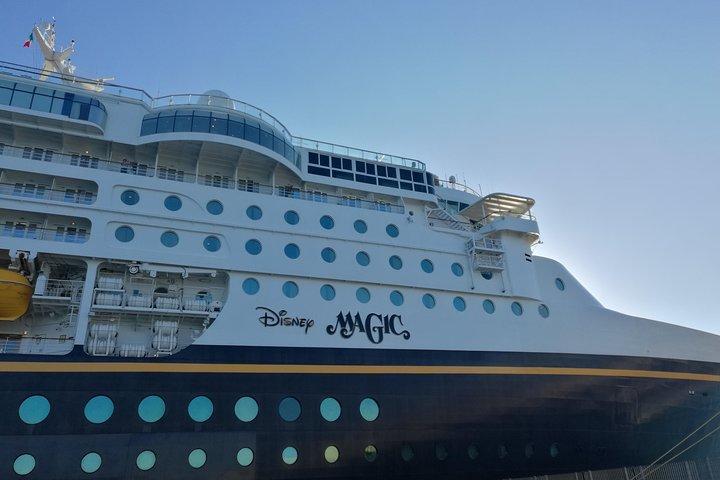
Civitavecchia Port pick up 8 am
Basilica Papale Di San Paolo Fuori le Mura30 min
The basilica was founded by the Roman Emperor Constantine I over the burial place of St. Paul, where it was said that, after the Apostle's execution, his followers erected a memorial, called a cella memoriae. This first basilica was consecrated by Pope Sylvester in 324.[4]
In 386, Emperor Theodosius I began erecting a much larger and more beautiful basilica with a nave and four aisles with a transept. It was probably consecrated around 402 by Pope Innocent I. The work, including the mosaics, was not completed until Leo I's pontificate (440–461). In the 5th century it was larger than the Old St. Peter's Basilica. The Christian poet Prudentius, who saw it at the time of emperor Honorius (395–423), describes the splendours of the monument in a few expressive lines.
Under Leo I, extensive repair work was carried out following the collapse of the roof on account of fire or lightening. In particular, the transept (i.e. the area around Paul's tomb) was elevated and a new main altar and presbytery installed. This was probably the first time that an altar was placed over the tomb of St. Paul, which remained untouched, but largely underground given Leo's newly elevated floor levels. Leo was also responsible for fixing the triumphal arch and for restoring a fountain in the courtyard (atrium).
Under Pope St. Gregory the Great (590–604) the main altar and presbytery were extensively modified. The pavement in the transept was raised and a new altar was placed above the earlier altar erected by Leo I. The position was directly over St. Paul's sarcophagus.
In that period there were two monasteries near the basilica: St. Aristus's for men and St. Stefano's for women. Masses were celebrated by a special body of clerics instituted by Pope Simplicius. Over time the monasteries and the basilica's clergy declined; Pope St. Gregory II restored the former and entrusted the monks with the basilica's care.
As it lay outside the Aurelian Walls, the basilica was damaged in the 9th century during a Saracen raid. Consequently, Pope John VIII (872–82) fortified the basilica, the monastery, and the dwellings of the peasantry,[5] forming the town of Johannispolis (Italian: Giovannipoli) which existed until 1348, when an earthquake totally destroyed it.
In 937, when Saint Odo of Cluny came to Rome, Alberic II of Spoleto, Patrician of Rome, entrusted the monastery and basilica to his congregation and Odo placed Balduino of Monte Cassino in charge. Pope Gregory VII was abbot of the monastery and in his time Pantaleone, a rich merchant of Amalfi who lived in Constantinople, presented the bronze doors of the basilica maior, which were executed by Constantinopolitan artists; the doors are inscribed with Pantaleone's prayer that the "doors of life" may be opened to him.[6] Pope Martin V entrusted it to the monks of the Congregation of Monte Cassino. It was then made an abbey nullius. The abbot's jurisdiction extended over the districts of Civitella San Paolo, Leprignano, and Nazzano, all of which formed parishes.
Circo Massimo10 min
The Circus was Rome's largest venue for ludi, public games connected to Roman religious festivals. Ludi were sponsored by leading Romans or the Roman state for the benefit of the Roman people (populus Romanus) and gods. Most were held annually or at annual intervals on the Roman calendar. Others might be given to fulfill a religious vow, such as the games in celebration of a triumph. In Roman tradition, the earliest triumphal ludi at the Circus were vowed by Tarquin the Proud to Jupiter in the late Regal era for his victory over Pometia.[2]
Ludi ranged in duration and scope from one-day or even half-day events to spectacular multi-venue celebrations held over several days, with religious ceremonies and public feasts, horse and chariot racing, athletics, plays and recitals, beast-hunts and gladiator fights. Some included public executions. The greater ludi at the Circus began with a flamboyant parade (pompa circensis), much like the triumphal procession, which marked the purpose of the games and introduced the participants.[3]
During Rome's Republican era, the aediles organised the games. The most costly and complex of the ludi offered opportunities to assess an aedile's competence, generosity, and fitness for higher office.[4] Some Circus events, however, seem to have been relatively small and intimate affairs. In 167 BC, "flute players, scenic artists and dancers" performed on a temporary stage, probably erected between the two central seating banks. Others were enlarged at enormous expense to fit the entire space. A venatio held there in 169 BC, one of several in the 2nd century, employed "63 leopards and 40 bears and elephants", with spectators presumably kept safe by a substantial barrier
Priorato dei Cavalieri di MaltaAdmission not included10 min
The site, on a rise directly overlooking the Tiber and access to the Roman Pons Sublicius, was already a fortified Benedictine monastery in the tenth century. The monastery passed to the Templars and after the destruction of their order, to the Knights Hospitallers, predecessors of the present Order of Malta. Radical rebuilding was undertaken in the 15th through 17th centuries. The villa was granted extraterritoriality in 1869.[3] On the piano nobile is an assemblage of portraits of the Grand Masters of the Order.
Piazza del CampidoglioAdmission not included20 min
The Capitolium or Capitoline Hill (/ˈkæpɪtəˌlaɪn, kəˈpɪ-/;[1][2] Italian: Campidoglio [kampiˈdɔʎʎo]; Latin: Mōns Capitōlīnus [ˈmoːns kapɪtoːˈliːnʊs]; ), between the Forum and the Campus Martius, is one of the Seven Hills of Rome.
The hill was earlier known as Mons Saturnius, dedicated to the god Saturn. The word Capitolium first meant the temple of Jupiter Optimus Maximus later built here, and afterwards it was used for the whole hill (and even other temples of Jupiter on other hills), thus Mons Capitolinus (the adjective noun of Capitolium). Ancient sources refer the name to caput ("head", "summit") and the tale was that, when laying the foundations for the temple, the head of a man was found,[3] some sources even saying it was the head of some Tolus or Olus. The Capitolium was regarded by the Romans as indestructible, and was adopted as a symbol of eternity
Complex of the Victorian Ala BrasiniPass by
The Vittorio Emanuele II Monument (Italian: "Monumento Nazionale a Vittorio Emanuele II"), also known as the (Mole del) Vittoriano, Il Vittoriano, or Altare della Patria (English: "Altar of the Fatherland"), is a monument built in honor of Victor Emmanuel II, the first king of a unified Italy, located in Rome, Italy.[1] It occupies a site between the Piazza Venezia and the Capitoline Hill. It's currently managed by the Polo Museale del Lazio, the Italian Ministry of Defense and the Museo Centrale del Risorgimento Italiano (Museo centrale del Risorgimento al Vittoriano).
The eclectic structure was designed by Giuseppe Sacconi in 1885. Established Italian sculptors, such as Leonardo Bistolfi and Angelo Zanelli, made its sculptures nationwide. [2] It was inaugurated on June 4th, 1911 and completed in 1935.[3]
Its design is a neoclassical interpretation of the Roman Forum. It features stairways, Corinthian columns, fountains, an equestrian sculpture of Victor Emmanuel II, and two statues of the goddess Victoria riding on quadrigas. The base houses the museum of Italian Unification[4][5] and in 2007 a panoramic lift was added to the structure, allowing visitors to ride up to the roof for 360-degree views of Rome.[6] The structure is 135 m (443 ft) wide and 70 m (230 ft) high. If the quadrigae and winged victories are included, the height reaches 81 m (266 ft).[4] It has a total area of 17,550 square metres.[7]
The monument holds great national significance. It is an architectonic and artistic tribute to the Italian Risorgimento: the complex process of unification undertaken by Victor Emmanuel II throughout the second half of the 19th Century. It is regarded as a national symbol of Italy and every year it hosts important national celebrations.[1] The largest annual celebrations are Liberation Day (April 25th), Republic Day (Italian: "Festa della Repubblica Italiana") (June 2nd), and Armed Forces Day (Italian: "Giornata dell'Unità Nazionale e delle Forze Armate") (November 4th). During these celebrations, the Italian President and the highest government officials pay tribute to the Unknown Soldier and those who died in the line of duty by laying a laurel wreath.
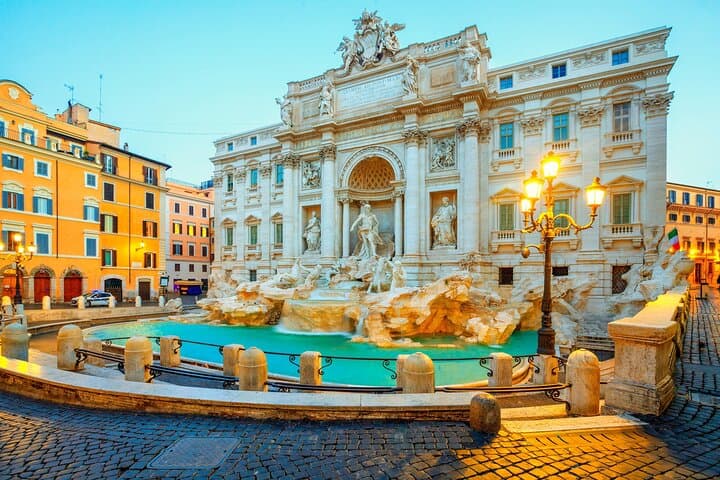
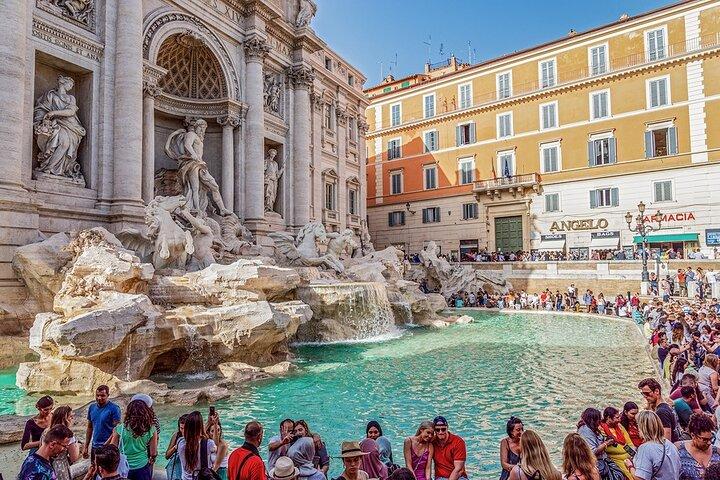
Trevi Fountain15 min
The fountain at the junction of three roads (tre vie)[3] marks the terminal point[4] of the "modern" Acqua Vergine, the revived Aqua Virgo, one of the aqueducts that supplied water to ancient Rome. In 19 BC, supposedly with the help of a virgin, Roman technicians located a source of pure water some 13 km (8.1 mi) from the city. (This scene is presented on the present fountain's façade.) However, the eventual indirect route of the aqueduct made its length some 22 km (14 mi). This Aqua Virgo led the water into the Baths of Agrippa. It served Rome for more than 400 years.[5]
Commission, construction, and design
In 1629 Pope Urban VIII, finding the earlier fountain insufficiently dramatic, asked Gian Lorenzo Bernini to sketch possible renovations, but the project was abandoned when the pope died. Though Bernini's project was never constructed, there are many Bernini touches in the fountain as it exists today. An early, influential model by Pietro da Cortona, preserved in the Albertina, Vienna, also exists, as do various early 18th century sketches, most unsigned, as well as a project attributed to Nicola Michetti[6] one attributed to Ferdinando Fuga[7] and a French design by Edmé Bouchardon.[8]
Competitions had become popular during the Baroque era to design buildings, fountains, as well as the Spanish Steps. In 1730 Pope Clement XII organized a contest in which Nicola Salvi initially lost to Alessandro Galilei – but due to the outcry in Rome over a Florentine having won, Salvi was awarded the commission anyway.[9] Work began in 1732.
Salvi died in 1751 with his work half finished, but he had made sure a barber's unsightly sign would not spoil the ensemble, hiding it behind a sculpted vase,[10] called by Romans the asso di coppe, the "Ace of Cups", because of its resemblance to a Tarot card.[11] Four different sculptors were hired to complete the fountain's decorations: Pietro Bracci (whose statue of Oceanus sits in the central niche), Filippo della Valle, Giovanni Grossi, and Andrea Bergondi.[12] Giuseppe Pannini was hired as architect.[13]
The Trevi Fountain was finished in 1762 by Pannini, who substituted the present allegories for planned sculptures of Agrippa and Trivia, the Roman virgin.It was officially opened and inaugurated on May 22 by Pope Clement XIII.
The majority of the piece is made from Travertine stone, quarried near Tivoli, about 35 kilometres (22 miles) east of Rome.
PantheonAdmission not included20 min
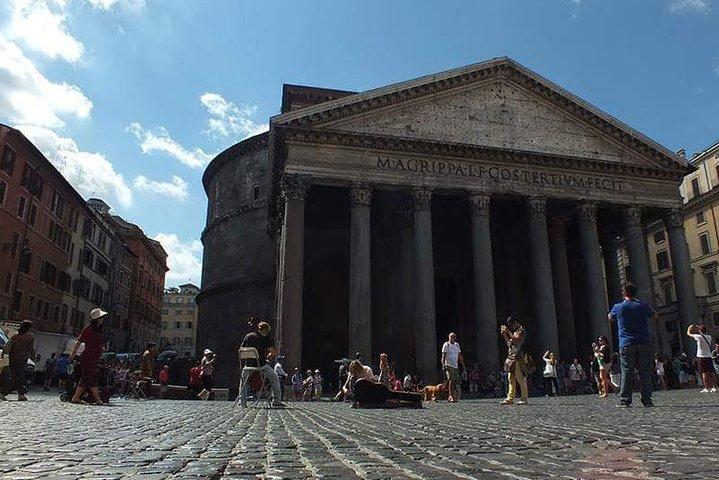
The Pantheon of all the gods") is a former Roman temple, now a church, in Rome, Italy, on the site of an earlier temple commissioned by Marcus Agrippa during the reign of Augustus (27 BC – 14 AD). It was completed by the emperor Hadrian and probably dedicated about 126 AD. Its date of construction is uncertain, because Hadrian chose not to inscribe the new temple but rather to retain the inscription of Agrippa's older temple, which had burned down.
The building is circular with a portico of large granite Corinthian columns (eight in the first rank and two groups of four behind) under a pediment. A rectangular vestibule links the porch to the rotunda, which is under a coffered concrete dome, with a central opening (oculus) to the sky. Almost two thousand years after it was built, the Pantheon's dome is still the world's largest unreinforced concrete dome.[3] The height to the oculus and the diameter of the interior circle are the same, 43 metres (142 ft).[4]
Roman ForumAdmission not included10 min
The Roman Forum, also known by its Latin name Forum Romanum (Italian: Foro Romano), is a rectangular forum (plaza) surrounded by the ruins of several important ancient government buildings at the center of the city of Rome. Citizens of the ancient city referred to this space, originally a marketplace, as the Forum Magnum, or simply the Forum.
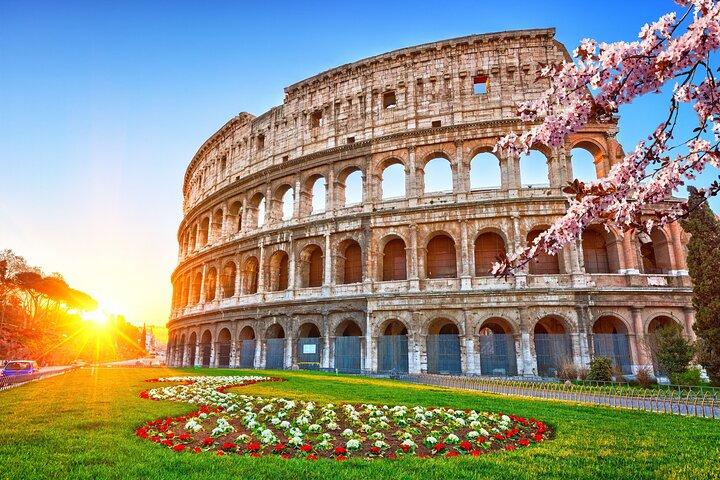
ColosseumAdmission not included15 min
The Colosseum or Coliseum , also known as the Flavian Amphitheatre (Latin: Amphitheatrum Flavium; Italian: Anfiteatro Flavio [aɱfiteˈaːtro ˈflaːvjo] or Colosseo [kolosˈsɛːo]), is an oval amphitheatre in the centre of the city of Rome, Italy. Built of travertine, tuff, and brick-faced concrete,[1] it is the largest amphitheatre ever built. The Colosseum is situated just east of the Roman Forum. Construction began under the emperor Vespasian in AD 72[2] and was completed in AD 80 under his successor and heir, Titus.[3] Further modifications were made during the reign of Domitian (81–96).
Terrazza del GianicoloAdmission not included10 min
The Janiculum (/dʒəˈnɪkjʊləm/; Italian: Gianicolo, pronounced [dʒaˈniːkolo]) is a hill in western Rome, Italy. Although the second-tallest hill (the tallest being Monte Mario) in the contemporary city of Rome, the Janiculum does not figure among the proverbial Seven Hills of Rome, being west of the Tiber and outside the boundaries of the ancient city.
St. Peter's BasilicaAdmission not included10 min
The Papal Basilica of St. Peter in the Vatican (Italian: Basilica Papale di San Pietro in Vaticano), or simply St. Peter's Basilica (Latin: Basilica Sancti Petri), is an Italian Renaissance church in Vatican City, the papal enclave within the city of Rome.