Athens60 min
Your personal driver will pick you up from Athens or Piraeus port and it will take about one and a half hours to reach your first stop, the Corinth Canal.
Corinth Canal30 min
The Corinth Canal connects the Gulf of Corinth in the Ionian Sea with the Saronic Gulf in the Aegean Sea. It cuts through the narrow Isthmus of Corinth and separates the Peloponnese from the Greek mainland, arguably making the peninsula an island. The canal was dug through the isthmus at sea level and has no locks. It is 6.4 kilometres (4 mi) in length and only 21.4 metres (70 ft) wide at its base, making it impassable for many modern ships.
From high up, you can enjoy the best view of Corinth's isthmus and admire the steep limestone walls while you observe the vessels below you navigate their way through the canal.
Citadel and Treasury of AtreusAdmission not included30 min
The Treasury of Atreus or Tomb of Agamemnon is a large tholos or beehive tomb on Panagitsa Hill at Mycenae constructed during the Bronze Age around 1250 BC. The stone lintel above the doorway weighs 120 tons, with approximate dimensions 8.3 x 5.2 x 1.2m, the largest in the world. The tomb was used for an unknown period. Mentioned by the Roman geographer Pausanias in the 2nd century AD, it was still visible in 1879 when the German archaeologist Heinrich Schliemann discovered the shaft graves under the "agora" in the Acropolis at Mycenae.
Archaeological Site MycenaeAdmission not included60 min
The archaeological site of Mycenae comprises the fortified acropolis and surrounding funerary and habitation sites, which are located mainly to its west and southwest. Most of the visible monuments date to the centre's great floruit, from 1350 to 1200 BC.
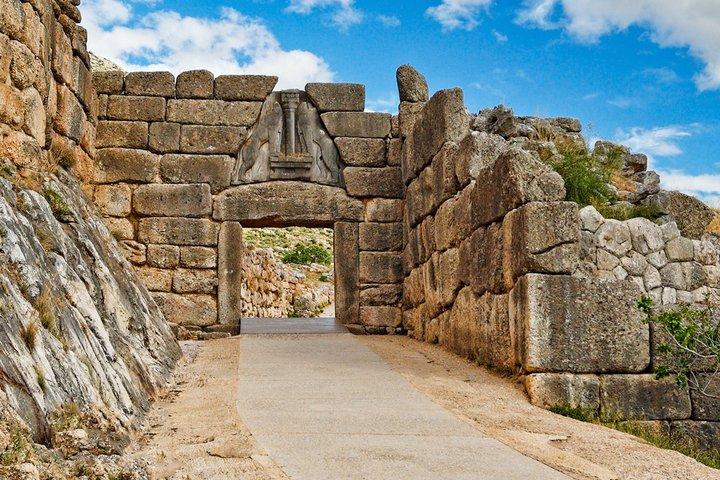
Great Cyclopean walls surround the almost triangular acropolis, which is accessed from the northwest through the famous Lion Gate, the symbol of the Mycenaean rulers' power. The gate was named after the two opposing lions carved in relief and set into the relieving triangle, a typical feature of Mycenaean architecture, over the door.
Lion GateAdmission not included30 min
The Lion Gate was the main entrance of the Bronze Age citadel of Mycenae, southern Greece. It was erected during the 13th century BC, around 1250 BC, in the northwest side of the acropolis and is named after the relief sculpture of two lionesses or lions in a heraldic pose that stands above the entrance.
The Lion Gate is the sole surviving monumental piece of Mycenaean sculpture, as well as the largest sculpture in the prehistoric Aegean. It is the only monument of Bronze Age Greece to bear an iconographic motif that survived without being buried underground, and the only relief image which was described in the literature of classical antiquity, such that it was well known prior to modern archaeology.
Archaeological Museum of Ancient MycenaeAdmission not included60 min
Athens60 min
We start our way back to Athens. Travel time is one and a half hours.