Herculaneum Small Group Tour and Ticket With an Archaeologist
Description
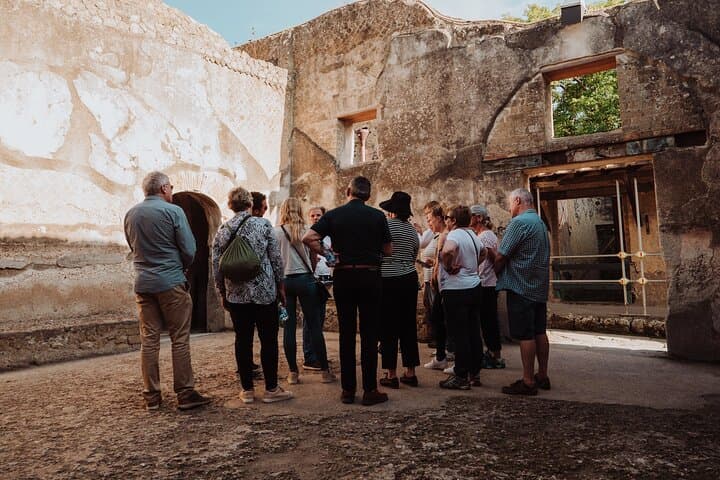
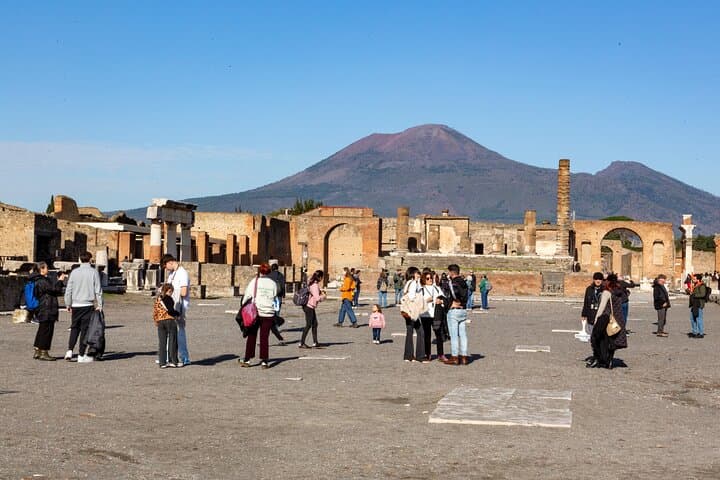
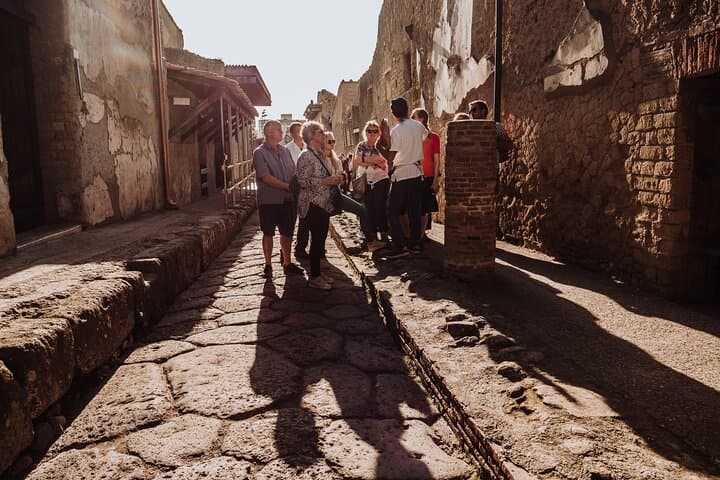
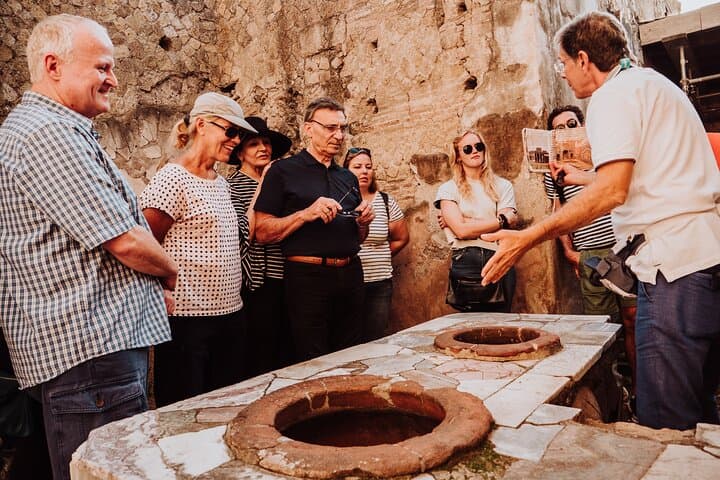
Get the chance to visit the site of Herculaneum being guided by an Archaeologist. Get to know more about this ancient Roman city, inhabited by merchants and nobility, whose life ended dramatically fast in 79 AD. The guide will show you the waterfront where more than 300 remains of people trying to escape by sea were found, but also the Samnite house, the thermal baths, the Temple of the Augustales, the forum, the house of Neptune and Amphitrite, the Gymnasium, the house of the wooden partition and much more. You will get an intense experience: you can see not only stone, marble and ceramics left, but also carbonized wood and even more exquisite paintings and mosaics than in Pompei. Herculaneum was destroyed by a much more powerful force which instantly burnt all wood and buried the city under a thick layer which didn’t let the air go through and cause decay.
Tour Options
Itinerary
Meeting place is the Ticket Office of the Herculaneum ruins. You can get there as follows: - By car in via Pignalver (There is a not guarded parking very close the meeting place) - By train in Corso Resina 1 (Circumvesuviana train station is 10 minutes walk away)
The house receives its name from marble statues of stags/deer found in the peristyle.
M. Nonius Balbus was the city's major benefactor restoring and building many public buildings. On his death he was made patron and feted with many honours, detailed in the long inscription on his funeral altar.
It is thought that the building was a centre of the cult of the Emperor Augustus and the headquarters of the Collegium Augustalium (or possibly even the local curia).
The house possibly belonged to one of the town's leading benefactors, Marcus Nonius Balbus and is somewhat unusual in that it has its own private access to the adjoining Suburban Thermae to the south.
It is very important house for the elegant wooden partition remained.
The House of the Skeleton probably the aggregation of three smaller buildings, derives its name from the discovery of human remains in a second floor room in 1831.
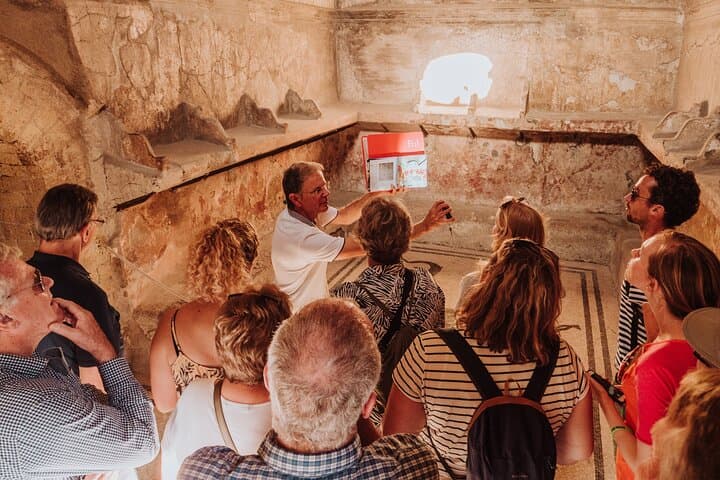
The Central Thermae were built around the beginning of the 1st century AD and were divided, as was then the common practice, into men's and women's baths, each with their own separate entrances.
The House of the Black Hall is one of Herculaneum's more luxurious mansions. The house has a monumental entrance which still retains the carbonised remains of the doorposts and lintel.
The house has an arrangement that was typical of the Samnites (an ancient people of the Sabine race who occupied this mountainous part of central Italy). The splendid atrium is skirted by a gallery with Ionic columns. The rooms are decorated with frescoes.
This is one of the most original houses in Herculaneum. It has a courtyard with a stairway and a stone balcony instead of an atrium.
Beautiful domus in the Centre of the archaeological area, with various environments, collonnati, frescos e-com everywhere at Herculaneum-charred remains of wooden parts.
Highlights
What's included
Traveller Ratings
Important Information
- Service animals allowed
- Public transportation options are available nearby
- Suitable for all physical fitness levels
- Confirmation will be received at time of booking
- Operates in all weather conditions, please dress appropriately
- Dogs are allowed at the Herculaneum Archaeological Park without breed or size restrictions, however they must be kept on a leash or muzzle and it is mandatory to have bags to collect any droppings. For reasons of logistics and conservation, within the Antiquarium premises, the Boat Pavilion, and the domus featuring mosaic floors, access is permitted only to dogs that are carried in arms or transported in an appropriate carrier.
- Herculaneum ruins' entry tickets: 16 euros (adult) 2 euros (EU citizens 18-25 y.o.)
Reviews(1,193)
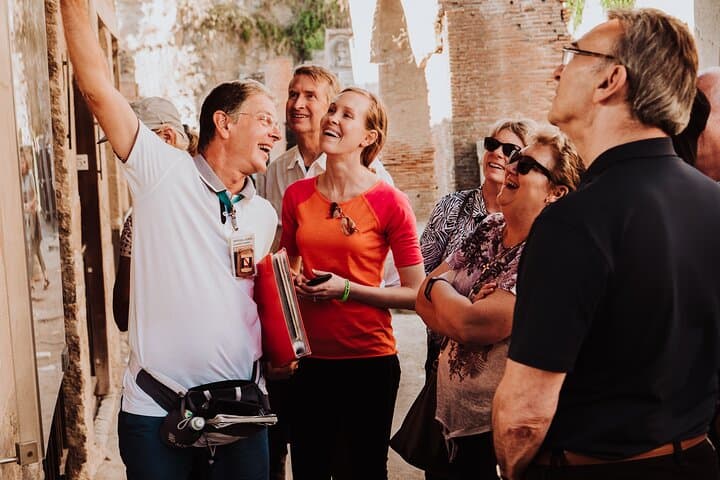
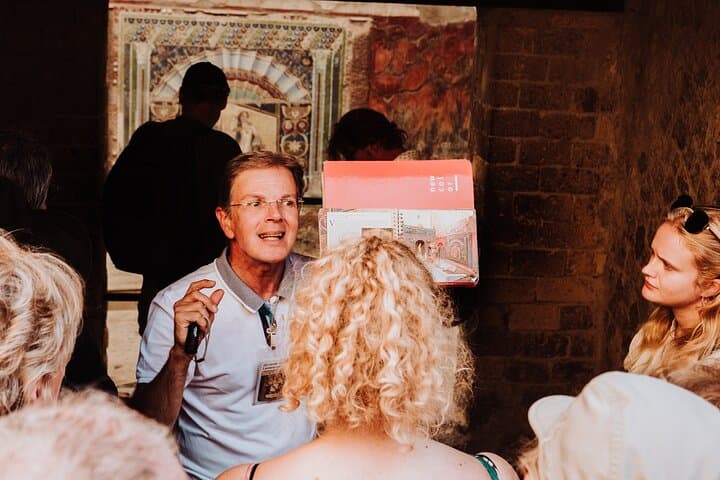
The guide, Luciano Leone was fantastic, he's actually written books about the site. He knew everything and wanted to tell us, despite only having 2 hours to do so (he went 10 minutes over). We learnt the history of the site in such a way that it made it come alive. While he was talking you could just about visualise what it was like before Mount Vesuvius erupted in 79 AD. He had a folder of photos and diagrams and used them effectively to demonstrate his point. Despite him protesting (far too often) that he didn't have good English, he did. He made sure that we stayed close so that we heard everything, pointed out things that if you weren't on a guided tour you would look at and maybe think "oh pretty" but knowing the hidden secrets as he called them, made it fascinating and amazing and he just kept blowing my mind with information. On a hot summer's day he took us from one pocket of shade to another, stopping in the sun only to show us something that we *really* needed to see. The site itself is so much more compact than Pompeii and was a different type of town. It was a resort, Pompeii was a trading centre, and it showed in the types of houses and facilities there. There are 2000 year old mosaic tiles that you walk on, there are the frescoes, there are the skeletons of those who were captured by the ferocity of the storm while waiting to be rescued by boat. Some smaller skulls as well 🙁 But it was so much more than just ruins to walk around. An entire garden of trees grown from seeds recovered from the site, a boat that was rescued, petrified wood, clothing, even rope! The guide went to great pains to point out that this is how they know it wasn't a magma flow that buried the site, because if it was, nothing would have survived. That the heat was great enough to burn flesh off, but not the disintegrate the bones. He knew what the melting point is for gold and lead, and how we know to a great extent what happened through the writing of Pliny the Younger. My mind was blown wide open with all of the information and I would love to come back and explore it again one day.
Roberta was knowledgeable. There is a lot to cover and she made sure that we got the highlights of this wonderful site. So glad that we came here instead of Pompei
Spell binding excursion. Askos responded fast to questions as we navigated from Sorrento. Not as large or crowded as Pompeii... and different due to the composition of the lava that engulfed it. It is better preserved. Both sites are a glimpse of Roman life. Our guide was a fountain of knowledge, but I cannot recall his name. Do step into the Musuem afterward to see the actual relics - jewelry, sculpture and even glass bowls! It is worth it - esp. to cool off on a hot August day.
A truly unforgettable visit to Herculaneum, made even more special by the extraordinary expertise and passion of our guide, Camillo Sorrentino. Camillo is an extremely knowledgeable guide, capable of recounting history with great clarity, but above all of conveying all his passion and enthusiasm. He didn't just limit himself to explaining what we were seeing: he managed to make us understand, imagine, and almost “live” the history of Herculaneum. Every detail, every story, and every curiosity made the visit engaging and never predictable. His ability to communicate and his love for this extraordinary heritage really made the difference. A visit that we will carry with us for a long time and that we absolutely recommend. Thank you Camillo for having transformed an archaeological visit into an authentic, exciting, and unforgettable experience!
Our guide was great! We all enjoyed the tour and learning about the historical city of Herculaneum. The colors remaining on the mosaics, walls and floor tiles were amazing!
We had an amazing tour at Herculaneum, led by Luciano Leone. Easily the best tour we did during our whole interrailing holiday. Luciano was incredibly knowledgeable and engaging, hooking the imagination of our two boys aged 11 and 9.
I booked this tour with an archeologist for an expert's view of the remains of Herculaneum. The guide, Francesco, did NOT deliver. It was a hot August day (not a surprise, we all knew the weather) and I think he was just hot and tired. The group was split between 2 different guides, and I was unfortunately in the group with the weaker guide. I hope this review will help future participants. The tour started slightly late (10:38 instead of 10:30), and he started the tour in the 2 museums (with AC). That would have been better to save until the end, no? Then, he gave superficial explanations that are written on placards next to the displays. We didn't enter the archeological remains until 50 minutes into the 2 hour tour. Then, he continued slowly repeating useless comments like, "Look at the decorations, just like we see today!" He spoke a lot about Pompeii and didn't seem to know any in-depth archeological, historical or anecdotal facts about Herculaneum. I've been on MANY tours including with archeologists. Sadly, this was a waste of time and money. He ended the tour promptly at 12:30 telling us that we'd seen everything there was to see. Thankfully I didn't believe him. At the visitor center there is a 1 Euro audio guide and a free brochure for download. I returned to the ruins and did a more thorough exploration on my own. I must say, it was better than the tour with the "archeologist".
Francesco our guide brought the tragedy of the volcano eruption to life an excellent 2hr tour. I would you fully recommend
Amazing tour with Luciano. Incredibly knowledgeable and had a great way to bring stories to life and feel like you were immersed in the surroundings. A very well preserved site and an excellent way to understand the history of what happened here.
Our guide was knowlegeable and kept us interested and engaged throughout the tour. He answered questions and provided context and background for us to better understand the significance of what we saw. Very happy with the tour as well as the price!