Bosphorus Strait180 min
Istanbul is a bridge between Europe and Asia, the Black Sea and the Mediterranean, a position that endows it with one of the most unique and beautiful settings in the world. For, between the hills on the European and Asiatic shores flows the Bosphorus, the brightest gem in the diadem of nature.
Dolmabahce PalacePass by
Dolmabahçe Palace located in the Beşiktaş district of Istanbul, Turkey, on the European coast of the Bosporus strait, served as the main administrative center of the Ottoman Empire from 1856 to 1887 and from 1909 to 1922.
Pass by
Occupying an ornate former Ottoman palace overlooking the Bosphorus strait, this luxe hotel is 2 km from Dolmabahçe Sarayı, an art museum in a grand palace
Dolmabahce MosquePass by
The Dolmabahçe Mosque is a mosque in Istanbul, Turkey. It was commissioned by queen mother Bezmi Alem Valide Sultan.
Galatasaray IslandPass by
The Galatasaray Islet is a small island on the Bosphorus strait off Kuruçeşme neighborhood in Istanbul, Turkey, which is owned by Galatasaray Sports Club.
Pass by
Arnavutköy is a town and rural district in Istanbul Province, Turkey. The district was newly formed in 2008 from the large rural part of Gaziosmanpaşa district and parts of other districts, including Çatalca.
Bebek ParkPass by
Bebek is one of the nicest neighborhoods on the Bosphorus, located on the European side of Istanbul. ... It was built in 1902 by the Italian architect Raimondo D'Aronco for an Ottoman minister than sold to the Egyptian Embassy when Istanbul was still the capital of the Ottoman Empire.
OrtakoyPass by
Ortaköy is a lively area centered on its waterfront square, where crowds gather to listen to impromptu concerts or sip tea on cafe terraces. Stands serving waffles or kumpir (stuffed baked potatoes) share busy alleys with souvenir stalls. The ornate, light-filled Ortaköy Camii mosque sits at the water’s edge in the shadow of the Bosphorus Bridge. After dark, upmarket restaurants and clubs nearby draw a chic crowd.
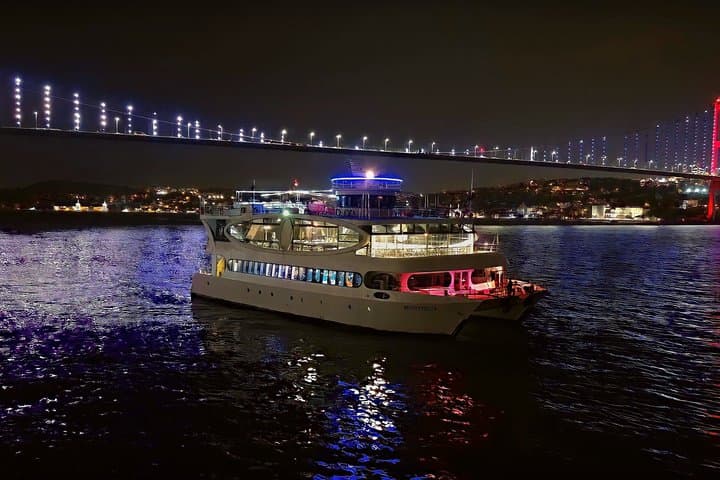
Bosphorus BridgePass by
Which was inaugurated on October 29, 1973 on the fiftieth anniversary of the Turkish Republic, has the longest span in Europe and the fourth in the world.
Fatih Sultan Mehmet BridgePass by
The Fatih Sultan Mehmet Bridge, also known as the Second Bosphorus Bridge, is a bridge in Istanbul, Turkey spanning the Bosphorus strait. When completed in 1988, it was the 5th-longest suspension bridge span in the world; today it is the 24th.
Kanlica MeydaniPass by
Anadoluhisarı is a small fishing village housing some old historical yalıs belonging to the rich. The road goes on to the village of Kanlıca, famous for its milk and yogurt and to the Meşrutâ Yalı, one of the oldest Yalıs on the Bosphorus.
Rumeli FortressPass by
At the narrowest point of the Bosphorus stands the Rumelihisarr Fortress, built by Sultan Mehmet, the Conqueror on the European shore. The Sultan himself on the 26th day of March 1452 laid the foundation stone of the Fortress with a view to controlling the passage of the ships through the Bosphorus and using it as a base for his attack on the city.
Kucuksu PavilionPass by
The summer Palace of Kucuksu, sometimes called the Palace of Göksu, is situated between the villages of Anadoluhisan and Kandilli on the Asiatic shore of the Bosphorus. The Kucuksu Palace was first built by Mahmut I in 1749. Later it underwent a restoration during the reigns of Selim Ill and Ahmet Il. It was renovated by Sultan Abdülmecit in 1857. Sultan Abdülaziz gave the palace a new face-lift and had it refurbished and redecorated. It is a small but elegant edifice, stretching along the lip of the Bosphorus, surrounded by intricately cast iron railings. Waters and waves of the Bosphorus wash its terraces of glittering marble and sometimes penetrate their latticed and mysterious recesses.
Beylerbeyi PalacePass by
Situated on the Asiatic shore of the Bosphorus between the villages of Kuzguncuk and Cengelköy, the palace was built by Sultan Abdülaziz in 1865. Beylerbeyi Palace seen from the Bosphorus floats like a white vision in a fairy tale. It is the most extravagant royal house of the 19th Century on which millions were spent. It is built completely of marble, surpassing all the Palaces of European Kings. Empress Eugénie, during her visit of 1869 stayed in this palace as well as Czar Nicholas Il of Russia. Edward VIII was a guest in 1936. Stone lionesses recline on marble carpets set in lawns, and swans float and fish swim in the unobtrusive pool where pigeons fly to catch the spray of the fountain upon their wings.
KIz KulesiPass by
About 180 metres away from the shores of Üsküdar stands this tower which bears two different names. Europeans who named it the Leander's Tower thought that it was here where Leander was drowned while attempting to swim the Bosphorus to reach his beloved Hero, the priestess of Aphrodite. But, in fact,
Leander never crossed here even in the legend which refers to the Hellespont, Dardanelles. The Turkish name is KIZ kulesi ( Maiden's Tower ). It is now a modern lighthouse. In the past, it served as a fort to tax ships up to one tenth of their cargo, similar to Pfalz Castle on the Rhine.
Galata KoprusuPass by
The Galata Bridge is a bridge that spans the Golden Horn in Istanbul, Turkey. From the end of the 19th century in particular, the bridge has featured in Turkish literature, theater, poetry and novels.
Galata TowerPass by
The Galata Tower, called Christea Turris by the Genoese, is a medieval stone tower in the Galata/Karaköy quarter of Istanbul, Turkey, just to the north of the Golden Horn's junction with the Bosphorus.
Anadolu Hisari FortPass by
On the opposite bank stands the Anadoluhisari Fortress by the Göksu stream.
This romantic castle which adorns the Asiatic shore of the Bosphorus was built in 1395 by Sultan Bayazit, the Thunderbolt and named as "Güzelcehisar". Later it was extended by Mehmet, the Conqueror. Today, as the first possession of Turks on the Bosphorus, it serves as the landmark of Turkish rule.