Pyramids Of Giza Sakkara And Memphis Tour

Description
Explore the wonders of ancient Egypt with our Pyramids Of Giza Sakkara And Memphis Tour. Embark on a journey back in time as you visit the iconic pyramids of Giza, the ancient burial ground of Sakkara, and the historic city of Memphis. Witness firsthand the architectural marvels and rich history of these UNESCO World Heritage Sites. Our knowledgeable guide on site will provide you with fascinating insights and stories about the significance of these landmarks. Book now for an unforgettable experience filled with culture, history, and awe-inspiring sights.
Tour Options
Itinerary
Pickup from your hotel in Cairo or Giza by tour guide to start your tour starts At 8:00 am Pickup from your hotel in Cairo/Giza By Tour guide to Start your full day tour visiting Giza Pyramids where you Visit the Great Pyramids - Cheops, Chephren & Mykerinos
Khufu's pyramid complex consists of a valley temple, now buried beneath the village of Nazlet el-Samman; diabase paving and nummulitic limestone walls have been found but the site has not been excavated
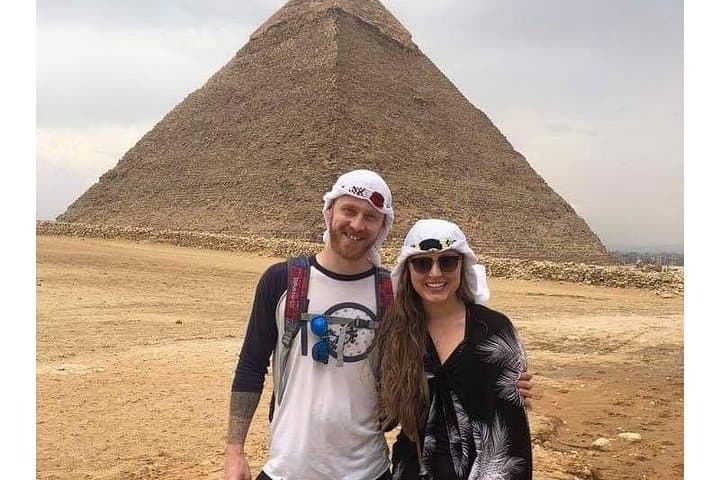
Khafre's pyramid complex consists of a valley temple, the Sphinx temple, a causeway, a mortuary temple and the king's pyramid. The valley temple yielded several statues of Khafre. Several were found in a well in the floor of the temple by Mariette in 1860.
Menkaure's pyramid complex consists of a valley temple, a causeway, a mortuary temple, and the king's pyramid. The valley temple once contained several statues of Menkaure. During the 5th Dynasty, a smaller ante-temple was added on to the valley temple.
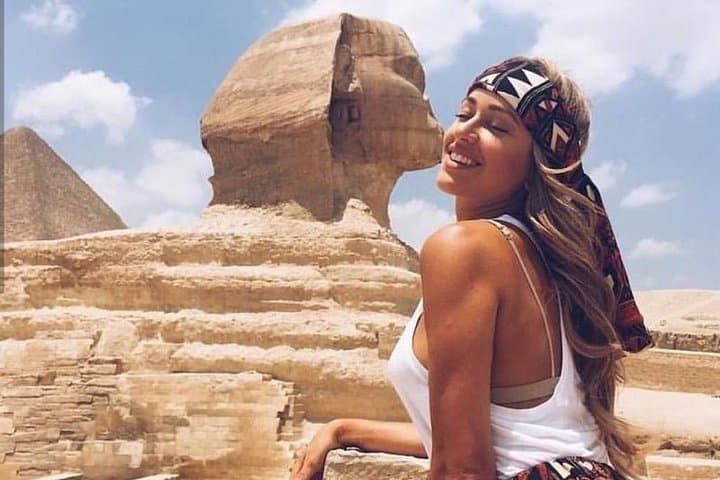
The Great Sphinx of Giza, commonly referred to as the Sphinx of Giza or just the Sphinx, is a limestone statue of a reclining sphinx, a mythical creature with the body of a lion and the head of a human. Facing directly from West to East, it stands on the Giza Plateau on the west bank of the Nile in Giza, Egypt. The face of the Sphinx is generally believed to represent the pharaoh Khafre.
Pickup from your hotel in Cairo or Giza by tour guide to start your tour The Sphinx is a statue of a mythical creature with a lion's body and a human head, carved from limestone, and it is likely that it was originally covered with a layer of plaster and colored, and traces of the original colors are still visible next to one of its ears. Located on the Giza plateau on the west bank of the Nile in Giza, Egypt, the Great Sphinx is also the guardian of the plateau
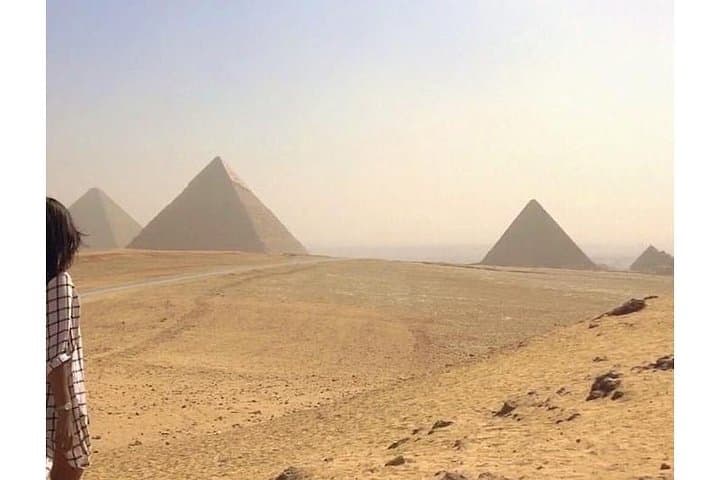
Explore the timeless wonder of the ancient pyramids with our Panoramic view tour. Behold the majestic structures from all angles as you take in the breathtaking beauty of these iconic landmarks. Our expert guides will provide you with fascinating insights into the history and significance of the pyramids, making this an unforgettable experience.
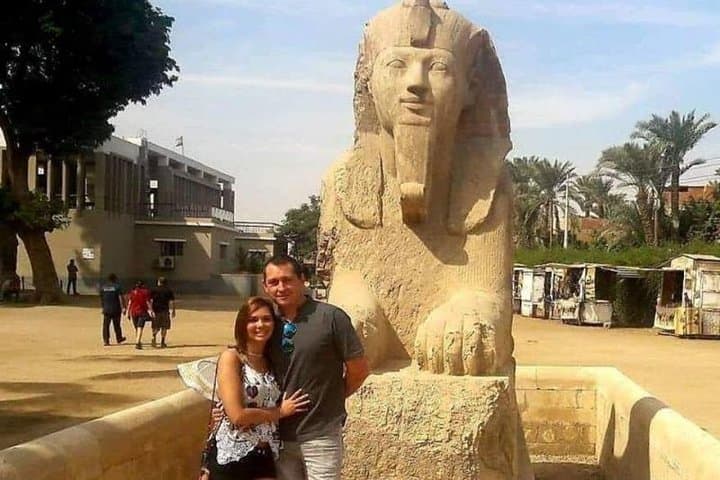
Memphis was an ancient Egyptian city and the ancient capital of Enb-Haj, the first province of Lower Egypt to be known as mḥw. Its ruins lie near the modern city of Mit Rahina, 20 km south of Giza in Greater Cairo, Egypt. The Statue of Ramesses II is a 3,200-year-old figure of Ramesses II, depicting him standing. It was discovered in 1820 by Giovanni Battista Caviglia at the Great Temple of Ptah near Memphis, Egypt. It is made from limestone and weighs 83 tons. This statue was built to celebrate the victory over the Hittites in the Battle of Kadesh in 1274 B.C.[citation needed]
Saqqara (Arabic: سقارة, Egyptian Arabic pronunciation: [sɑʔːɑːɾɑ]), also spelled Sakkara or Saccara in English /səˈkɑːrə/, is an Egyptian village in the markaz (county) of Badrashin in the Giza Governorate,[1] that contains ancient burial grounds of Egyptian royalty, serving as the necropolis for the ancient Egyptian capital, Memphis.[2] Saqqara contains numerous pyramids, including the Pyramid of Djoser, sometimes referred to as the Step Tomb, and a number of mastaba tombs. Located some 30 km (19 mi) south of modern-day Cairo, Saqqara covers an area of around 7 by 1.5 km (4.3 by 0.9 mi).
The Pyramid of Djoser (or Djeser and Zoser), or Step Pyramid (kbhw-ntrw in Egyptian), is an archaeological site in the Saqqara necropolis, Egypt, northwest of the city of Memphis. The 6-tier, 4-sided structure is the earliest colossal stone building in Egypt.[4] It was built in the 27th century BC .
The pyramid of Teti is a smooth-sided pyramid situated in the pyramid field at Saqqara in Egypt. It is the second known pyramid containing pyramid texts. Excavations have revealed a satellite pyramid, two pyramids of queens accompanied by cult structures, and a funerary temple. The pyramid was opened by Gaston Maspero in 1882 and the complex explored during several campaigns ranging from 1907 to 1965.[4] It was originally called Teti's Places Are Enduring. The preservation above ground is very poor, and it now resembles a small hill. Below ground the chambers and corridors are very well preserved.
Unas built his pyramid between the complexes of Sekhemket and Djoser, in North Saqqara. Anchored to the valley temple at a nearby lake, a long causeway was constructed to provide access to the pyramid site. The causeway had elaborately decorated walls covered with a roof which had a slit in one section allowing light to enter, illuminating the images. A long wadi was used as a pathway. The terrain was difficult to negotiate and contained old buildings and tomb superstructures.
The Mastaba of Ti is one of the most important archaeological sites of Saqqara. The mastaba was discovered by Auguste Mariette.[1] The mastaba contains two serdabs.[2] The walls of the tomb show various scenes of everyday life. Ti (also spelled Ty) was a senior official and royal architect in the Fifth Dynasty who served under several kings.[3] He oversaw the sun temples of Neferirkare and Niuserre.[4] His wife was Neferhetepes.
after the tour is finished you will be transferred back to your Hotel.
Highlights
What's included
Pickup Locations & Times
Pick up from all hotels in Cairo and Giza
Traveller Ratings
Important Information
- Public transportation options are available nearby
- Specialized infant seats are available
- Not recommended for travelers with spinal injuries
- Not recommended for pregnant travelers
- Not recommended for travelers with poor cardiovascular health
- Suitable for all physical fitness levels
- Entry fees includes basic area only
- Entrance fees -Depending on the Tour Options Chosen