I had wanted to travel to Poland for a long time. I adore Chopin—his compositions and the sheer force of emotion in his music—so where better to go than to the International Chopin Festival, held in late August and early September? I had booked tickets for the concerts as early as May, just in time to catch the last available ones. Another good reason to visit Poland is that it is the homeland of Nicolaus Copernicus, the astronomer who completely changed the way people viewed the world by challenging the prevailing geocentric system and placing the Sun at the centre, with the planets revolving around it. And then there is Isaac Bashevis Singer, who was one of my favourite writers for a period of my life and, of course, a Nobel Prize winner. I sometimes think there isn't a single word he ever published that I haven't read. Through his wonderful writing and the Yiddish language, he introduced us to the world of Jewish Poland: Bilgoraj, Lublin, Warsaw, Krochmalna Street. We flew from Belgrade to Kraków on an evening flight. We were welcomed by 22 degrees Celsius—essentially Belgrade spring—and beautiful weather stayed with us throughout our entire time in Poland. We immediately set off on foot towards the city centre. We assumed the city would be deserted and that we would end up hungry. After all, this was the north, and it was Sunday. Oh, how wrong we were! After about a ten-minute walk from our hotel, we found ourselves in the main square, Rynek Główny, the very heart of Kraków. And at its heart stands St. Mary’s Basilica, followed by the Renaissance building of the former Cloth Hall, Sukiennice, now filled with shops selling amber and everything that can be made from it—from jewellery to crucifixes. There is, of course, also the monument to Adam Mickiewicz, Poland’s great Romantic poet and a symbol of love for the homeland. Restaurants and cafés crowd around the enormous square with its colonnades. Everything was buzzing with people. Everyone who could possibly walk had come out onto the square. There were also white horse-drawn carriages, their horses beautifully decorated. Children ran after them. It was wonderfully chaotic. And where to eat? The choice was enormous. We decided to use the simplest possible criterion: the busiest place must surely be the best. Most people apparently know this rule. We chose Staropolska Karczma. And we kept coming back there throughout our stay in Kraków. Pierogi—potato dough filled with all sorts of fillings: meat, mushrooms, cabbage. My choice was cottage cheese. Nobody could go wrong with the breaded schnitzels, which irresistibly reminded me of Wiener schnitzels. They were always served with sauerkraut and whole peppercorns in a wooden bowl, while another wooden bowl held the potatoes. Lager beer was by far the most popular drink. You simply couldn’t go wrong. Prices were much like those in Belgrade, and the bill arrived with the tip already included. The following morning, we walked along the Vistula to the remarkable district of Kazimierz, founded by charter of King Casimir the Great in 1335. Over time, it developed into the centre of Ashkenazi Jewish life and community. Jews were allowed to live there freely, trade, practise crafts and, of course, pursue intellectual professions. They were doctors, lawyers, pharmacists and bankers. Over time, their influence on the city’s economic life grew stronger and stronger. Kazimierz flourished and pulsed to its own rhythm, with its own customs, schools and places of worship—its synagogues. And even now, when you walk along the district’s main street, Szeroka, you can feel the spirit of its long-departed inhabitants. Jews from all over the world are helping to bring this place back to life, preserving the traditions and way of life of their people. The cafés and restaurants that have opened here have a distinctly Jewish character, which I find slightly exotic. We had coffee with honey, a whole cinnamon stick and cardamom. Then we entered the small, old Remuh Synagogue, named after its famous sixteenth-century rabbi. It is also one of the oldest surviving synagogues in Kraków. What made the strongest impression on me was the cemetery in the synagogue courtyard. Some of the graves date back as far as the sixteenth century. Every grave preserves a story about the person who lies there. There are many small graves too—children’s graves. Carefully placed little stones lie on each one, a sign that people still remember them. There are no candles, no flowers. They melt and decay. Stones, like memories, do not. During the Second World War, the inhabitants of this district were first taken to the ghetto, which was located outside Kazimierz, and from there to the camps that became their final destination. Kraków has its patron saint, St. Florian. The city’s main gate into the Old Town is named after him, and from there, along Floriańska Street, one reaches the main square. A green ring surrounds the walls of the Old Town. This park, a green oasis, is full of benches and swings and crowded with students, elderly people, mothers with children and tourists exhausted from walking. Poland had many aristocratic families who competed with one another in wealth and social power. One of the most important was the Czartoryski family. They were patrons of the arts and passionate collectors. The most important among them was Izabela Czartoryska and her son Adam, who acquired Leonardo da Vinci’s painting *Lady with an Ermine* and gave it to his mother. Leonardo painted Cecilia Gallerani, the mistress of Ludovico Sforza. Unlike the conventional poses of high-society ladies of that period, she appears as though someone had suddenly called her and she had turned to look over her shoulder. It is one of those paintings that requires a bench, so that you can sit down and give it the time it deserves. What can I say? A beauty that leaves you speechless. To be in Kraków and not visit Wawel would simply be unforgivable. Wawel was the seat of the Polish kings for centuries. They lived there, and they were buried there. From the hill they had the most beautiful possible view of the royal city. They also kept their treasures there, many of which have survived to this day. And what kind of castle would it be without a terrifying cave and a dragon breathing fire? Proof that there is simply no point arguing about taste was my husband’s declaration that all European castles look alike to him. Hahaha! What really interested him was the Wieliczka Salt Mine—which, I must admit, pleasantly surprised me too. It is located 15 kilometres from Kraków. Salt was mined there for almost seven centuries. It is an entire city beneath the ground. It reminded me of Moria from *The Lord of the Rings*—only with chandeliers. The mine reaches a depth of 327 metres. It is an entire complex of corridors, chapels, chambers and underground salt lakes. Can you guess what the sculptures, chandeliers, floors and crucifixes are made of? Salt. The most beautiful part is St. Kinga’s Chapel, named after the Hungarian princess who married a Polish king. Many miners lost their lives in this mine. Descending so far underground and working endless shifts was incredibly difficult, and for some, returning to the surface was simply impossible. The temperature inside the mine remains constant, between 14 and 16 degrees Celsius. I had the strange feeling that the deeper we went, the warmer it became. The total length of the excavated corridors is an astonishing 245 kilometres. A special experience was travelling to Warsaw on the high-speed Pendolino train. The distance of 300 kilometres takes just two hours and twenty minutes. For me, this is a hundred times better than flying. First, through the large windows you can see endless forests of golden pines and birch trees, little lakes and beautifully maintained villages. Second, the service on the train is excellent—the friendliness of the staff as well as the choice of Polish dishes. Warsaw, of course, is a story in itself. It is a huge city of 1.9 million inhabitants. It represents a combination of medieval European and socialist architecture. During the Second World War, it was practically razed to the ground, but through determination, perseverance and enormous effort, the Polish people managed to reconstruct the entire historic centre, stone by stone and brick by brick. As Warsaw is an educational and university centre, I had the impression throughout our stay that the average age of people on the streets was about 25. From almost every part of the city, the imposing Palace of Culture and Science catches your eye. It reminded me very much of the building of the Ministry of Foreign Affairs in Moscow, as well as Moscow’s Lomonosov University. My daughters, for example, would probably have found the Złote Tarasy shopping centre fascinating, with its extraordinary water-like architecture. It looks almost like a sea wave made of glass and steel. And how could we possibly be in Warsaw during the Chopin Music Days and not visit the Church of the Holy Cross, where Chopin’s heart is kept? Chopin was born in Poland and spent his childhood and youth in Warsaw, where it quickly became apparent that he was a musical child prodigy, something like Mozart. He then moved to Paris at the age of twenty. He quickly became a star of the aristocratic salons. He socialised with Liszt and Berlioz, but unlike Liszt, who gave large concerts and earned good money, the refined and delicate Chopin disliked large audiences. As a result, he was constantly on the edge of financial hardship and poverty. He practically supported himself by giving private music lessons. Such an irregular and impoverished life inevitably led, in those days, to tuberculosis, a disease that claimed the lives of many young artists. It was tuberculosis that eventually took Chopin too. He was buried in Père-Lachaise Cemetery, while, according to his final wish, his sister carried his heart back to the aforementioned Church of the Holy Cross, so that it could rest in his beloved Poland and so that admirers of his music from all over the world could pay tribute to him there. At this time of year, all of Warsaw seems to be under the spell of Chopin and his music. His preludes, nocturnes and polonaises can be heard throughout the city. The International Music Festival *Chopin and His Europe* brought together virtuosos and audiences from all over the world. We attended a concert held at the National Philharmonic. The pianist was the young Chinese musician Zitong Wang, winner of the third prize at the 2025 International Chopin Competition. She performed a brilliant piano recital, playing nocturnes and impromptus. The concert hall was packed to the last seat. Young and old had gathered, and what delighted me most was seeing so many entire families there. The applause and ovations were thunderous, and young Zitong returned several times to play encores. The champagne served before the concert certainly added something to the overall atmosphere! For me personally, the best-designed museum—modern, engaging and accessible to young people—is POLIN, a name that can mean Poland but also resembles the Hebrew expression “here you may rest.” It is dedicated to the thousand-year history of Jewish life in Poland. The museum stands on the site of the former Warsaw Ghetto. It is an interactive exhibition that takes you through the streets of a small shtetl, a Jewish town. You can look inside the home of an ordinary, modest man whose entire family lives in a single room, or enter the elegant salon of a bourgeois Jewish intellectual where the crème de la crème of society gathers. There is also a reconstruction of the interior of a beautiful synagogue. Original newspapers can be seen that demonised and dehumanised Jews. You can walk along railway tracks and enter a railway carriage that carries them towards the point of no return. You can experience the ghetto, where poverty, disease, hunger and death prevailed. Sadly, Jews also suffered after the war, under accusations of spreading communism. Sadly, an entire world disappeared. That Warsaw and Poland no longer exist. Most of those who managed to survive emigrated to the United States or Israel. In the final analysis, of the 3.3 million Jews who lived in pre-war Poland, today only around 10,000–15,000 people identify as Jewish. Walking through this museum, and afterwards, I was left with a powerful realisation: we Serbs, too, should create something like this, dedicated to the suffering of the Serbian people at the hands of the Croatian Ustaše and Nazi Germany. We need a Memorial to Remembrance that gives an individual identity to every Serbian victim. I had always thought Belgrade was a green city, so I was astonished by the amount of greenery and the number of parks in Warsaw. And, of course, the most beautiful of them all is Łazienki Park, with its Palace on the Isle. The palace was once the summer residence of the Polish kings. The park is full of lakes where carp swim, streams, squirrels and peacocks. Yes, even the way to Łazienki Park takes you through a large park. I must admit that my idea of what constitutes a green city has changed somewhat. Kraków and Warsaw are beautifully illuminated with modern lighting. But what leaves a particularly strong impression at dusk and at night are the countless street lamps and lanterns. At night, the historic parts of these cities look almost unreal in their beauty. It would be wonderful to see them in winter, covered in snow. It must be truly magical. And finally, I was so happy when we returned to Belgrade that I realised something: the more beautiful a place is, the more beautiful it feels when you come home. Because nowhere—and I mean absolutely nowhere—is it as beautiful as our Serbia!
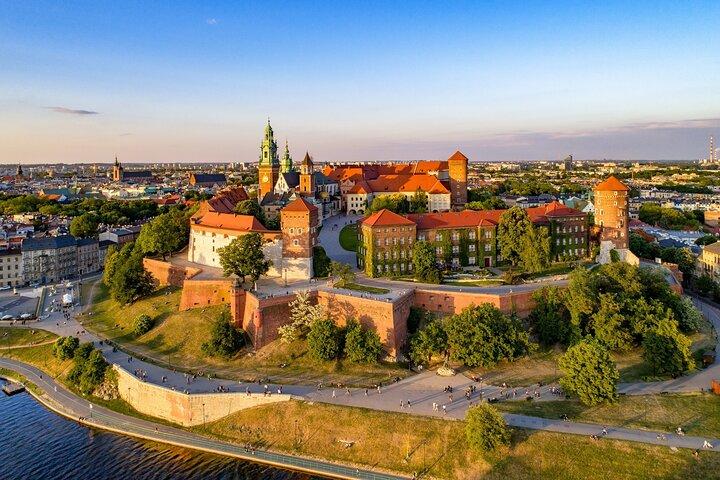
クラクフ:優先入場のヴァヴェル城ガイド ツアー


+4 photos


概要
- 所要時間
- 1h 15分–4h 30分
- 料金
- $129 / 人
- 場所
- Krakow, ポーランド
- 評価
- 4.7 / 5 · 37 件のレビュー
- 言語
- EN
- グループ
- 少人数(最大15名)
- キャンセル
- 24時間前まで無料キャンセル
- 確認
- 即時
- チケット
- モバイルチケットまたは印刷したチケットの受付可
- 事業者
- Rosotravel - Wawel Castle and other Tours
- 集合場所
- ヨハネ パウロ 2 世記念碑、Zamek Wawel 2、33-332 Kraków、ポーランドの前でガイドに会いましょう
説明
グループの人数、言語のニーズ、時間制限に合わせてツアーでヴァヴェルの歴史と文化を体験しましょう。ヴァヴェル大聖堂、ヴァヴェル公邸、王室プライベート アパートメントの探索からさまざまなオプションをお選びいただけます。 あなたのニーズや興味に合わせて、当社の優れたツアー オプションから 1 つをお選びください。各オプションには異なるプログラムが含まれているため、オプションの説明をよくお読みください。 75 分間のヴァヴェル大聖堂ツアー (英語) 部屋、埋葬地、ジークムントの鐘を含むヴァヴェル大聖堂を訪れます。 2時間:ヴァヴェル城 最大 15 名の参加者からなる小グループで、ヴァヴェル城の広間を訪れます。 3時間:ヴァヴェル城と大聖堂 最大 15 名の参加者からなる小グループで、ヴァヴェル城の広間とヴァヴェル城の大聖堂を訪れます。 4.5時間:ヴァヴェル城、大聖堂、王室のアパートメント 最大 15 人の参加者のグループで、複合施設全体 (ヴァヴェル大聖堂、国家広間、丘、王室のアパートメント) を訪問します。
原文からGoogle 翻訳により自動翻訳されています。
催行日と料金
- 催行日
- 毎日
- 開始時刻
- 1日12回(9:00〜15:30)
- 最短の空き日
- 10月7日(水)
- 大人 (6歳以上)
- $129
料金は日付によって異なります。表示は最安値です。
料金は2名で予約した場合の1人あたりです。1名で参加する場合は$231です。
人数が多いほど1人あたりの料金が下がります。
Viator上の催行会社の最新スケジュールより(10月6日確認)。
ツアーオプション
旅程
Statue of John Paul II
教皇になり、20世紀と21世紀のカトリック教会の最も偉大な聖人の一人となった驚くべき男の歴史を発見してください。
Wawel Cathedral
この3時間のツアーでは、Wawel Castle State RoomsとWawel Cathedralを訪れます。多くのポーランドの君主がcrown冠して埋葬されたポーランドで最も重要な教会の1つを訪れてください。その後、ポーランド最大の鐘の1つと街の美しいパノラマを見ることができるジグムントタワーに行きます。
Wawel Royal Castle
2時間または3時間のガイド付きツアーでクラクフのナンバーワンアトラクションを探索してください。旅行中は、ヴァヴェル城の最も美しい場所であるロイヤルステートルームを訪れ、城とその住民の歴史を学びます。クラクフを訪れる際には必見です!
Wawel Royal Castle
銀製品や絵画のコレクション、コラム ホール、ルネサンス様式の家具をご覧ください。
ヴァヴェルの丘は旧市街の最も重要な場所の1つであり、ヴァヴェルの丘を訪れてエキサイティングな歴史について学びます。 (旧市街の散策は旅行の料金に含まれていません)
Krakow's Rynek Glowny Central Square
この素敵なマーケットスクエアから散歩し、ロイヤルルートに沿って歩き、素晴らしいヴァヴェル城、カテドラルに行き、ステートルーム、ロイヤルアパートメンツ、大聖堂などの素晴らしいツアーをお楽しみください!
タデウシュ・コジオスコ将軍の記念碑を見て、国民的英雄の歴史について学びましょう。
含まれるもの
含む
15名までの少人数での観光
ヴァヴェル ロイヤル アパートメントへの優先入場チケット(オプションを選択した場合)
特別な Wawel ライセンスを持つエキスパート ガイド
ヴァヴェル城ステート ルームへの優先入場チケット(オプションを選択した場合)
ヴァヴェル コンプレックスの外側と内側を巡る 1 時間 15 分から 4.5 時間のガイド付きツアー
ヴァヴェル大聖堂の通常チケット(オプションを選択した場合)
旅行者の評価
レビューはViatorとTripadvisorが収集したものです
4.7
37 レビュー
重要情報
- 車いす対応
- 幼児や小さなお子様は乳母車やベビーカーに乗せることができます
- 近くに公共交通機関があります
- 幼児は大人の膝の上に座る必要があります
- 送迎は車いす対応です
- すべてのエリアは車いす完全対応です
- あらゆる体力レベルの方に適しています
- これはグループツアーです。他の参加者がグループに参加できることを意味します
- ポーランドまたはカトリックのイベント中は、通常よりも多くの訪問者が訪れ、大聖堂での待ち時間が長くなる場合があります
- ヴァヴェル城とロイヤル アパートメントの優先入場チケットを提供しています。ヴァヴェル大聖堂のチケットは通常のチケットです
キャンセル
出発予定時刻の24時間前までにキャンセルされた場合、全額返金の対象となります。
1日前以上100%の払い戻し
0〜1日前まで0%の払い戻し
レビュー(37)
レビューはViatorとTripadvisorが収集したものです
V
Magical Poland, Travelogue through Krakow and Warsaw
A
Tour cut short by 15 minutes.
Nice tour. Supposed to be 2 hours, but she ended it 15 minutes. Paid premium for skip the line tour.
事業者からの返答
Dear aberdeennj, We appreciate your review and are glad you had a nice time on the tour. Wawel Castle is truly special, and we hope to show you more highlights on your next visit. Regards, Rosotravel Team
T
Wonderful Tour from an Actual Polish Academic
I cannot emphasize enough how absolutely off the charts wonderful this tour was. This was my first tour after landing in Krakow and it was worth every penny and second. Helen, who is an academic historian of the highest order provided a world class tour of the most sacred ground in Krakow, Wawel Hill. I will remember this tour for a very long time. You get so entrenched and enriched by Helen’s telling of Polish history throughout the tour. This is a must. Please check this out.
事業者からの返答
Thank you so much for your wonderful review! We are thrilled to hear that you enjoyed your tour of Wawel Castle with Helen. She truly is passionate about Polish history, and we’re glad that her knowledge and storytelling made your experience so memorable. It means a lot to us that the tour left such a lasting impression. We hope to welcome you on another Rosotravel experience in the future! Best regards, Rosotravel Team
C
Wawel and cathedral tour
I had the pleasure of experiencing a private tour of Wawel Castle and Cathedral with Barbara, and it was truly unforgettable. Even though it was just the two of us, she gave her full energy and passion to the tour, making me feel like I had a personal journey through centuries of history. Barbara’s deep knowledge is matched only by her heartfelt storytelling. You can tell that the history of the castle and cathedral lives in her heart—she speaks not just with expertise, but with genuine love and pride for the place. Every detail she shared made the walls, halls, and stones of Wawel come alive.
事業者からの返答
Dear cherelld2025, Thank you so much for your kind words! We’re thrilled to hear that Barbara made your Wawel Castle and Cathedral tour such a memorable experience. It’s wonderful that her knowledge, passion, and storytelling brought the history to life for you. We truly appreciate your feedback and hope to welcome you on another tour in the future! Best regards, Rosotravel Team
S
This was a great tour. ...
This was a great tour. Helen, the guide, was very knowledgeable and helpful. She explained all the history and hidden stories that made it very interesting. She knows the history back and forth. She interjected humor with history. I would recommend this tour to anyone.
事業者からの返答
Dear smarchitelli, Thank you for your wonderful feedback! We’re delighted to hear that Helen made your Wawel Castle Guided Tour so engaging and informative. It’s great that her knowledge, storytelling, and sense of humor helped bring the history to life. We truly appreciate your recommendation and hope to see you on another tour soon! Best regards, Rosotravel Team
V
Once a lifetime experience!
This tour far exceeded our expectations and was worth way more than the price. It was great sight seeing, cultural education, and a history lesson wrapped into one with a tour guide who was more knowledgeable and qualified than we could have hoped. A truly amazing once in a lifetime experience.
R
Amazing site toured with a wonderful guide
Our Guide was very professional, accommodating, and highly knowledgeable. She permitted our questions and obviously knows her stuff.
J
Don’t miss a second of this memorable tour!
Incredible tour with the most knowledgeable and vivacious guide. There is so much to see- the skip the lines tickets are a must. Bring comfortable shoes, lots of walking and climbing if you want to go up the tower.
事業者からの返答
Dear Jane, Thank you for your positive feedback. We are thrilled to hear that you enjoyed our tour and had a great experience with us. We hope that you will use our services again in the future. We look forward to welcoming you back on another tour! Best regards. Rosotravel Team
B
Disappointed
We booked the tour before leaving Australia hoping for the best experience ever. Unfortunately the experience was opposite. We were at the meeting point on time, even a little earlier to be sure that nobody would have to wait for us. After 20 minutes of waiting and not knowing why nobody else is at the meeting point I called the number given to me prior to the tour. I have learned that the tour guide Irena just could not make it and there is no tour. What a disappointing experience on the first day in Krakow. The only good news about the tour is that money was refunded straight away.
M
Excellent tour
Our tour guides were very knowledgeable and informative. It was a wonderful experience. Would definitely recommend this tour.
Krakowの類似ツアーを比較
- 最安値: Auschwitz Birkenau Guided Tour with Ticket Hotel Pickup Small Van — $27
- 最高評価: Krakow–Zakopane: Cable Car, Chocholow Baths, Cheese & Vodka — 4.9 (13,387 件のレビュー)
- 最短: クラクフ:優先入場のヴァヴェル城ガイド ツアー — 1h 15分–4h 30分
| ツアー | 所要時間 | 評価 | 料金 | |
|---|---|---|---|---|
| クラクフ:優先入場のヴァヴェル城ガイド ツアー | 1h 15分–4h 30分 | 4.7 (37) | $129 | |
 Krakow–Zakopane: Cable Car, Chocholow Baths, Cheese & Vodka Krakow–Zakopane: Cable Car, Chocholow Baths, Cheese & Vodka | 11–12 時間 | 4.9 (13,387) | $45 | 見る |
 Krakow to Auschwitz Birkenau Guided Tour with Transfer and Ticket Krakow to Auschwitz Birkenau Guided Tour with Transfer and Ticket | 7 時間 | 4.7 (10,196) | $40 | 見る |
 Auschwitz Birkenau Guided Tour with Ticket Hotel Pickup Small Van Auschwitz Birkenau Guided Tour with Ticket Hotel Pickup Small Van | 7 時間 | 4.8 (5,305) | $27 | 見る |
 Day Trip Auschwitz-Birkenau and Wieliczka Salt Mine from Krakow Day Trip Auschwitz-Birkenau and Wieliczka Salt Mine from Krakow | 10–12 時間 | 4.7 (4,447) | $143 | 見る |
 Krakow to Auschwitz-Birkenau Live Guided Tour & Hotel Pick-up Krakow to Auschwitz-Birkenau Live Guided Tour & Hotel Pick-up | 7 時間 | 4.7 (4,224) | $29 | 見る |
 Auschwitz Birkenau Museum Tour from Krakow with Ticket & Transfer Auschwitz Birkenau Museum Tour from Krakow with Ticket & Transfer | 7 時間 | 4.6 (4,121) | $56 | 見る |
料金$129
4.7(37) 無料キャンセル