Nara 8hr Private Tour - Kyoto DEP. with Licensed Guide
Description
Explore Nara with a government-licensed and experienced multilingual guide! Your guide will help you efficiently enjoy a full-day walking tour of Nara and introduce both modern and traditional sides of this dynamic and ancient Japanese city. Nara's proximity to Kyoto, and its rich collection of traditional sites, make it an ideal destination for a day trip from either of its larger neighbors. Your private guide can help you efficiently enjoy a full-day walking tour of this ancient Japanese city. You can start your day at your hotel in Kyoto. Let us know what you would like to experience and we will customize Nara day tour that's best for you! Note*1: Please select your must-see spots from a list in the tour information to create your customized itinerary. Note*2: The National Government Licensed Guide Interpreter certification is issued by the Japanese government requires a good knowledge and understanding of Japanese culture and history.
Tour Options
Itinerary
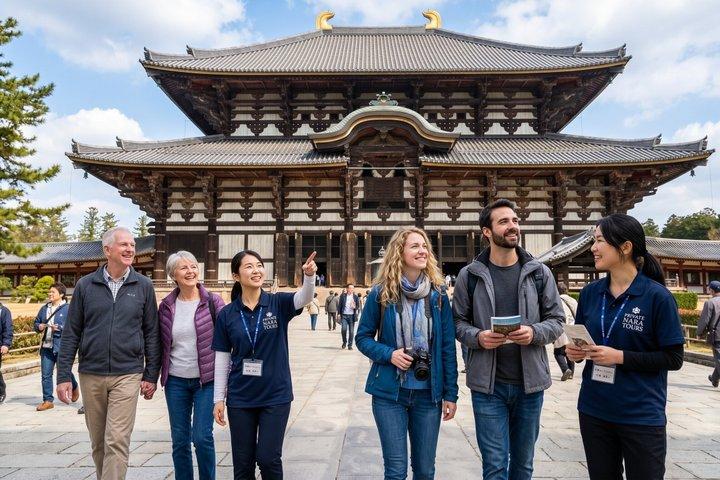
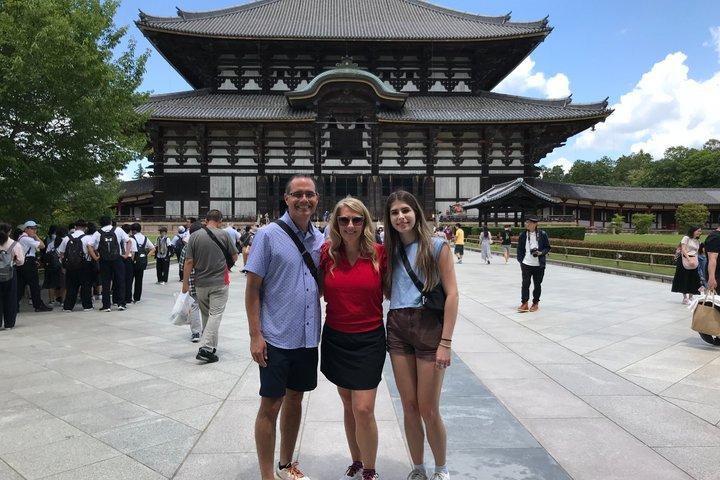
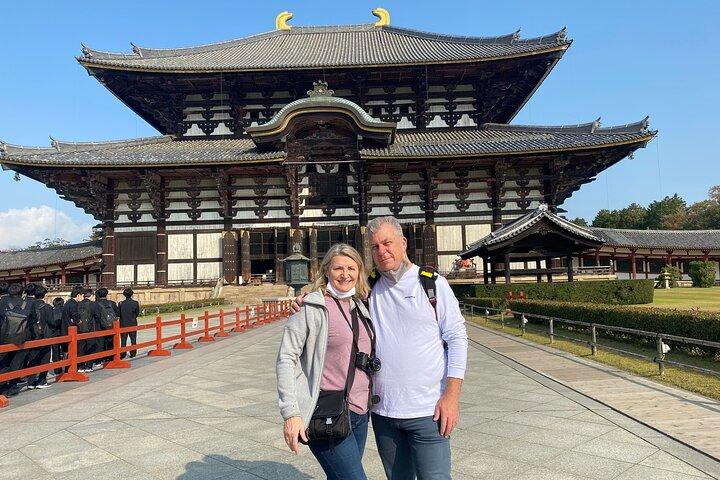
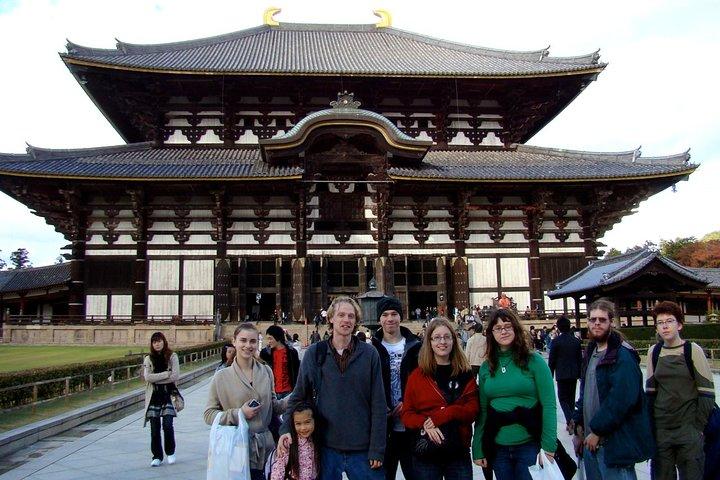
Todaiji (東大寺, Tōdaiji, "Great Eastern Temple") is one of Japan's most famous and historically significant temples and a landmark of Nara. The temple was constructed in 752 as the head temple of all provincial Buddhist temples of Japan and grew so powerful that the capital was moved from Nara to Nagaoka in 784 in order to lower the temple's influence on government affairs. Until recently, Todaiji's main hall, the Daibutsuden (Big Buddha Hall), held the record as the world's largest wooden building, despite the fact that the present reconstruction of 1692 is only two thirds of the original temple hall's size. The massive building houses one of Japan's largest bronze statues of Buddha (Daibutsu). The 15 meters tall, seated Buddha represents Vairocana and is flanked by two Bodhisattvas.
Nara Park (奈良公園, Nara Kōen) is a large park in central Nara. Established in 1880, it is the location of many of Nara's main attractions including Todaiji, Kasuga Taisha, Kofukuji and the Nara National Museum. It is also home to hundreds of freely roaming deer.
Kasuga Taisha (春日大社) is Nara's most celebrated shrine. It was established at the same time as the capital and is dedicated to the deity responsible for the protection of the city. Kasuga Taisha was also the tutelary shrine of the Fujiwara, Japan's most powerful family clan during most of the Nara and Heian Periods. Like the Ise Shrines, Kasuga Taisha had been periodically rebuilt every 20 years for many centuries. In the case of Kasuga Taisha, however, the custom was discontinued at the end of the Edo Period. Beyond the shrine's offering hall, which can be visited free of charge, there is a paid inner area which provides a closer view of the shrine's inner buildings. Furthest in is the main sanctuary, containing multiple shrine buildings that display the distinctive Kasuga style of shrine architecture, characterized by a sloping roof extending over the front of the building.
Mount Wakakusayama (若草山) is the grass covered mountain behind Nara Park, located between Todaiji Temple and Kasuga Shrine. The mountain is about 350 meters tall and affords unobstructed views over Nara City. Tourists are allowed to climb Mount Wakakusayama all year round except during winter. A small entrance fee is charged. The grassy slope of the mountain is lined by cherry trees that are usually in full bloom around early April. A steep trail leads along the leftmost edge of the slope to a plateau halfway up the mountain with great views over the city. It takes about 15-20 minutes to reach the plateau and many people do not hike farther. An additional 20-30 minutes would get you to the mountain's peak.
Horyuji Temple (法隆寺, Hōryūji) was founded in 607 by Prince Shotoku, who is credited with the early promotion of Buddhism in Japan. Horyuji is one of the country's oldest temples and contains the world's oldest surviving wooden structures. It was designated a world heritage site in 1993. Horyuji's temple grounds are spacious and separated into two main precincts, the Western Precinct (Saiin Garan) and the Eastern Precinct (Toin Garan).
Naramachi (奈良町, literally "Nara Town") is the former merchant district of Nara, where several traditional residential buildings and warehouses are preserved and open to the public. Boutiques, shops, cafes, restaurants and a few museums now line the district's narrow lanes. Many of Naramachi's buildings in the Edo Period and earlier were machiya, long, narrow "townhouses" that served both as shops and as the living quarters of the local merchants. The store fronts of machiya were often kept narrow in order to save on taxes, which used to be calculated on a property's street access rather than its total area. Today, a handful of machiya have been preserved and made open to the public as museums.
Kofukuji (興福寺, Kōfukuji) used to be the family temple of the Fujiwara, the most powerful aristocratic clan during much of the Nara and Heian Periods. The temple was established in Nara at the same time as the capital in 710. At the height of Fujiwara power, the temple consisted of over 150 buildings. The temple features several buildings of great historic value, including a five-storied pagoda and a three-storied pagoda. At 50 meters, the five-storied pagoda is Japan's second tallest wooden pagoda, just seven meters shorter than the five-storied pagoda at Kyoto's Toji Temple. Kofukuji's pagoda is both a landmark and symbol of Nara. It was first built in 730, and was most recently rebuilt in 1426. Neither pagoda can be entered by the public.
Yakushiji (薬師寺) was constructed by Emperor Tenmu in the late 7th century for the recovery of the emperor's sick wife. One of Japan's oldest temples, Yakushiji has a strictly symmetric layout, with the main hall and lecture hall standing on a central axis, flanked by two pagodas. The main hall was rebuilt in the 1970s after being destroyed by fire and houses a Yakushi trinity, a masterpiece of Japanese Buddhist art. The East Pagoda is the temple's only structure to have survived the many fires that have beset the temple over the years, and dates from 730. It appears to have six stories, but is in fact only truly three-storied, like the West Pagoda.
Shin-Yakushiji Temple (新薬師寺) was founded during the Nara Period (710-794) by an empress for the sake of the ailing emperor. It is devoted to Yakushi Buddha, the patron of medicine in Japanese Buddhism. Shin-Yakushiji means "New Yakushi Temple", because there already existed a Yakushiji Temple. During its heyday, Shin-Yakushiji consisted of a large complex of buildings, but all except for the main hall (Hondo) have since been lost. Inside the main hall there are life size statues of 12 guardian deities surrounding a two meter tall statue of a seated Yakushi Buddha, which are the temple's main objects of worship. The Yakushi statue is made of wood while the guardians are made of clay. Each guardian has a different character and possesses a different weapon, and visitors can spend quite a while admiring them. There are also a few small paths around the temple grounds.
The Nara National Museum (奈良国立博物館, Nara Kokuritsu Hakubutsukan), located in Nara Park, is an art museum which primarily displays Japanese Buddhist art. Established in 1889, the museum retains its original building and is joined by a new wing that is connected to the original building by an underground passage. Both wings display the museum's permanent collection, which includes Buddhist statues, paintings, scrolls and ceremonial objects mainly from Japan. The new wing also houses temporary exhibitions, including an annual exhibition every autumn of treasures from Todaiji Temple. A ticket to the museum gives access to both wings, and English explanations are available throughout the museum.
During most of the Nara Period (710-794), Nara served as the capital of Japan and was known as Heijo-kyo. The Heijo Palace extended about one kilometer wide and one kilometer long and served as the site of the emperor's residence and government offices. For its great historical and cultural importance, the palace site is included as one of the UNESCO World Heritage Sites of Nara.
Toshodaiji (唐招提寺, Tōshōdaiji) was founded in the year 759 by Ganjin, a Chinese priest who was invited to Japan by the emperor in order to train priests and improve Japanese Buddhism. Ganjin's influence in the introduction of Buddhism to Japan was monumental, and his arrival and teaching at Toshodaiji (which roughly translates to "temple of the one invited from Tang China") were important stages in that process. Toshodaiji's main hall (kondo) was re-opened in late 2009 after being renovated over a period of almost ten years, during which the building was dismantled and reconstructed. The temple's lecture hall (kodo) was originally an administrative building located in the Nara Imperial Palace and was later moved to Toshodaiji. Today, it is the only surviving building of the former palace.
Isuien (依水園) is an attractive Japanese garden with a variety of features, such as the use of Todaiji Temple's Nandaimon Gate and Mount Wakakusayama as "borrowed scenery". Isuien means "garden founded on water", and the garden's name is derived from the fact that its ponds are fed by the small adjacent Yoshikigawa River. The Yoshikien Garden is located just on the other side of the river.
Yoshikien (吉城園) is a pleasant Japanese garden located in central Nara. It is named after the Yoshikigawa River, a small river that runs beside the garden, and was built on the site of Kofukuji Temple's former priest residences. The entry fee to the garden is waived for foreign tourists. There are three unique gardens within Yoshikien: a pond garden, a moss garden and a tea ceremony garden. So, a visit to Yoshikien provides the opportunity to see three different variations of Japanese gardens in one spot. If visitors still want to see more techniques of Japanese gardening, the Isuien Garden is located just across the small river.
Highlights
What's included
Pickup Locations & Times
This private tour is a walking day tour with meet up in KYOTO. A private vehicle is not included. Public transportation or local taxis maybe used to transfer between sites. Exact transportation costs can be discussed with the guide after a reservation is finalized. Please have Japanese Yen on hand for your transportation costs. Please book Private Nara Tour with Government Licensed Guide & Vehicle (Kyoto Departure) if you wish to have a tour with a private vehicle.
Traveller Ratings
Important Information
- Service animals allowed
- Public transportation options are available nearby
- Infants and small children can ride in a pram or stroller
- All areas and surfaces are wheelchair accessible
- Transportation options are wheelchair accessible
- Wheelchair accessible
- Suitable for all physical fitness levels
- A guide will be designated to them after the booking is made
- This is a walking tour. Pick up is on foot.
Reviews(116)
The tour was exceptional. The sites that we visited far surpassed what we saw in Kyoto, allowing us to see more beauty and historical sites in one day than we did our entire two week trip in Japan. More so, however, was that the guide was far more knowledgeable than any other we encountered. Junichi had deep knowledge about the history, culture, and religion of the whole of Japan and Nara, as well as exacting understanding of each site in particular. He tailored the tour and the information provided specifically to our interests. If you are visiting Kyoto or Osaka, this tour should be on the very top of your list. It far surpassed anything and everything in those cities. If hesitating, just book it now
Thank you for the awesome review! Yes, Nara is a unique place where, with a very good guide, you can have a basic and overall understanding of Japanese history, culture and religions just in a day while playing with the deer, though more than 1 day is far better than just one. Please come back to cover what we had to skip due to the limited time frame. - Junichi
The tour was exceptional. The sites that we visited far surpassed what we saw in Kyoto, allowing us to see more beauty and historical sites in one day than we did our entire two week trip in Japan. More so, however, was that the guide was far more knowledgeable than any other we encountered. Junichi had deep knowledge about the history, culture, and religion of the whole of Japan and Nara, as well as exacting understanding of each site in particular. He tailored the tour and the information provided specifically to our interests. If you are visiting Kyoto or Osaka, this tour should be on the very top of your list. It far surpassed anything and everything in those cities. If hesitating, just book it now
Thank you for the awesome review! Yes, Nara is a unique place where, with a very good guide, you can have a basic and overall understanding of Japanese history, culture and religions just in a day while playing with the deer, though more than 1 day is far better than just one. Please come back to cover what we had to skip due to the limited time frame. - Junichi
Very nice guide! Now, No one in the organisation to ensure you nice experience. They are there to take our money and ask for our opinion, even before the booking. Confusing site
Thank you very much for your review. However, we do not ask for reviews before tours. We also monitor emails sent from guides to guests. If there are problems, we state in our welcome email post booking to please contact us directly so that we can assist you. Guides also contact the agency and provide full reports of the tours. If you were pressured to give a review before your tour, please contact us directly so that we may investigate this matter. JGA Customer Service
We enjoyed a full day at Nara guided by Noriko who started by collecting us at Kyoto station. Nice introductions and we liked the conversations. Throughout the day Noriko provided excellent information and we were able to beat the crowds by using some alternative routing. She helped us to introduce to the owner of a local Calligraphy store which was highly appreciated. We can strongly recommend booking the tour with Noriko and it was a pleasure spending the day in Nara. Paul & Lut Belgium
Thank you very much for a wonderful comment. I am glad you enjoyed the tour with me and so did I. I hope you will create fabulous works of art using ink and washi paper. Noriko
Interesting and busy day. Our English-speaking guide Tatsuya Ito was very pedagogical and extremely kind to us. We walked back to the station by local bus to the major points of interest of Nara. Kyoto Nara round trip was made by train from Kyoto (prefer express trains if schedules are suitable for a small fee).
Merci pour votre avis positif. Nara est une ville ancienne et magnifique. J'ai été ravi de vous guider toute la journée. Vous vous intéressez à la culture et à l'histoire japonaises, j'ai donc pu vous expliquer beaucoup de choses. Merci beaucoup. Prenez soin de vous.
We had a wonderful full-day tour from Kyoto to Nara with our guide, Ichiro-san. From start to finish, he was kind, attentive, and incredibly knowledgeable. He explained everything in great detail and made the entire experience smooth and engaging. Ichiro-san took care of all the logistics, including train connections and a quick taxi to save time, which made the day stress-free. We also enjoyed a fantastic lunch with delicious local specialties — one of the highlights of the day! Overall, it was a perfect mix of culture, history, and nature, made even better by Ichiro’s warm personality and deep knowledge. Highly recommended!
We saw everything we wanted to see on our tour and the guide was good even though he was a little on the quiet side. He was very timely and flexible when we wanted to drop one of the previously requested sites and add a saki tasting. He expertly led us through the train stations and the bus stops to get to our destination. We all enjoyed our visit to Nara.
Thank you very much for your kind review! We’re glad to hear that you enjoyed your day in Nara and that your guide was able to adjust the plan to fit your interests. It’s always our pleasure to help guests make the most of their time in Japan. We truly appreciate your feedback and hope to welcome you again on your next trip to Japan! Japan Guide Agency
An unbelievable experience at a destination unmatched all over the world. I must say we were lucky to have the guide Mr Junichi who was wonderful. Super friendly, cult and fun, he taught us a lot about Japanese culture and about Nara, his hometown. We couldn't have had a better guide!
Thank you so much for your awesome review! If I am the best guide as you wrote, it is all because of you. You asked me lots and lots of questions, which made it easier for me to decide what topics to talk about. Because Nara is the unique place where everything Japanese started, there are too many topics on history and religions etc. that are worth talking about. We covered just a tiny part of Nara. Please come back to Nara hopefully in the near future! Junichi
Haru was a wonderful tour guide. Very professional and always prepared with information about each site. We probably saved two hours of our time by hiring a tour guide who knew exactly where to go and how to get there, but the added information was even more valuable.
We appreciate your kind feedback and our guides do too! We are so happy to hear that you enjoyed the tour with your guide. We look forward to your next visit to Japan. Japan Guide Agency
Hiro did a great job guiding us through Nara. Leading up to the trip he was easy to communicate with and he helped us customize the itinerary. He met us right on time at the hotel and helped us navigate through the train/bus stations. He was flexible with the schedule as it was raining when we arrived and he added a Sake tasting experience for us to get a break from the rain. He took us to a museum of the old houses of Nara and then walked with us through the deer park. Hiro planned a wonderful lunch and was very accommodating to my food allergies. We got to feed and interact with so many deer! We wandered through a beautiful garden and then back through the deer park on our way to the bus and train stations. Hiro did a great job with us!
Dear my guests, Thank you very much for your wonderful review! I'm happy to know you have been really satisfied with me, despite of not good weather. Please appoint me when you come back to Japan. I'll provide further satisfaction to you. See you again! Hiro