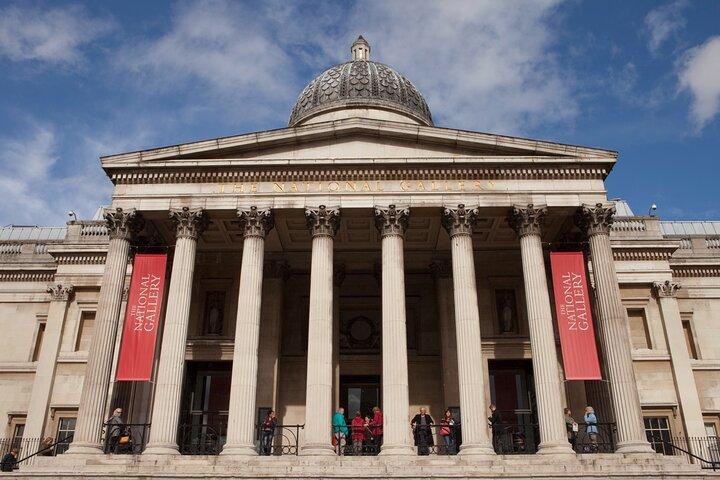
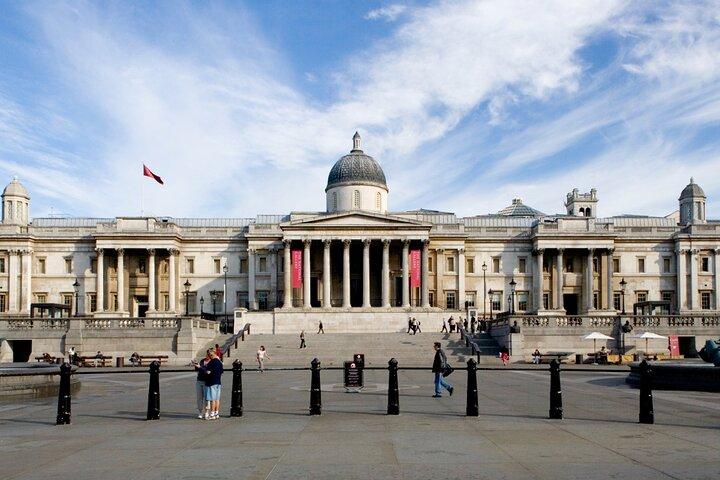
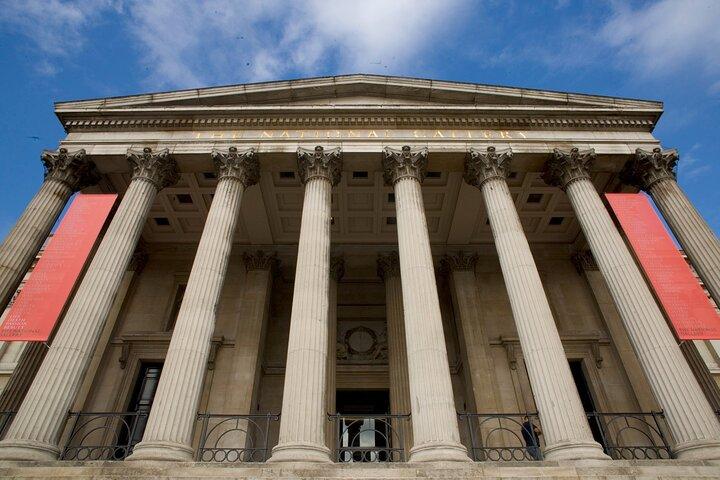
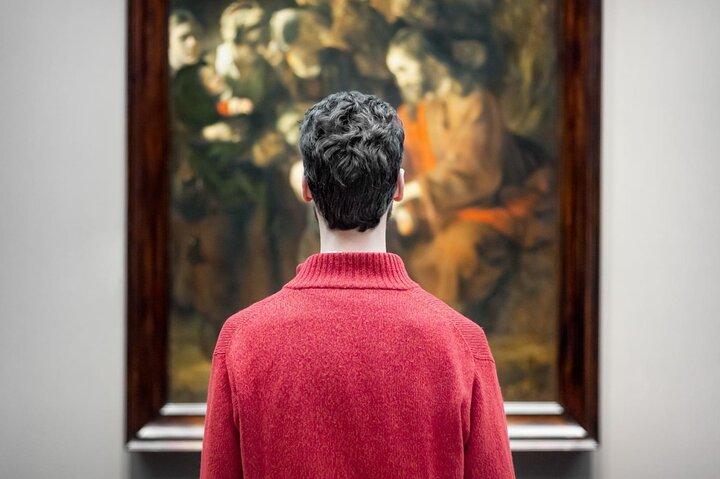
I’ve visited some impressive places over the years, but the National Gallery really does take the picture\. Or possibly the entire picture frame\. Because where else in central London can you wander through magnificent galleries, admire centuries of artistic genius and casually announce: **“I’M JUST POPPING IN TO LOOK AT A FEW PAINTINGS\.”** And then emerge several hours later with a completely new appreciation for light, shadow, dramatic clouds and people wearing extremely serious expressions? Yes\. The NATIONAL GALLERY\. Not a small local gallery with three paintings, a gift shop and a café selling one slightly confused sandwich\. Not a trendy exhibition space where everyone whispers because they’re afraid of disturbing the installation\. An enormous, world\-famous collection of art right in the heart of London, overlooking Trafalgar Square\. And it’s absolutely BRILLIANT\! **FIRST OF ALL, THE LOCATION\.** You’re in the middle of London\. Nelson is standing on his column, pigeons are holding important meetings, tourists are photographing absolutely everything, and the traffic is doing what London traffic does best\. Not moving\. Then, just when you think Trafalgar Square has finished showing off, you look up and see the magnificent National Gallery sitting proudly above it all\. It’s grand, imposing and wonderfully dramatic\. The sort of building that makes you feel you should immediately improve your posture\. I would absolutely love to have heard the original planning meeting\. “We need somewhere to display some paintings\.” “How about a magnificent building overlooking Trafalgar Square?” “Will it be large enough?” “Only if we make it enormous\.” “Will people come and look at the art?” “Of course\.” “What if they don’t understand it?” “They can stand in front of it and nod thoughtfully\.” And somehow, one of the greatest art galleries in the world was born\. **NOW, LET’S TALK ABOUT THE ATMOSPHERE\. 🎨** OH\. MY\. GOODNESS\. It’s wonderful\. You walk inside and immediately find yourself surrounded by grand architecture, elegant galleries and an extraordinary collection of paintings spanning centuries of European art\. There are enormous rooms, beautiful details and enough masterpieces to make you question whether your own attempts at drawing are best kept safely inside a notebook\. The architecture alone is worth seeing\. It feels like you’ve stepped into a world where everyone understands art, knows the difference between a Baroque masterpiece and a Renaissance painting, and has at least one opinion about the correct use of perspective\. Except you’re also surrounded by ordinary visitors doing exactly what you are: Looking at paintings\. Reading the labels\. Taking photographs where permitted\. And occasionally standing in front of a masterpiece thinking: **“I’M SURE THIS IS VERY IMPORTANT, BUT I’M NOT ENTIRELY SURE WHAT’S HAPPENING\.”** And that’s perfectly fine\. Above ground: London chaos\. Inside the gallery: quiet contemplation, dramatic landscapes, royal portraits and an astonishing number of people looking as though they’ve just received terrible news\. It’s almost surreal\. I half expected a guide to appear and announce: “Today’s highlights include saints, kings, battles, fruit, clouds and one gentleman who appears to be deeply disappointed with everyone\.” Fortunately, the collection was considerably more varied\. **AND YES, I ACTUALLY LOOKED AT THE ART\! 🖼️** And thoroughly enjoyed it\! There’s something particularly exciting about seeing famous works in person\. You may have seen them in books, on television or online, but standing in front of the real painting is completely different\. You notice the scale\. The texture\. The brushwork\. The tiny details\. The fact that somebody created this extraordinary object hundreds of years ago, and it has somehow survived long enough for you to stand in front of it while wearing comfortable shoes and wondering where to find a coffee\. You can admire paintings by artists such as Van Gogh, Monet, Turner, Rembrandt, Velázquez and many others\. And every room seems to contain another reason to stop and stare\. You can spend ages looking at one painting and still notice something new\. Or you can spend ten seconds looking at another and immediately decide that you need to read the label because you have absolutely no idea what is going on\. Both approaches are valid\. Art appreciation is wonderfully flexible\. **THE HISTORY MAKES IT EVEN BETTER\.** The National Gallery was founded in 1824 and opened to the public in the same year\. Unlike many great European galleries, it was created as a national collection for everyone rather than as a royal palace or private court collection\. That makes the whole experience even more special\. This is not simply a place where wealthy people once displayed their favourite paintings\. It is a public gallery, created so that people could enjoy great art\. And people have been doing exactly that for generations\. The collection covers centuries of European painting, from the medieval period through to the nineteenth century\. That means you can move through different eras, styles and artistic ideas without having to travel across half of Europe\. One minute you’re looking at a religious masterpiece\. The next, you’re admiring a dramatic landscape\. Then you’re standing in front of a portrait of somebody who appears to have been born already disappointed by modern life\. The National Gallery has stood at the heart of London for two centuries, and its position in Trafalgar Square makes it one of the city’s most recognisable cultural landmarks\. The British really are extraordinary\. Other countries might put their greatest paintings in a palace guarded by people who look as though they have never smiled\. We put ours in the middle of London and invite everyone in\. And somehow, it works magnificently\. **THE ARTISTIC DRAMA IS OFF THE SCALE\.** Everything about the place feels a little different\. The grand entrance\. The enormous galleries\. The historic paintings\. The dramatic lighting\. The visitors standing perfectly still while pretending they understand symbolism\. The knowledge that you’re looking at works that have influenced art, culture and history for centuries\. Even the names of some paintings are brilliant\. You can find works with titles that sound like the beginning of a very serious conversation: **“The Ambassadors\.”** **“The Fighting Temeraire\.”** **“The Hay Wain\.”** **“The Arnolfini Portrait\.”** And then there are paintings where you look at the title and think: **“RIGHT\. THAT’S VERY HELPFUL\. I STILL HAVE NO IDEA WHAT I’M LOOKING AT\.”** No elaborate explanation required\. No trendy nonsense\. No calling a painting “An Exploration of Emotional Geometry in a Post\-Industrial Landscape\.” Just a painting\. In a gallery\. Job done\. Although I do think they’re missing an opportunity with the audio guides\. Imagine the possibilities: “Please observe the dramatic cloud formation\.” “Please admire the tiny dog\.” “Please notice that the person in the corner has clearly had enough\.” “Please do not attempt to recreate the painting using household objects\.” And for the portraits? “Please maintain eye contact with the subject, even though they are several hundred years old\.” Honestly, I’d happily volunteer to write the commentary\. Although I suspect the management might politely ask me to leave after describing a Renaissance angel as “a very fancy flying baby\.” **AND THE BEST BIT?** It’s genuinely a wonderful place to spend time\. Not just somewhere you visit because it’s famous\. Not simply somewhere you pop into to take a photograph and say you’ve been\. It’s somewhere you can wander, explore, learn and enjoy art at your own pace\. You can spend an entire day there and still not see everything properly\. Or you can visit for half an hour, choose a few favourite paintings and leave feeling as though you’ve had a remarkably sophisticated afternoon\. And that’s what makes it so special\. It manages to be historic, educational, beautiful and welcoming all at once\. A rare combination\. Especially in central London, where some attractions seem to believe that charging you £30 to stand in a queue automatically makes them culturally important\. Here, the surroundings do all the talking\. And they’ve got rather a lot to say\. **WOULD I RECOMMEND IT?** ABSOLUTELY\! In fact, I’d go further\. **IF YOU’RE VISITING TRAFALGAR SQUARE, DO NOT MISS THIS PLACE\!** Seriously\. Walk past the crowds\. Admire the fountains\. Look up at the magnificent building\. And step inside one of the greatest art galleries in the world\. You don’t need to be an art expert to appreciate it\. You don’t need to know every artist, every movement or every historical detail\. You simply need to be curious\. Although if you love art, architecture or history, you’ll be in your element\. And if you have a slightly ridiculous sense of humour, like me, you’ll probably spend half your visit thinking of completely inappropriate painting\-related jokes\. **FIVE MASSIVE, MAGNIFICENTLY MASTERPIECE\-FILLED STARS\! ⭐⭐⭐⭐⭐** Beautiful paintings\. Magnificent architecture\. Extraordinary history\. A wonderfully inspiring atmosphere\. And an experience that’s genuinely different from your average London attraction\. My only concern is that after visiting the National Gallery, ordinary walls may now seem terribly boring\. “Would you like to hang something above the sofa?” “No thank you\. Have you got anything by Turner?” “Sorry?” “Preferably something with dramatic skies, emotional depth and a small boat in the distance\.” “Madam, this is IKEA\.” **THE NATIONAL GALLERY — THE ART IS BRILLIANT, THE BUILDING IS STUNNING, AND THE WHOLE EXPERIENCE IS A MASTERPIECE\! 🎨🤣** **DO NOT MISS IT\!** And remember… If somebody tells you to go and look at paintings in Trafalgar Square, don’t panic\. **They might just be recommending somewhere absolutely fantastic for a cultured day out\
公式ナショナル ギャラリー ハイライト ガイド付きツアー
+4 photos


概要
- 所要時間
- 1 時間
- 料金
- $27 / 人
- 場所
- London, イギリス
- 評価
- 4.6 / 5 · 166 件のレビュー
- 言語
- EN
- グループ
- 少人数(最大25名)
- キャンセル
- 24時間前まで無料キャンセル
- 確認
- 即時
- チケット
- モバイルチケットまたは印刷したチケットの受付可
- 事業者
- National Gallery
説明
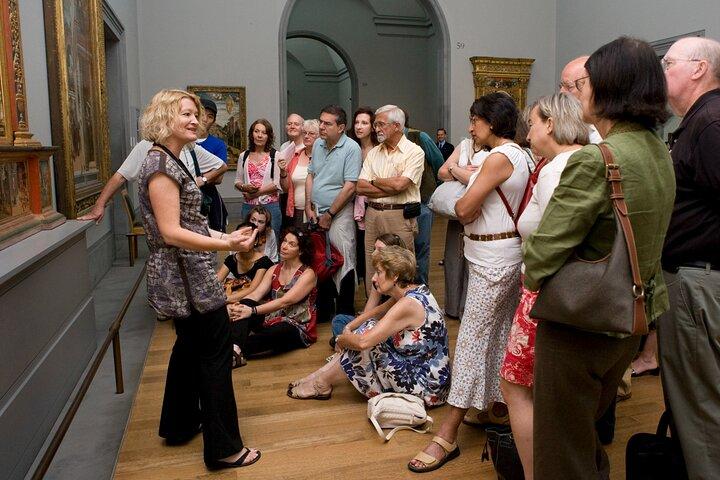
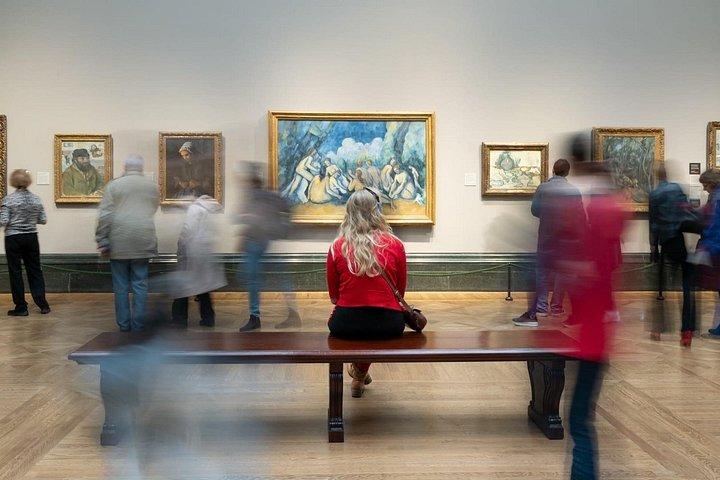
世界で最も優れた西ヨーロッパ絵画のコレクションの 1 つを訪れ、レオナルド、モネ、ヴァン ゴッホなどの芸術家による世界最高の絵画に囲まれてください。 この公式ツアーでは、専門家とギャラリーが承認し、認定されたブルー バッジ ガイドが案内します。 ツアーは、ロンドン中心部にあるグレード I の指定建造物で行われます。
原文からGoogle 翻訳により自動翻訳されています。
催行日と料金
- 催行日
- 火曜日、水曜日、木曜日、土曜日
- 開始時刻
- 14:00、15:30
- 最短の空き日
- 10月20日(火)
- 大人 (18歳以上)
- $27
- 子ども (0〜17歳)
- $20
人気:今後24回の催行のうち12回はすでに満席です。
Viator上の催行会社の最新スケジュールより(10月17日確認)。
ツアーオプション
旅程
The National Gallery
ナショナル・ギャラリーの世界的に有名なコレクションを専門家が案内するツアーに参加し、700年以上にわたる壁一面の傑作を探索しましょう。 ツアーのハイライトは以下の通りです。 •ギャラリーが認定し、認定されたブルーバッジガイドが主導 • 13世紀から19世紀にかけての西ヨーロッパ絵画の世界で最も偉大なコレクションの1つを訪れます。 • ツアーは、ロンドン中心部にあるグレードI指定の遺産建造物で行われます。 • レオナルド、モネ、ゴッホなど、世界で最も偉大な画家の作品に囲まれて •VOXヘッドセットを含む
含まれるもの
含む
ブルーバッジガイド
Vox ヘッドセット
ギャラリーへの入場
含まない
個別の移動手段
半常設展への入場
旅行者の評価
レビューはViatorとTripadvisorが収集したものです
4.6
166 レビュー
Londonのツアーとの比較
- 最低料金$27は、Londonの同程度の所要時間のツアーの標準的な料金$68より60%安い
Viatorの4,762件のツアーをExcurgoが比較(毎日更新)。
重要情報
- 車いす対応
- 幼児や小さなお子様は乳母車やベビーカーに乗せることができます
- 介助動物の同伴可
- 近くに公共交通機関があります
- 送迎は車いす対応です
- すべてのエリアは車いす完全対応です
- あらゆる体力レベルの方に適しています
キャンセル
出発予定時刻の24時間前までにキャンセルされた場合、全額返金の対象となります。
1日前以上100%の払い戻し
0〜1日前まで0%の払い戻し
レビュー(166)
レビューはViatorとTripadvisorが収集したものです
T
**FRAMestatic
B
Excellent
Excellent intro to the Museum collection. Tour guide was knowledgeable and organized.
事業者からの返答
Thank you for joining us!
L
The small group tour was...
The small group tour was led by a fascinating, knowledgeable tour guide. Although the tour lasted only an hour, I learned a great deal and appreciated each of the paintings she discussed. Our tour guidebrought them to life with humor and intelligence.
L
Great guide
Guide was great Unfortunately there were so many people in the group it was slow moving from spot to spot
M
Excellent
Muriel was an excellent guide and spoke knowledgeably and enthusiastically about the masterpieces she highlighted. Really enhanced my visit
事業者からの返答
We're so happy to hear it!
S
Excellent Visit with a terrific guide.
The Highlights Tour was led by Stephen who was excellent. We are regular visitors to the gallery but he gave us really interesting insights into several of the paintings which he chose.
事業者からの返答
We're so happy to hear you enjoyed your tour, Simon. We hope to see you again soon!
M
Exceptional tour of the national Gallery
Outstanding tour of the national Gallery with an amazing tour guide.Matilda is the best! There were eight of us traveling together and we all learned so much. Matilda is outstanding in her knowledge and her graciousness and her pacing of the Tor. I highly recommend gravel on tours. I’ve had them on many occasions and they are truly outstanding.
1人が参考になったと回答
8
good
nice and good memory but next time i will go at a time with less people
1人が参考になったと回答
T
Really good
Amazing tour , and people , super good if you love artwork 🖼️
K
Terrific high lights tour!
Our guide was terrific. We had a group of about 7. He was very thorough and enjoyed what he did! I highly recommend the tour!
Londonの類似ツアーを比較
- 最安値: ガイド付きナショナルギャラリーツアー(優先入場付き) — $24
- 最高評価: 大英博物館&ロンドン・ナショナル・ギャラリー セミプライベート 8ppl Max — 5.0 (204 件のレビュー)
- 最短: 公式ナショナル ギャラリー ハイライト ガイド付きツアー — 1 時間
| ツアー | 所要時間 | 評価 | 料金 | |
|---|---|---|---|---|
| 公式ナショナル ギャラリー ハイライト ガイド付きツアー | 1 時間 | 4.6 (166) | $27 | |
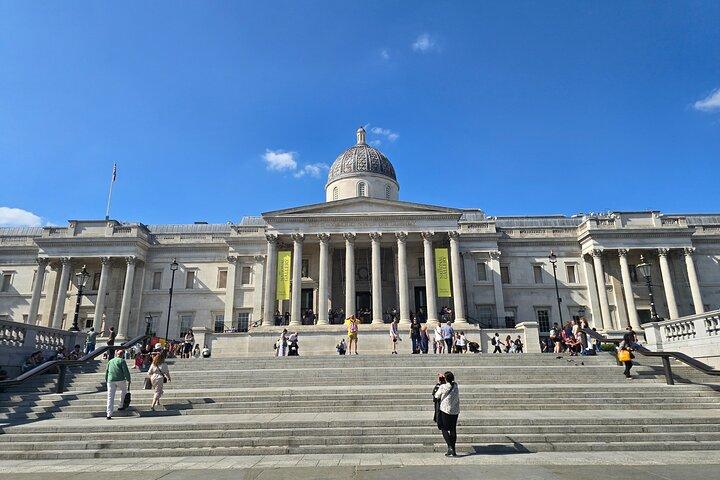 ガイド付きナショナルギャラリーツアー(優先入場付き) ガイド付きナショナルギャラリーツアー(優先入場付き) | 2 時間 | 5.0 (50) | $24 | 見る |
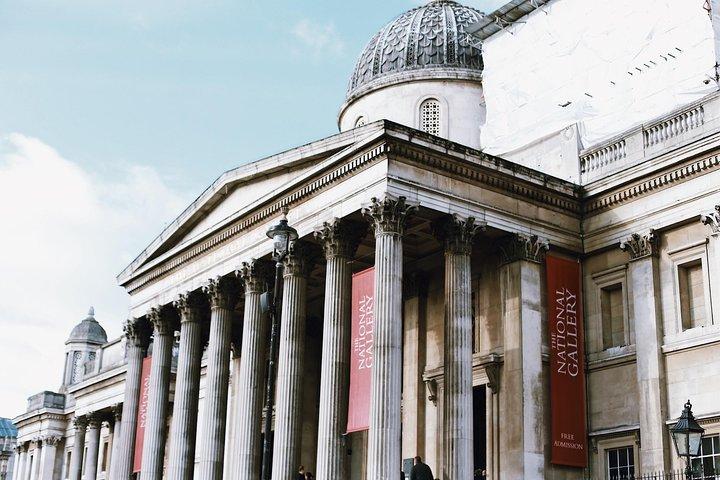 ロンドン ナショナル ギャラリー - 限定ガイド付きミュージアム ツアー ロンドン ナショナル ギャラリー - 限定ガイド付きミュージアム ツアー | 2h 30分 | 5.0 (118) | $120 | 見る |
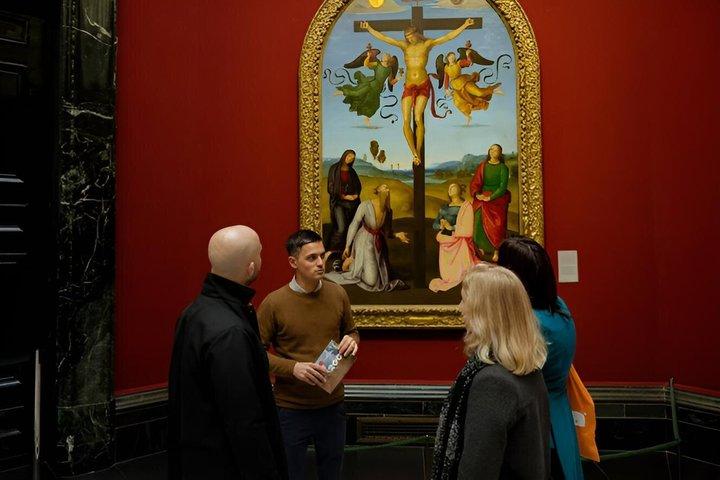 ナショナルギャラリーのプライベートガイドツアー-ファストトラックチケット ナショナルギャラリーのプライベートガイドツアー-ファストトラックチケット | 2 時間 | 5.0 (58) | $190 | 見る |
 大英博物館&ロンドン・ナショナル・ギャラリー セミプライベート 8ppl Max 大英博物館&ロンドン・ナショナル・ギャラリー セミプライベート 8ppl Max | 5h 30分 | 5.0 (204) | $246 | 見る |
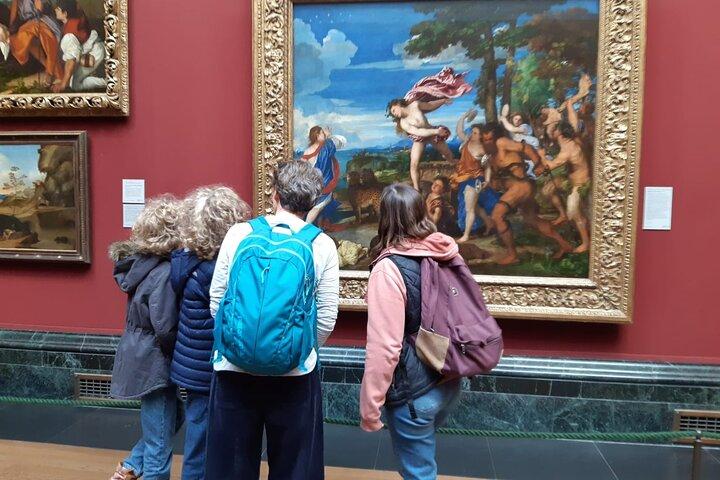 ナショナルギャラリーオブロンドン子供と家族のためのガイドツアー ナショナルギャラリーオブロンドン子供と家族のためのガイドツアー | 2h–2h 30分 | 5.0 (4) | $258 | 見る |
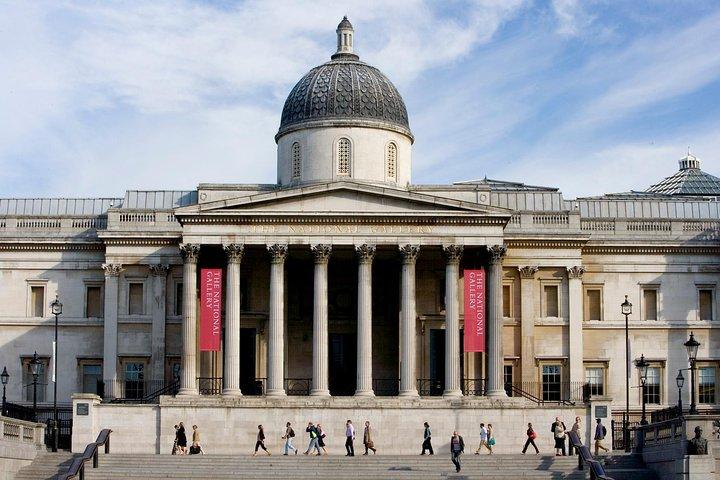 ロンドン ナショナル ギャラリー プライベート ガイド付きツアー - 3 時間 ロンドン ナショナル ギャラリー プライベート ガイド付きツアー - 3 時間 | 3 時間 | 5.0 (22) | $264 | 見る |
料金$27
4.6(166) 無料キャンセル