Private Santa Barbara History and Architecture Walking Tour


Description
When you come on a tour with me, I can show you the must see sites, as well as some out-of-the-way architectural gems that only a local like me knows about. I have researched local history quite extensively and am very knowledgeable. What makes this tour unique is my in-depth understanding of local history, lore, and architecture, and my abilities to answer whatever questions you might have, as well as to show you the hidden places that aren’t listed in every guidebook. We can arrange beforehand to focus on what you find most interesting: Architecture? History? Adobe construction? Fabulous views? Gardens (Santa Barbara has one of the largest varieties of trees in its downtown area of any city in the country!)? Perhaps a combination of them all! I can cater to whatever interests you have!
Tour Options
Itinerary
Here, guests will admire one of the oldest structures in California. Built in 1782 of Adobe brick, the Presidio includes original rooms, soldiers gardens, a chapel, and re-creations of everyday objects of the 18th century. Guests will learn how the buildings were constructed only from materials of the surrounding countryside, and get a chance to imagine life in the far-reaches of the once great Spanish Empire.
We will pass by the Rochin Adobe, built in 1856 by a descendant of Captain Francisco Ortega, first Comandante of the Presidio, using adobe bricks salvaged from the almost destroyed fort. Circa 1900, it was covered in wooden clapboard, as it remains today.
Constructed in 1964 of Adobe brick, the museum is a classic example of early California-style architecture. The museum contains many excellent exhibits on local history, including painting and a collection of etchings. The courtyard also features two adobe structures dating from 1817 and a gift shop, and is an excellent spot for pictures. Guests can enter to explore the exhibits if they choose.
The Lugo adobe and Meridian studios. The picturesque studios, designed by famous architect George Washington Smith, were completed in 1925. Here, guests can admire the unique pastel-colored stucco walls and large glass windows of the studios, as well as an ancient wisteria vine, covered in purple flowers in spring. In the back of the studios lies a hidden gem: the Lugo Adobe. Built by a retired Presidio soldier in the early 19th century, the adobe has been well-preserved and remodelled. Due to its secluded location, it is seldom frequented by tourists.
Taking its name after the Presidio, to which it is immediately adjacent, this beautiful building was constructed in 1945, but incorporates two original Mexican-period adobes, as well as the 1906 Nardi Hotel. Behind the building there is a hidden courtyard and garden, and Presidio St., technically Santa Barbara’s earliest city street, as it was once part of the path that ran from the waterfront to the Presidio, and on to the Mission.
These Adobes, which line this section of E. De La Guerra St., were built in 1849 by Jose de la Guerra, fifth Comandante of the Santa Barbara Presidio. They are a perfect example or original Mexican-Californio architecture. They were later sold to Gaspar Orena. His descendants still own these structures today!
Constructed before the 1925 earthquake, in 1923, Santa Barbara’s City Hall is an early monument to the Spanish Colonial Revival movement. The building is decorated with hand-painted tiles, and has arches which extend over the sidewalk. In front, there is a large California Pepper Tree, which is a city landmark. City Hall, along with Casa de la Guerra and the News-Press Building, face Plaza de la Guerra, the ceremonial heart of the city.
Constructed in 1819 by Don Jose de la Guerra, fifth Comandante of the Presidio, as both a mansion for his family and a center for his business, this adobe remains just as impressive as it did back in the day. It was a center of cultural and political activities, back when Santa Barbara was simply a few adobes grouped around the Presidio. Today, it remains a centerpiece of the town, hosting the Fiesta celebrations each summer. It is open for visitors on the weekends.
The construction of El Paseo, from 1922-29, was the first major step in converting the architecture of Santa Barbara from Eastern US main street to Hispanic Pueblo. We will wander through the quaint passageways, visit the romantic courtyard, and meander down the famous “Street in Spain,” before emerging onto State St. proper. Great spot for pictures.
As we stroll up State St., the principal avenue of Santa Barbara, will will enter the pleasant courtyards of the La Arcada building. This tiled paseo wanders past quaint shops and restaurants through the center of the block, which will lead us to the Santa Barbara County Courthouse. On the way, enjoy the quirky bronze statues, second-story arches bridges, and fountain filled with live turtles!
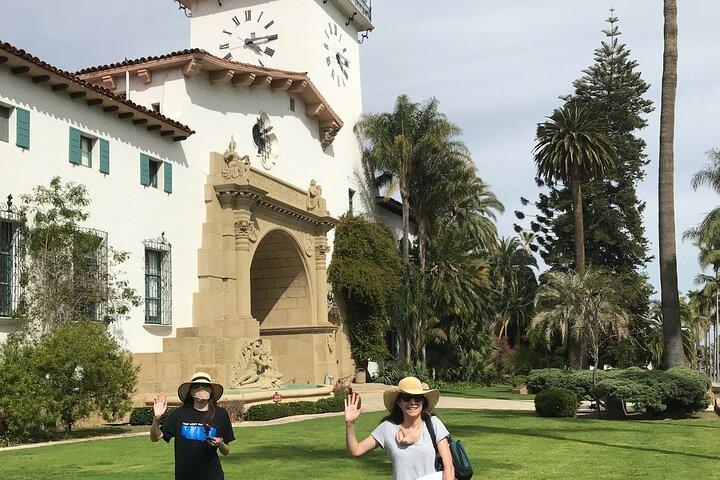
The beauty and architectural significance of this building cannot be overstated. The most important 20th century building in all of Santa Barbara, it is only second to the Mission in significance, and can be considered the public monument to the Spanish Colonial Revival movement in the United States. We will observe all the wonders the courthouse has to offer, from the great Roman triumphal arch flanked by stone statues on its front facade, to its hand-carved column capitals and painted tiles throughout. Once restrictions ease, we will journey inside, visit the stunning mural room, and climb the stairs or take the elevator up the clock tower for a 360 degree view of the entire town!
With different parts of the structure dating from 1917, 1925, and 1930, the Santa Barbara Public Library is an impressive structure, directly across the street from the courthouse. As we walk down Anapamu St, we can admire the detailed stone sculptures which surround the main doorways.
The Granada Theatre stands out as a city landmark for many reasons; for one, it is the tallest building in the entire city of Santa Barbara, built in 1924 before the 60ft height ordinance. Additionally, its upper floors are decorated in stunning glazed terra cotta. Hopefully, after restrictions ease, we will be able to journey inside once more to marvel at the wonderfully restored theatre space.
Another architectural marvel of downtown Santa Barbara, the Arligton theatre, with its tower that shoots above the surrounding skyline, and arched paseo at ground level, is a pleasant place to sit in the shade. Inside the building, the theatre space itself is rather stunning: it was built to feel like the town square of a Spanish Village. Lined with fake, 3-dimensional building facades, and with a vaulted roof painted with stars, this effect is achieved quite well.
Set out in 1850 for public space, the Alameda parks of today still play a central role to downtown life, hosting events during the Summer Solstice and Earth Day celebrations annually. Planted with a variety of trees brought from abroad, from redwoods to East African Fern Pines. One of the blocks contains a bandstand from the 1880’s, while the other contains an extensive playground dubbed “Kids’ World.” The third block of parks was once home to the internationally famous Mirasol Hotel, but, after the building was badly damaged in a fire in 1966, the entire space was converted into a stunning botanical garden, replete with a duck pond and rare flowering trees.
Once home to the famous El Mirasol Hotel, this entire square block is now a stunning garden home to a butterfly meadow that attracts monarchs, a running creek with stepping stones, and a massive Australian Fig tree that provides a shady area overlooking a duck pond with live turtles!
A fascinating blend of Streamline Moderne and Spanish elements, the Santa Barbara Post Office is a fun building to see. The building incorporates sculptures, both within and without.
We will end our tour at El Cuartel, across the street from where we began. This small structure was once a part of the Presidio complex, and is the oldest building in town, constructed in 1788. Here, you can wander inside the rooms and back garden, to see a relatively unchanged 18th-century structure, and imagine what life was like back then.
Built in 1924 by esteemed architect George Washington Smith, the Lobero Theatre is an important city landmark. This site has operated as a theatrical space since 1873, when Italian immigrant Jose Lobero opened Southern California’s first opera house here. If restrictions ease, we can go inside and admire the painted vaulted ceiling.
Highlights
What's included
Traveller Ratings
Important Information
- Wheelchair accessible
- Infants and small children can ride in a pram or stroller
- Service animals allowed
- Public transportation options are available nearby
- Transportation options are wheelchair accessible
- Not recommended for travelers with spinal injuries
- Not recommended for travelers with poor cardiovascular health
- Suitable for all physical fitness levels
Reviews(61)
We had an excellent walking tour of Santa Barbara's historical architecture, with stories of the city's colorful past, and enjoyed the beautiful old mission, the County Courthouse, and fun buildings all around the Funk Zone, by the downtown area, and more! Sully, our guide, kept us laughing and learning, finding how the spirit of Santa Barbara is as beautiful and varied as we had hoped! We recommend this as a low impact walking tour, easily managed by us 70 year olds, and fun!
Sully is incredible!! We organized a tour for a company retreat and it was truly the highlight of our week. He has a wealth of knowledge and passion for the city that that keeps you engaged throughout and he leaves no question unanswered. Would highly recommend Sully for your SB adventures!
Tour was very informative and enjoyable, and went at a comfortable pace. If you want to know about the history of Santa Barbara, this is the tour for you.
Sully is knowledgeable and interesting who has skills in describing the history of the area with enthusiasm
Sully is well informed, communicates very well, and provides Santa Barbara area history in a clear engaging manner. His presentation is not reciting a memorized script that others use. Sully clearly loves Santa Barbara, its history and current strengths and challenges. He’s the best choice-don’t choose day other tour!
Sully leads a wonderful tour of Santa Barbara. His expansive knowledge of California and Santa Barbara history is astounding, and his enthusiasm and passion for this history keeps you engaged and amazed. We saw some hidden away architectural elements of Santa Barbara that are so beautiful, as well as the fantastic major architectural elements of the city. Sully’s insights added so much and he helped us see details that we would never have known. We highly recommend.
We had an outstanding walking tour of Santa Barbara with Sully. The experience was part architectural exploration, part history lesson, and fully engaging from start to finish. The tour is exceptionally well-researched, and Sully shared countless fascinating anecdotes that brought the city’s past to life. As a native Santa Barbaran, he answered all of our questions—not just about the buildings and landmarks we encountered, but also about the city’s culture, fun facts, and lesser-known stories. His depth of knowledge and warm, approachable style made the entire experience both entertaining and informative. A major highlight was walking up the Santa Barbara Courthouse tower to take in the panoramic views of the city—truly spectacular and something we wouldn’t have appreciated as much without Sully’s context. If you want to learn about the history of Santa Barbara, this tour is a must. We thoroughly enjoyed our time with Sully and highly recommend his tour to anyone visiting the area. We hope to be back in Santa Barbara soon and would love to join another one of his tours focusing on a different neighborhood or another facet of the city’s rich history. Highly recommended!
Sully is a young man with incredible knowledge about the history of Santa Barbara. I would put him up against old timers and historians a like. He has studied antique books and consulted professionals. He is engaging and genuinely loves sharing the interesting details and stories that have shaped Santa Barbara’s past. We loved our time with him and learned so much. I kind of wish he had had a hand-out to share with us at the end. He covered a lot of great info I want to remember. Sully’s passion is Santa Barbara, it’s past and its future… It was a pleasure meeting you. Thanks for a wonderful tour!
This was an excellent tour. Sully was extremely informative about the history of Santa Barbara and his architectural knowledge was amazing. This is an excellent way to learn about Santa Barbara and I would highly recommend this tour!
This was a very interesting and informative tour. Sully knows everything about the history and architecture of Santa Barbara. We saw sites we would never have come across on our own.