Perugia Walking Tour with Audio and Written Guide by a local


Description
If you're looking for a fun and curious way to visit Perugia, you've come to the right place! With this digital guide created with the support of a local, you will be able to visit all the most important monuments at your own pace. You'll get to know the stories and curiosities of Perugia! But also you will discover everything about local foods, Italian Aperitivo in authentic local restaurants, and much more!
Tour Options
Itinerary
The Etruscan Arch, or better defined as the Monumental Etruscan Gate, was probably built in the 3rd century BC and is located on the north side of the ancient city walls of Perugia that extend for 3 kilometers. The two main gates were the Etruscan Arch, or Arch of Augustus, to the north, and Porta Marzia to the south, which I will tell you about later.
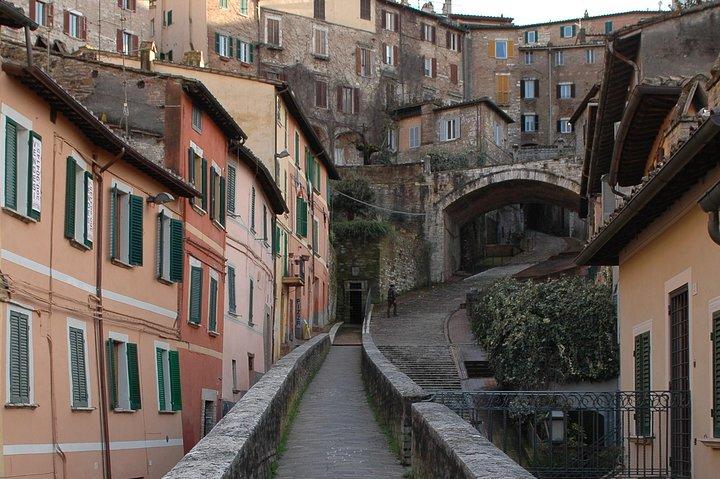
The construction of the aqueduct, which extends for about 4 km, began in 1254 with the aim of transporting water from Monte Pacciano to the Fontana Maggiore, which I will tell you about later.
The Etruscan Well, located in the historic center of Perugia in the basement of Palazzo Sorbello, was built in the second half of the 16th century and acquired by the Bourbon di Sorbello family in 1780. The palace is currently still owned by their descendants.
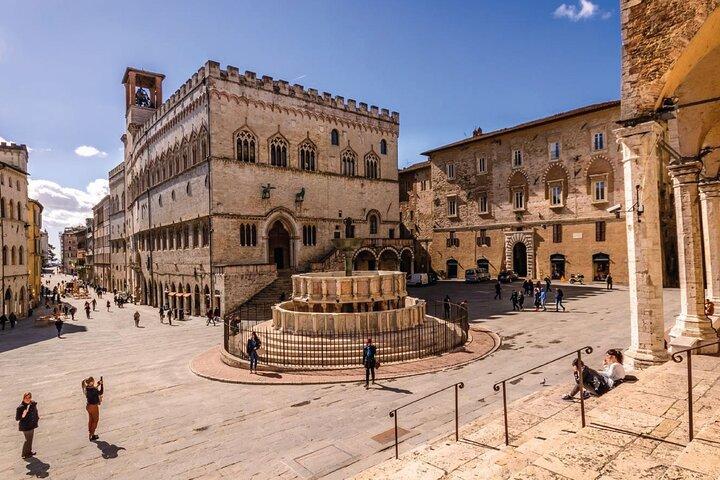
Piazza IV Novembre represents the true heart of the city: a symbolic and cultural place that has been at the center of political and religious life for centuries. Significant events take place here, such as Umbria Jazz concerts, Eurochocolate stands and conferences during the International Journalism Festival, which hosts important Italian and international journalists.
The majestic Cathedral of San Lorenzo stands on the site of a previous 12th-century Romanesque church, which in turn occupied an area of the ancient Etruscan and Roman acropolis, now underground. Let's discover this amazing church!
Braccio Fortebracci da Montone was a skilled and determined leader who managed to expand his dominion over a vast area of central Italy, pushing as far north as Bologna, and in 1416 he obtained control of Perugia after defeating Carlo I Malatesta, chosen by the Church as “Defender of Perugia”. In 1423, a year before his death, Braccio commissioned the Bolognese architect Fioravante to create a loggia overlooking Piazza IV Novembre and including a staircase leading to his stately residence.
Corso Vannucci is the central avenue of Perugia and represents the historical and cultural soul of the city. Named after the great Renaissance painter Pietro Vannucci, known as Perugino, the avenue crosses the historic center and connects Piazza Italia to Piazza IV Novembre.
Rocca Paolina is a historic 16th-century papal fortress. Built by order of Pope Paul III Farnese between 1540 and 1543, the Rocca Paolina represented the papal dominion over Perugia, consolidated after the victorious “Salt War” against the people of Perugia. Designed by the military architect Antonio da Sangallo the Younger, the construction of the fortress entailed the demolition of about a quarter of the city. The structure was divided into two complexes: a larger fortress on the Landone hill and a smaller one, called “Tenaglia”, located lower down and connected to the first by three fortified passages.
The Belvedere del Borgobello is one of the most fascinating panoramic points of Perugia. From here you can admire the buildings, the historic center and the typical Umbrian landscape. It is also a meeting place for young people and families, a typical meeting place for the locals.
Highlights
What's included
Traveller Ratings
Important Information
- Wheelchair accessible
- Infants and small children can ride in a pram or stroller
- Service animals allowed
- Public transportation options are available nearby
- Suitable for all physical fitness levels
- You will need a smartphone with internet connection to use the digital guide (details to activate the digital guide will be in your voucher, read it carefully!)
- You'll be able to hear the audio through your speakers or, if you have them, through your headphones
Reviews(45)
Grest tour, lots of interesting facts. Suoer to have audio, the transcriotion and photos.
The plus? Observing places and monuments while listening to explanations, without having to read them!
Excellent walking tour. Very easy to use, took us to places we would have missed. Will definitely use again
Absolutely fantastic. Great value and very entertaining and informative.
You can pause the tour and resume it afterwards. You can go back on it. Very convenient. Saves money, flexible on time.
It makes such a difference to know a bit of a history and more details about the most important and interesting places in a new city and this guide provided exactly what we needed! It was easy to follow, the option to either listen or read the information was really helpful, the map integrated with Google Maps made it all so easy! We loved it and I highly advise whoever missed the Free walking tour option to come and pick that guide - it is practically the same but with your own pace and without the crowds!
Easy to use and just the right amount of information. Would recommend!
The walk was fine for those short of time and the information provided was very detailed and interesting; more than signs that you can read at each site.
The walking tour helped us to be organized so that all the important information we wished to gather was accomplished. A great tool for all
Very well prepared, can be used as preparation for the visit, during the stay and afterwards.