Arashiyama Bamboo Forest & Sagano Tour with Licensed Guide
Description
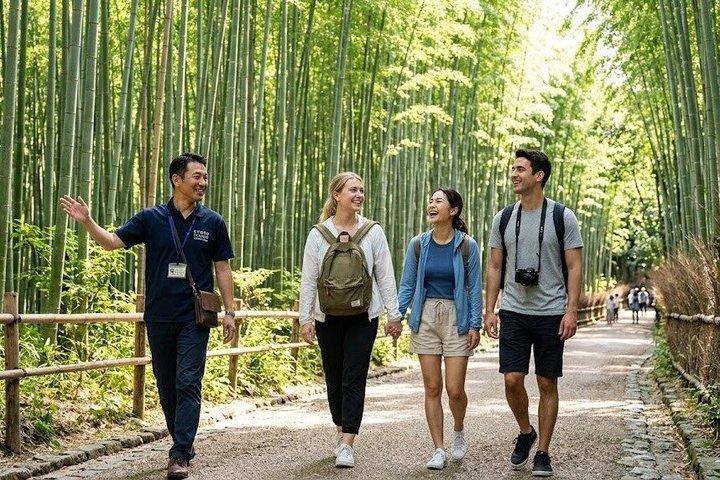
Accompanied by a government-licensed and experienced multilingual guide, explore the area of Arashiyama and Sagano, where aristocrats once unwound in their villas more than 1,000 years ago. The highlights of this tour include the scenic countryside views from Togetsukyo bridge; Tenryu-ji temple with its beautiful traditional gardens; the enchanting world from within the Bamboo Grove; and Jojakko-ji Temple with its breathtaking green moss. During the tour you will also visit some secret spots unfamiliar to the usual tourists. Enjoy the walk and delicious food while learning about Japanese culture and history. Our guides are looking forward to arranging a tour that’s best for you! Note*1: Please select your must-see spots from a list in the tour information to create your customized itinerary. Note*2: The National Government Licensed Guide Interpreter certification is issued by the Japanese government requires a good knowledge and understanding of Japanese culture and history.
Tour Options
Itinerary
Arashiyama (嵐山) is a pleasant, touristy district in the western outskirts of Kyoto. The area has been a popular destination since the Heian Period (794-1185), when nobles would enjoy its natural setting. Arashiyama is particularly popular during the cherry blossom and fall color seasons. The Togetsukyo Bridge is Arashiyama's well known, central landmark. Many small shops, restaurants and other attractions are found nearby, including Tenryuji Temple, Arashiyama's famous bamboo groves and pleasure boats that are available for rent on the river.
The Togetsukyo Bridge (lit. "Moon Crossing Bridge") is Arashiyama's most iconic landmark. It was originally built during the Heian Period (794-1185) and most recently reconstructed in the 1930s. The bridge looks particularly attractive in combination with the forested mountainside in the background. A riverside park with dozens of cherry trees is located just adjacent to the bridge.
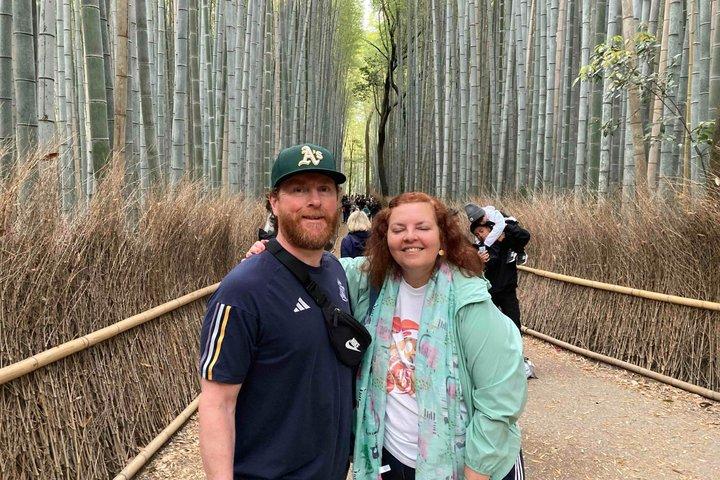
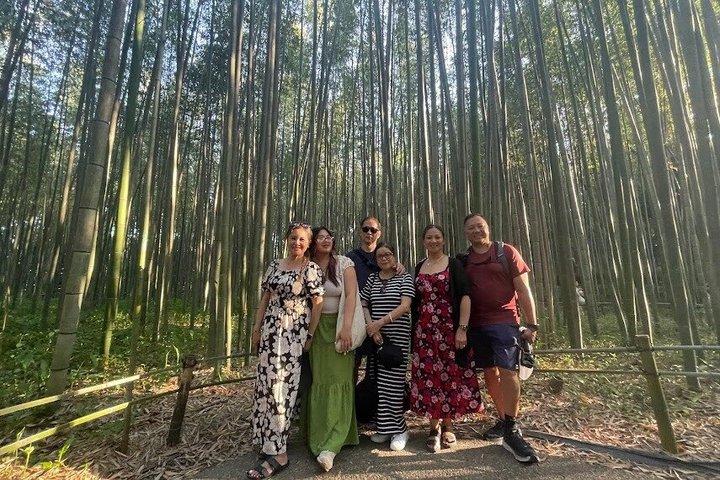
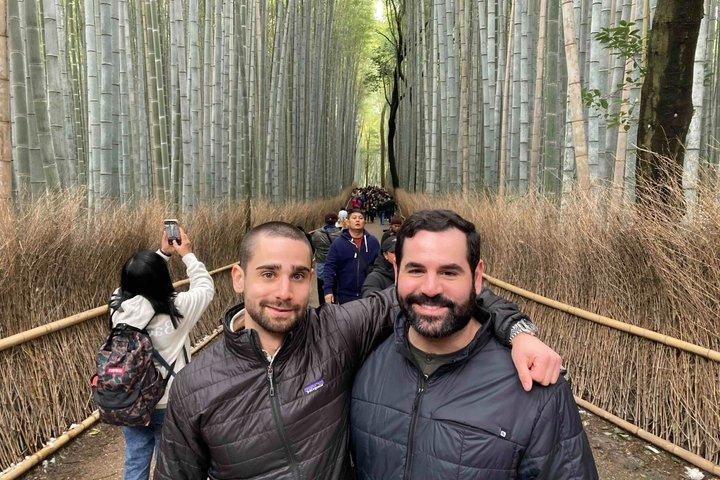
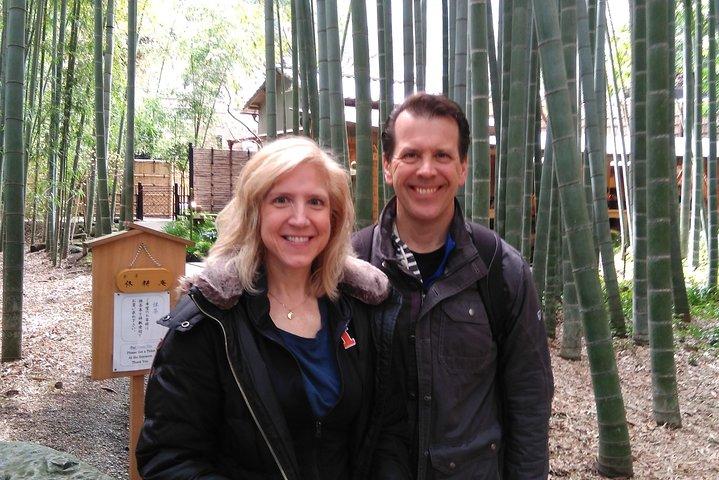
The walking paths that cut through the bamboo groves make for a nice walk or bicycle ride. The groves are particularly attractive when there is a light wind and the tall bamboo stalks sway gently back and forth. The bamboo has been used to manufacture various products, such as baskets, cups, boxes and mats at local workshops for centuries.
Shugakuin Imperial Villa (修学院離宮, Shugakuin Rikyū) was built in the 17th century by Emperor Gomizuno and is now managed by the Imperial Household Agency. It consists of the Upper, Middle and Lower Villa areas, each featuring gardens and buildings of the traditional imperial style. Shugakuin's name comes from a former temple built on the same site in the tenth century. The Imperial Villa was constructed between 1655 and 1659, with a palace for Gomizuno's daughter added ten years later. More recently in 1964, the surrounding farmlands were bought by the Imperial Household Agency. They are leased out to local farmers who continue to work the fields.
Katsura Imperial Villa (桂離宮, Katsura Rikyū) is one of the finest examples of Japanese architecture and garden design. The villa and garden in their present form were completed in 1645 as the residence for the Katsura Family, members of Japan's Imperial Family. Visiting Katsura Imperial Villa requires joining a tour. The tour follows the garden's circular walking trail around the central pond. Palace buildings can be viewed only from the outside, and photographing is allowed only from designated spots. Tours in English are available.
Kurama (鞍馬) is a rural town in the northern mountains of Kyoto City, less than one hour from the city center. Kurama is best known for its temple Kurama-dera and its hot spring, one of the most easily accessible hot springs from Kyoto. Outdoor and indoor baths can be enjoyed at Kurama Onsen, a ryokan located at the upper end of the town of Kurama. It can be reached in a 10 minute walk from the train station along the town's only road or along a nature trail following the river. Staying guests can use the baths for free, while daytrippers pay 2500 yen(Weekday), 2700 yen(Weekend) to use all of the baths or 1400 yen(Weekday), 1600 yen(Weekend) for just the outdoor bath (rotemburo).
Yoshiminedera (吉峰寺) is a temple of the Tendai sect of Japanese Buddhism located in Kyoto's western mountains. Similar to Kiyomizudera on the opposite side of town, Yoshiminedera is built along the mountain side and looks out onto Kyoto. The temple grounds are spacious and there are many buildings distributed up the mountain side. A priest from Enryakuji, named Gesan, established Yoshiminedera as a personal retreat in 1029. In 1467 the temple was destroyed in the Onin War but was rebuilt in 1621. The temple's main objects of worship are a Kannon statue carved by Gesan and a Kannon statue given to the temple by Emperor Gosuzaku in 1042.
Daikakuji (大覚寺) is a large temple in the northern part of Kyoto's Sagano district. It was originally built in the early 800s as the detached palace of Emperor Saga, who thoroughly enjoyed spending time in this calm area on the outskirts of Kyoto. Thirty years after the emperor's death, the palace was converted into a temple and has since been one of the highest ranked temples of Shingon Buddhism. Daikakuji has had a role in several significant historical events. A succession of retired emperors reigned from here, and in the 12th century the temple hosted peace talks that reunited the Northern and Southern Imperial Courts after 50 years of civil war. Daikakuji is also featured in the Tale of Genji, the first novel in Japanese literature. Today, the temple is one of the best places to still feel the ancient court atmosphere described in the novel and is often used for filming historical dramas.
Daikakuji is a temple of the Shingon sect of Japanese Buddhism. Formerly the residence of an emperor, the buildings were converted into a temple in 876. During its history the temple traditionally had members of the imperial family serve as the head priest. Beside the main temple buildings there is a large pond and a pagoda.
This is the former villa of the popular actor Okochi Denjiro (1896-1962), located in the back of Arashiyama's bamboo groves. Okochi Sanso consists of several different gardens and buildings, including living quarters, tea houses and gates. The buildings can only be viewed from the outside.
Ranked among Kyoto's five great Zen temples, Tenryuji is the largest and most impressive temple in Arashiyama. Founded in 1339 at the beginning of the Muromachi Period (1338-1573), the temple is one of Kyoto's many UNESCO World Heritage Sites. In addition to its temple buildings, there are attractive gardens with walking paths.
Katsura Imperial Villa (桂離宮, Katsura Rikyū) is one of the finest examples of Japanese architecture and garden design. The villa and garden in their present form were completed in 1645 as the residence for the Katsura Family, members of Japan's Imperial Family. Visiting Katsura Imperial Villa requires joining a tour. The tour follows the garden's circular walking trail around the central pond. Palace buildings can be viewed only from the outside, and photographing is allowed only from designated spots. Tours in English are available.
This mountainside temple was founded in 1596. With small, attractive buildings and gates, the temple has a quiet and understated atmosphere. Maple trees and moss are located just beside the paths and stairs that lead across the temple grounds. From a number of spots, visitors can enjoy views over Kyoto.
Similar to Jojakkoji, Nisonin Temple is a hillside temple with slightly larger and imposing buildings. A generally understated atmosphere on the temple grounds is partly due to the overhanging trees along approach. Founded in the mid 9th century, Nisonin is a temple of the Tendai sect. There are views over the city from the upper grounds.
Gioji is even more nestled into the forest than Jojakkoji and Nisonin. It is known for its moss garden that is punctuated with tall maple trees. The temple's entrance gate and small main hall have thatched roofs. The latter has an attractive round window looking into the gardens.
Adashino Nenbutsuji is located at the end of the Saga-Toriimoto Preserved Street. The temple was founded in the early 9th century when the famous monk Kobo Daishi placed stone statues for the souls of the dead here. Today, the temple grounds are covered by hundreds of such stone statues. In the back of the temple, a short path leads through a bamboo forest.
Another ten minute walk north of the similarly named Adashino Nenbutsuji, the Otagi Nenbutsuji Temple is famous for its 1200 stone statues of rakan, devoted followers of Buddhism, each with a different facial expression. Created relatively recently in the 1980s and early 1990s, the many statues stand across the temple grounds which cover part of a forested mountain slope.
Kibune (貴船) is a small town in a forested valley in the northern mountains of Kyoto City, which developed around Kifune Shrine. According to legend, a goddess traveled in a boat from Osaka all the way up the river into the mountains north of Kyoto, and Kifune Shrine was built at the site where her boat journey had come to an end. Kifune Shrine is dedicated to the god of water and rain and believed to be the protector of those at sea. Here you can obtain a unique type of fortune written on paper slips (omikuji) that reveal their messages when dipped into water. Okunomiya, the inner sanctum and original site of Kifune Shrine, lies about one kilometer further up the valley. It has a large rock, known as the boat stone, which is said to be where the goddess' yellow boat is buried.
Highlights
What's included
Pickup Locations & Times
This private tour is a walking day tour. A private vehicle is not included. Public transportation or local taxis maybe used to transfer between sites. Exact transportation costs can be discussed with the guide after a reservation is finalized. Please have Japanese Yen on hand for your transportation costs. If you wish to arrange for a private vehicle, please contact us directly. All Private vehicles must be booked 2 days in advance. Maximum number of passengers: 7.
Traveller Ratings
Important Information
- Specialized infant seats are available
- Service animals allowed
- Public transportation options are available nearby
- Infants and small children can ride in a pram or stroller
- All areas and surfaces are wheelchair accessible
- Transportation options are wheelchair accessible
- Suitable for all physical fitness levels
- Wheelchair accessible
Reviews(57)
We had a great day with Kazu touring Arishiyama. Kazu is extremely knowledgeable and provided an excellent overview of Kyoto history. The day was well planned and we got a full perspective on each site was visited. Kazu speaks excellent English and is a friendly and interesting guide. We highly recommend him with 5 stars.
Thank you so much for joining me on the Kyoto tour the other day with a great review. As your tour guide, nothing would bring me more joy than for you to enjoy yourself here in Kyoto & Japan with tons of wonderful memories on way back home. Again, congratulations for your special celebrations!! Best wishes Dear families for the future. - Kazu Akiyama
We were met by Yuka at our hotel. She was very personable and professional. She explained where we were going and how to get there. She had great knowledge and explained what we were seeing.. At the end of the tour, there was still more time. She offered to take us to the market which was a couple of kilometres from the Golden Temple where we were. She took us to the market, and showed us how to get back to our hotel. Really enjoyed the market.
Hi! Thank you for your beautiful comments! I'm really happy to know that you enjoyed the tour with me. Thanks for your help, I felt really relaxed and did my responsibility as much as I could. Holding a coala in my arms...This is in my bucket list. When my time has come, I'll surely let you know! See you again in your beautiful country:) - Yuka
Our tour Arashiyama park was fabulous! Our guide Kazuo S. was knowledgeable, passionate about Japan’s culture and history, friendly and very flexible with a good command of English language. Kazuo organized everything and made out tour relaxing and enjoyable; he showed us not only places in itinerary but also some unique and hidden Arashiyama jams and treasures. It was an amazing day! We highly recommend this tour and our guide to people who want to know more about Japan.
Thank you for your having sent me such a nice review for the tour. I really appreciate your great cooperation with me during the tour. You walked a lot in Arashiyama and Sagano Area. I hope it had become your wonderful experience in Kyoto, Japan. Please come to Japan again in the near future to enjoy our country and culture. Thank you again, Kazuo Sumi
Tom was our guide. He spoke fluent English and was able to communicate enough with the Japanese locals at all the stops. He is very knowledgeable about all the sites we visited and was able to answer the questions we peppered his way. The tour felt thorough and unrushed.
We really enjoyed our guided tour with Kazuo, he was very helpful and knowledgeable. We covered the following areas within the 6 hours of our tour. - Arashiyama bamboo forest - Okochi Sanso garden / villa - Otagi / Adashino / Gioji / Tenryu-ji temples - Togetsukyo bridge - Walking through Sagano area
Thank you for your having sent such a great review on our tour. I appreciate your kindness and cooperation with me. Especially both of you walked a lot. I’m very happy to hear that you enjoyed walking. I hope you will come to Japan to learn more about our culture and traditions soon in the near future. Thank you again, Kazuo Sumi
Nabet is truly wonderful. He did a great job making sure we saw all the important things, gave detailed and interesting information on each place, and key us on pace! He’s GREAT!
Thank you so much for your wonderful review! I’m delighted that you were satisfied with my tour in my hometown Kyoto. Kyoto has so much more to offer, so I hope you’ll visit again in another season to enjoy its changing scenery. Warmest regards, Nabet
Nabet was the best!!! He clearly knows and loves Kyoto. Perfect itinerary and kept us on pace to see everything. Thank you!
Thank you so much for your wonderful review! I’m delighted that you were satisfied with my tour in my hometown Kyoto. Kyoto has so much more to offer, so I hope you’ll visit again in another season to enjoy its changing scenery. Warmest regards, Nabet
Had a wonderful time with Michi san. He’s very knowledgeable and flexible. Visiting the Shugakuin Imperial Villa was a unique experience. We had excellent views of Arashyama, slightly away from the crowds. I took many beautiful photos.
Thank you for your kind message. I am glad that you could take many photos . There are many photogenic places in Kyoto and depending on the season you can take different photos in the same place. Thanks again for your heart-warming message Best Regards - Michi
You need a knowledgeable guide to get the most out of the experience. Arashiyama is so much more than a pretty backdrop for photos. So much history & culture
We appreciate your kind feedback and our guides do too! We are very happy to hear that you enjoyed the tour with your guide. We look forward to your next visit to Japan! Japan Guide Agency
We had a great tour of the Kyoto monkey park and bamboo forest. Our guide Michi was terrific. He made the tour both fun and educational for our entire family. He also showed us many other sites in the Arashimaya area that were interesting and very pretty. We cannot say enough great things about Michi.
Thank you for your kind message. I could also enjoy the tour with you and your family, although it was a bit hot. Thanks again for your heart-warming message. Please take care! Best Regards Michi