Jewish Quarter and Trastevere District Private Walking Tour
Description
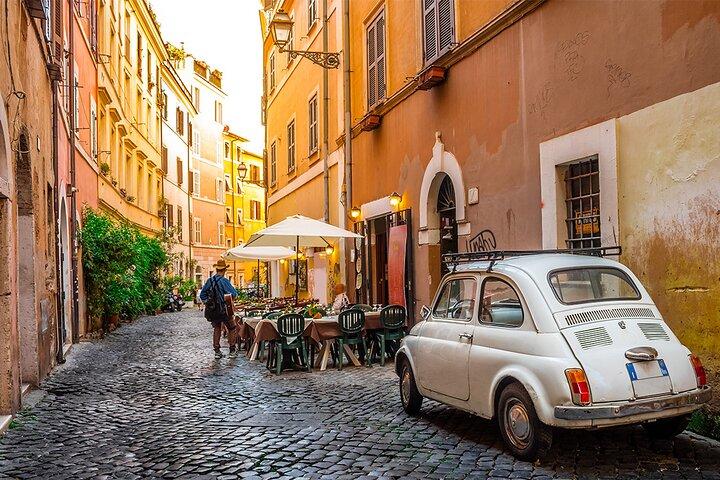
Rome's Jewish cultural heritage is extremely rich. In the Jewish district, the so-called "Ghetto" we will see the huge impact that the Jewish community has had on the cultural identity of the city, from the architecture to the culinary traditions. Once we have finished our stroll from the Theatre of Marcellus and the Synagogue to the Portico di Ottavia we will walk to the Tiber Island, once the sight of the Temple of Aesculapius. Finally I will take you to visit the medieval Trastevere district, with its narrow cobblestone alleys, restaurants, cafes and artisan shops, charming area for people who are looking for a taste of the "authentic" Rome. The Basilica of Santa Maria in Trastevere, one of the oldest churches in Rome, resplendent with magnificent medieval mosaics inside and outside, is the heart of the area. Rome is a city where history does come alive, every street corner has its particular stories and by telling these stories, I will take you to discover the Eternal City!
Tour Options
Itinerary
Theatre of Marcellus (outside) The Theatre of Marcellus (Latin: Theatrum Marcelli, Italian: Teatro di Marcello) is an ancient open-air theatre in Rome, Italy, built in the closing years of the Roman Republic. At the theatre, locals and visitors alike were able to watch performances of drama and song. Today its ancient edifice in the rione of Sant'Angelo, Rome, once again provides one of the city's many popular spectacles or tourist sites. Space for the theatre was cleared by Julius Caesar, who was murdered before its construction could begin; the theatre was advanced enough by 17 BC that part of the celebration of the ludi saeculares took place within the theatre; it was completed in 13 BC and formally inaugurated in 12 BC by Augustus,[1] named after his nephew Marcus Claudius Marcellus who had died in 23 BC.
Piazza Mattei In the centre of the small square is one of the most beautiful fountains in Rome: the Fountain of Turtles, built in the second half of the 16th century to a design by Giacomo Della Porta and with bronze sculptures by Taddeo Landini. In the centre of the basin at ground level, a decorated pedestal supports four African marble shells that receive water from dolphins, on which four Ephebians rest their feet in the act of pushing four turtles towards the edge of the marble basin. The turtles, probably added by Gian Lorenzo Bernini in 1658 following the restoration carried out on the fountain at the time of Pope Alexander VII Chigi (1655-1667), were the object of repeated thefts as in 1906, 1944 and, recently, 1981. The turtles currently visible are copies of the originals preserved, in number of three surviving specimens, in the Capitoline Museums.
Portico di Ottavia The Porticus Octaviae (Portico of Octavia; Italian: Portico di Ottavia) is an ancient structure in Rome. The colonnaded walks of the portico enclosed the temples of Jupiter Stator and Juno Regina, as well as a library. The structure was used as a fish market from the medieval period up to the end of 19th century.
Synagogue (outside) Designed by Vincenzo Costa and Osvaldo Armanni, the synagogue was built from 1901 to 1904 on the banks of the Tiber, overlooking the former ghetto. It contains elements of Assyrian-Babylonian, Egyptian and Greco-Roman architecture. The interior of the synagogue is lavishly decorated in the Art Nouveau style.
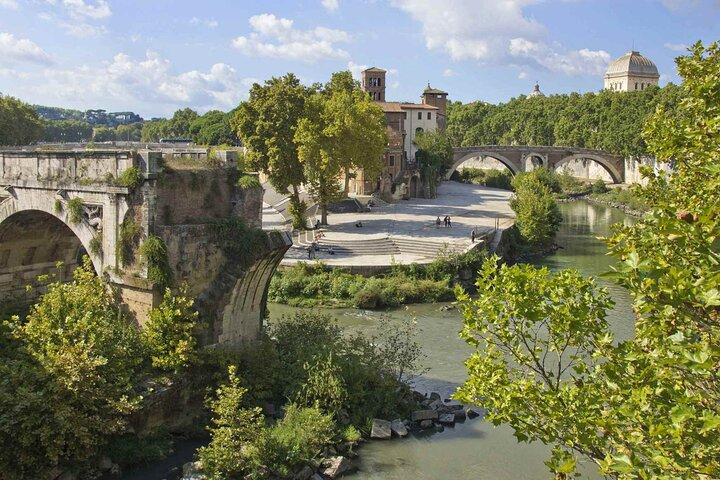
Ponte Rotto It is commonly known as Ponte Rotto (Broken Bridge) but the great arch with a decadent and poetic aspect that emerges from the waters of the Tiber, not far from the Tiber Island, is actually what remains of the ancient Pons Aemilius, made of wood in the 2nd century BC and reconstructed of stone a century later.
Ponte Fabricio The Pons Fabricius (Italian: Ponte Fabricio, "Fabrician Bridge") or Ponte dei Quattro Capi, is the oldest Roman bridge in Rome, Italy, still existing in its original state.[1] Built in 62 BC, it spans half of the Tiber River, from the Campus Martius on the east side to Tiber Island in the middle (the Pons Cestius is west of the island). Quattro Capi ("four heads") refers to the two marble pillars of the two-faced Janus herms on the parapet, which were moved here from the nearby Church of St Gregory (Monte Savello) in the 14th century.
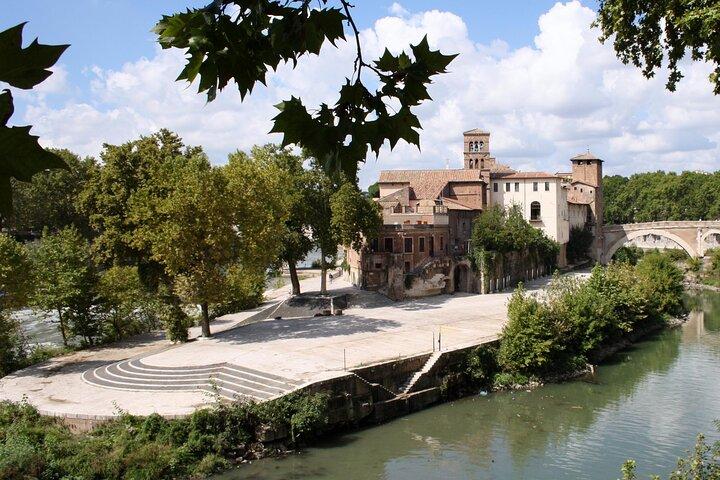
Tiber Island The Tiber Island (Italian: Isola Tiberina, Latin: Insula Tiberina) is the only river island in the part of the Tiber which runs through Rome. Tiber Island is located in the southern bend of the Tiber. The island is boat-shaped, approximately 270 metres (890 feet) long and 67 metres (220 feet) wide, and has been connected with bridges to both sides of the river since antiquity. Being a seat of the ancient temple of Asclepius and later a hospital, the island is associated with medicine and healing. The Fatebenefratelli Hospital founded in the 16th century, and the San Bartolomeo all'Isola dating from the 10th century are located on the island.
Trastevere District rastevere (Italian pronunciation: [trasˈteːvere])[1] is the 13th rione of Rome: it is identified by the initials R. XIII and it is located within Municipio I. Its name comes from Latin trans Tiberim, literally 'beyond the Tiber'. Its coat of arms depicts a golden head of a lion on a red background, the meaning of which is uncertain.
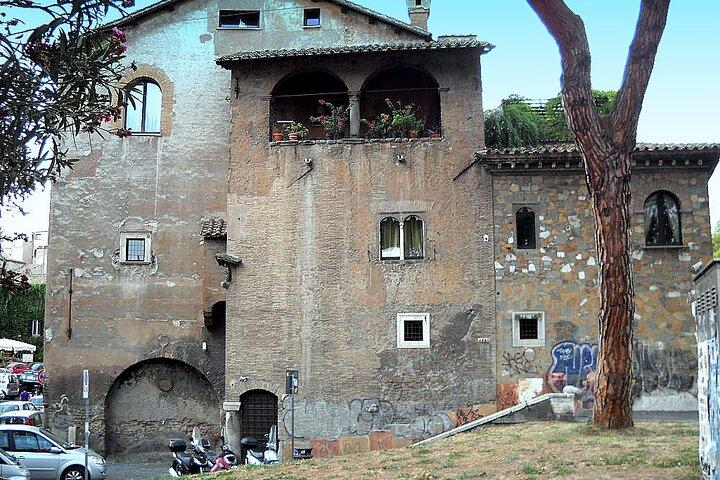
Piazza in Piscinula A place of particular interest is Piazza in Piscinula, now known as a quite convenient parking lot amidst the calmness of this side of Trastevere. Medieval structures, the Case Mattei, flank the piazza tenderly, and the Church of San Benedetto in Piscinula lures any passerby in – by its endearing petiteness. The name Piscinula is reminiscent of Latin and Italian piscina, but not many know why the square gets its name.
Santa Cecilia Church Santa Cecilia in Trastevere is a 5th-century church in Rome, Italy, in the Trastevere rione, devoted to the Roman martyr Saint Cecilia (early 3rd century AD). The first church on this site was founded probably in the 3rd century, by Pope Urban I; it was devoted to the young Roman woman Cecilia, martyred it is said under Marcus Aurelius Severus Alexander (A.D. 222–235).
Basilica of Santa Maria in Trastevere The Basilica of Santa Maria in Trastevere (Italian: Basilica di Santa Maria in Trastevere); English: Our Lady in Trastevere) is a titular minor basilica in the Trastevere district of Rome, and one of the oldest churches of Rome. The basic floor plan and wall structure of the church date back to the 340s, and much of the structure to 1140–43. The first sanctuary was built in 221 and 227 by Pope Callixtus I and later completed by Pope Julius I. The church has large areas of important mosaics from the late 13th century by Pietro Cavallini.
Highlights
What's included
Traveller Ratings
Important Information
- Wheelchair accessible
- Infants and small children can ride in a pram or stroller
- Service animals allowed
- Public transportation options are available nearby
- Infants are required to sit on an adult’s lap
- Transportation options are wheelchair accessible
- All areas and surfaces are wheelchair accessible
- Suitable for all physical fitness levels
Reviews(6)
The guide was misinformed and nervous, hard to understand, could not finish a sentence and was not factual. Our money and time was a waste. Not sure if she just had a bad day. To add to being misinformed, she said that we could not visit the synagogue which we did and that was the highlight of our visit to the Jewish Ghetto in Rome. I will reach out to Viator for a refund.
I’m very sorry to hear that the tour did not meet your expectations. Karin is one of our most experienced guides in Rome, especially for this type of tour, as she is highly specialized in Jewish history. However, we understand that sometimes there may not be a natural “connection” between guest and guide, and we are truly sorry if this affected your experience. We genuinely appreciate your feedback, as it helps us improve, and we would be happy to welcome you again in the future and try to offer you a tour more in line with your preferences.
We had a great time and learned quite a bit, even though we've had similar tours in the past. Our guide, Yev, was great at engaging our group of jetlagged students and kept them awake and interested the whole time. He adapted his route to show us things based on the experience we'd already had. A great day!
Sara gave us an absolutely wonderful and informative tour of the Rome Jewish Quarter. Our two 13 year-old grandchildren put it at the top of their list of things they enjoyed during our Italy vacation. Well worth doing! Ellen and John
I originally booked the tour for Trastevere and the Jewish Ghetto but then added in the Roman Forum and Palantine Hill. Emanuele easily added in this option and let me tailor the tour to include specific sites, e.g. Villa Farnesia. I had several questions on the tour and communication with Emanuele was great. My tour guide, Yevgen, was fantastic. He met me at the predetermined location ready to go. He gave me time to take photos, ask questions, take a second look at sites, added in some additional sites, and was very knowledgeable of the area. I enjoyed the conversation with Yevgen throughout the tour. He seemed almost as excited as I was to see this part of Rome. The ticket for the Roman Forum and Palantine Hill included sites that were just opened for tours and only available with a super ticket. Highly recommend this provider and tour guide.
The tour guide, Yevgen, was fantastic. Best tour EVER. Seeing Trastevere and the Jewish Ghetto was better that I could have imagined. Yevgen gave me time to take lots of pictures, answered all my questions. Highly recommend this tour.
We did a tour of the Jewish Ghetto, Trastevere and the synagogue. Maria was our tour guide and did an amazing job. Very knowledgeable about the areas, answered all of our questions, waited while we bought some fried artichokes. We never felt rushed, and even our young adults were kept interested the entire time. Highly recommend using this company. The communication was also very good, responsive and upfront about pricing