Entrada para o principal repositório de história e artefatos da Colúmbia Britânica.
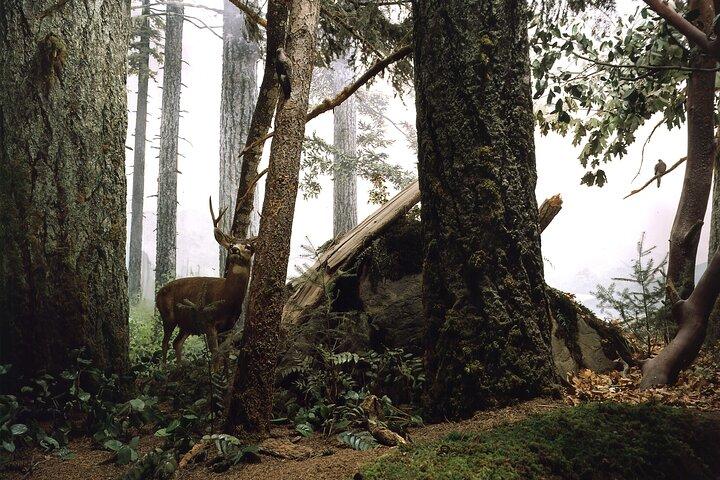
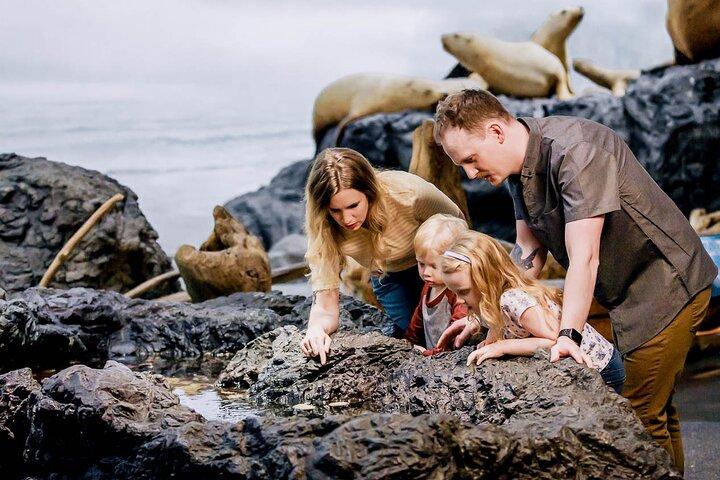
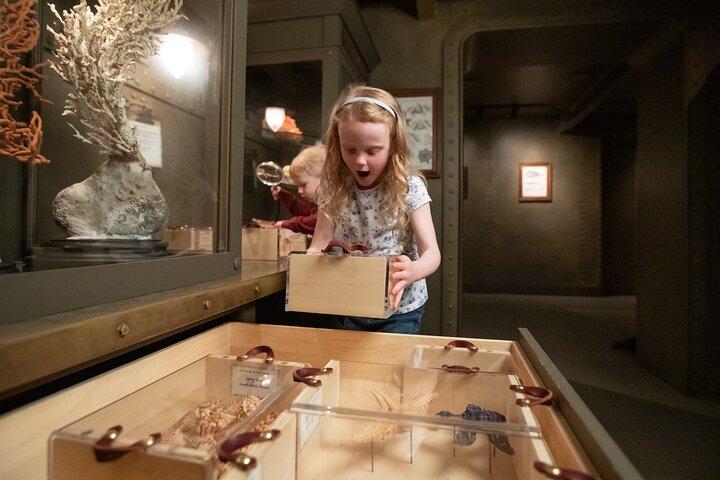
Exposições que revisitam séculos de eventos naturais.
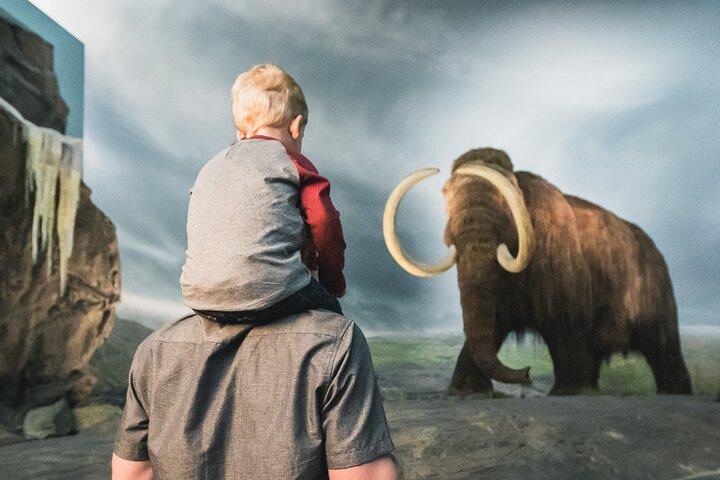
Um olhar sobre a vida de um mamute-lanoso durante a Era do Gelo.
Sítios históricos e totens autênticos no recinto.
Opções de passeio
Ingresso para o Royal BC Museum
Itinerário
Royal BC Museum
Entrada incluída
Descubra o Royal BC Museum e celebre a diversidade de BC por meio de galerias esclarecedoras e inspiradoras que capturam as histórias das pessoas, plantas e animais que chamam a província de lar, e veja exposições fascinantes de todo o mundo. Dê um passeio pela Cidade Velha, uma recriação de uma cidade da virada do século XX em BC. Visite Jonathan Hunt House, uma casa cerimonial e instalação de museu da casa do falecido Jonathan Hunt, um chefe Kwakwaka'wakw. Confira a premiada Our Living Languages, uma exposição que compartilha a história e a beleza das línguas interrompidas em BC. Termine a aventura com uma experiência cinematográfica imersiva no IMAX® Victoria, a maior tela de BC.
Aproveite os outros locais históricos notáveis em nossos terrenos, incluindo Helmcken House, St. Ann's Schoolhouse, o Netherlands Centennial Carillon e o Thunderbird Park. Nosso distrito também abriga food trucks e o café 2% Jazz. Localizado no Inner Harbour de Victoria, estamos a uma curta distância do centro da cidade.
O que está incluído
Incluído
Entrada para o Royal BC Museum
Não incluído
Admissão ao IMAX Victoria
Avaliações dos viajantes
4.0
52 avaliações
5
27
4
10
3
6
2
4
1
5
Informações importantes
Acessibilidade para cadeira de rodas
Bebês e crianças pequenas podem andar em um carrinho
Aceita animais de serviço
Opções de transporte público disponíveis perto
Opções de transporte com acessibilidade para cadeirantes
Todas as áreas e superfíceis são acessíveis para cadeirantes
Adequado para todos os níveis de condicionamento físico
Cancelamento
Para receber um reembolso integral, cancele até 24 horas antes do horário de partida.
1+ dias antes100% de reembolso
0–1 dias antes0% de reembolso
Avaliações(52)
S
SeniorTravelerTF
September 21, 2026
Does not have to be on the "must do" list
Big plus - the section on ice age and geologic periods how British Columbia looked and developed up to present day. Big negative, recreation of an old town, ostensibly a BC town (or even Victoria?) could have been any town almost anywhere. The standard shops and construction, but I was not aware of what set this apart from any other recreation (Although it was very well done.) There was (is?) a First Nation exhibit but signs indicated some change and there was no direction. Four IMAX films that you pay extra for. There is an onsite cafeteria, and the museum is located in the hob of the city making it easy to get to and easy to combine with other activities or meals.
S
SHamel67
September 20, 2026
A beautiful museum
We enjoyed this museum - from the Egypt room to natural history and the old west reconstruction, we spent the whole afternoon.
R
Robert_P
September 19, 2026
Royal BC Museum
The Egyptian artefacts were well displayed with excellent videos giving a clear explanation of their culture
A
Apk57
September 12, 2026
Beautiful museum with diverse topics in connection with British Columbia.
Beautiful museum about British Columbia. About nature, the original inhabitants, fishing, the land resettlers, lifestyle, and current environmental aspects. In addition, there was the ancient Egypt exhibition as a rotating exhibition. It has a nice setup.
Z
Z7427OJpaulo
September 1, 2026
So so museum - you won’t miss much if time doesn’t permit a visit
I hate to say it but I agree with many other reviewers who have indicated this museum, unfortunately, is one you could skip. Although we’re retired, and have seen numerous natural history museums over our lifetime, we thought we’d go anyway as a new Egypt wing was open, and while it was nice, because we were in Victoria to soak up both the history, culture, inner harbor, and restaurants….in retrospect it just did fit in.
A
AnnaNicole_L
August 31, 2026
Must do!
Beautiful and immersive! One of my favourite activities in all of Canada. I’ve been multiple times. The “Old Town” section is like nothing else out there.
D
DerekSanderson
August 15, 2026
A Woke, historically sanitized dxperienxet
I went to the Royal BC Museum on a Saturday morning at about 11:30, expecting a worthwhile museum experience, particularly with the Egyptian exhibition. Unfortunately, the visit was a complete disappointment compared with what I expected from an institution carrying the “Royal” designation and representing the history of British Columbia.
The problems started before we even got inside. Only two cashiers were open and a substantial line had formed. A third staff member was sitting at a computer directly in front of everyone waiting, but her station remained closed. Eventually, she removed the sign from her counter and began accepting visitors. It was frustrating to watch a line continue to build while an apparently available station sat closed.
Something else struck me immediately at the entrance. For an institution that speaks so much about reconciliation and Indigenous representation, there was next to zero sincere recognition of the traditional territories on which the museum operates, beyond a small, generic-looking acknowledgement above the cashiers. It felt perfunctory rather than meaningful.
That does a particular disservice to the Songhees and Esquimalt Nations. These are the Nations whose traditional territories are directly connected to where this museum stands, yet outside of a small language exhibit, I saw remarkably little meaningful representation of either Nation throughout the museum. If reconciliation and Indigenous representation are genuinely priorities for the Royal BC Museum, surely the local Nations should be substantially and visibly represented rather than effectively reduced to an acknowledgement above the admissions counter and a limited language display.
The Egyptian exhibition was the biggest disappointment. I expected a museum exhibit with a meaningful collection of genuine artifacts and objects that would bring ancient Egypt to life. Instead, much of the experience consisted of reading posters, looking at information panels and using computer screens. There were some original artifacts, but a surprising amount of what was on display consisted of 3-D printed replicas. There is nothing inherently wrong with using replicas to supplement an exhibition, but when they become such a prominent part of an exhibit people are paying specifically to see, it starts feeling more like an educational display than the major museum exhibition I was expecting.
The remainder of the museum was equally disappointing. A number of the original exhibits and displays that made the Royal BC Museum memorable have been closed or removed.
The First Nations exhibits that once formed such a significant part of the museum experience have been completely removed. Whatever justification leadership has for that decision, the result for the paying visitor is the same: an enormous part of British Columbia’s history and culture is simply no longer there to experience. Ironically, removing these exhibits also means removing opportunities for visitors to actually see, engage with and learn about Indigenous history.
They have also removed the old museum areas that displayed artifacts and everyday objects from different decades. Those exhibits were one of the things that made the museum interesting. You could actually walk through displays, see physical objects from different periods and get a sense of how people lived. Those tangible connections to the past are exactly what I go to a museum to see. Removing them and replacing so much of the experience with interpretation, signage and screens takes away much of what made this museum special.
What bothers me most is the philosophy that appears to be driving these decisions.
Museums should preserve history and present it honestly, including the parts of history that are uncomfortable, offensive by today’s standards, or difficult to reconcile with modern values. History does not need to be endorsed in order to be displayed. It needs to be preserved, explained and put into context.
I understand that perspectives change and that museums have a responsibility to include voices and experiences that may previously have been overlooked. I support adding that context. What I do not support is removing or sanitizing historical representations because a board or leadership considers them inconsistent with today’s ideological standards. Add the Indigenous perspective. Add previously excluded perspectives. Explain what was wrong. Explain how attitudes changed. Put competing perspectives beside one another and let visitors learn from them. But don’t erase what was there.
This is exactly where woke leadership and ideological museum governance become a problem. When today’s political and social agenda becomes the filter through which yesterday’s history is allowed to be displayed, the inevitable result is sanitization and exclusion. Museums are supposed to record and display history, not rewrite it to satisfy a woke board, leadership group or current agenda. The job of a museum is not to protect visitors from the past. It is to preserve the evidence of the past and give visitors enough context to understand it for themselves.
And there is a contradiction here that is difficult to ignore. In the apparent effort to rethink how Indigenous history is presented, the museum has removed major First Nations exhibits while providing, in my experience, remarkably little substantive representation of the Songhees and Esquimalt Nations whose traditional territories are directly relevant to the museum itself. That is not meaningful inclusion. If anything, the result feels like less Indigenous history being available to the public, not more.
We don’t expect a human rights museum discussing Auschwitz to sanitize what happened because the reality is disturbing or incompatible with modern values. The entire point of preserving difficult history is that future generations need to see and understand what actually happened. I don’t understand why British Columbia’s provincial museum, particularly one carrying the Royal designation, should operate according to a different principle.
There is an important distinction between expanding history and rewriting it. If previous exhibits failed to tell the whole story, then tell more of the story. If an exhibit lacked an Indigenous perspective, add it. If an interpretation was inaccurate, explain why. More history is the answer to incomplete history. Less history is not.
The Royal BC Museum used to feel like a place where you could walk into another time and experience British Columbia’s history. On this visit, too much of that experience was gone. What remains increasingly feels like interpretation replacing preservation, with today’s ideology determining which pieces of yesterday are considered acceptable enough to remain on display.
Then, after walking through a museum where so much British Columbia and First Nations history and culture has been removed, you arrive at the gift shop. It is extremely expensive, and during our visit it was playing loud, annoying Mexican music. It seemed completely disconnected from everything we had just seen. It had nothing to do with the Egyptian exhibition, nothing to do with British Columbia history and nothing that I could see connecting it to any culture or exhibit represented in the museum. After everything else that had been removed or changed, it was a bizarre final note to the experience.
Between the poor experience getting through admissions, the almost token recognition of the traditional territories at the entrance, the lack of meaningful Songhees and Esquimalt representation beyond a small language exhibit, an Egyptian exhibition dominated by reading material, screens and replicas, the complete removal of the former First Nations exhibits, the disappearance of the old displays showing artifacts from different decades, the broader sanitizing of history and culture, and finally ending up in an overpriced gift shop with loud music completely unrelated to the museum, I left extremely disappointed.
For the admission price and the reputation of the Royal BC Museum, I expected considerably more.
A museum should not be an institution where each new board or leadership group gets to decide which pieces of history survive according to the ideology of the day. Preserve it. Display it. Explain it. Challenge it where necessary. Add perspectives that were previously missing. Give the local Nations meaningful space to tell their histories and cultures. But stop rewriting and removing history to make it conform to a woke agenda.
History belongs to the public, not to the ideology of whichever board happens to be governing the museum today.
B
betsys686
August 12, 2026
A morning at the RBCM
I was expecting more Canadian art. Enjoyed the House Poles.
The Ancient Egyptian display was interesting,
S
Silver_S
August 12, 2026
It used to be much better
Disappointed in much of the museum. They had alot of sessions where you could use headphones to listen to facts and history. Which I find unsanitary. Some parts were under construction. It definitely did not feel the worth. They charged unfair prices at the Imax theater. Which was in the same building, for a 45 minute program that you could’ve watched on YouTube, but because it was iMax felt necessary to charge phenomenal prices. I remember visiting the museum many many years ago and it was so much better. I hope they can make it a lot better in the future.
M
Melissa_B
August 7, 2026
Significantly better than expected
This was an amazing museum. There was a lot to see, and the Egypt exhibit was a nice addition. We spent about 1.5 hours but we were on a tight schedule. Our 3 teenagers were not excited to go to a museum, but ended up loving it so we stayed longer than expected. If your short on time start with level 3.
Compare tours semelhantes em Victoria
O mais barato: Ghostly Walking Tour in Victoria — $17
O mais bem avaliado: Victoria Guided Food and History Tour — 5.0 (2,258 avaliações)
O mais curto: Ghostly Walking Tour in Victoria — 1 hora