Ghetto juif de Varsovie : visite privée en voiture rétro avec prise en charge à l'hôtel




Description
Cette visite privée du ghetto juif de Varsovie explore l'un des chapitres les plus tragiques de l'histoire de la Seconde Guerre mondiale. Avant la guerre, Varsovie était l’une des plus grandes villes juives du monde. Pendant l'occupation nazie Allemande, la communauté juive est presque entièrement détruite et le ghetto effacé. Voyager en minibus rétro vintage Żuk vous permet de visiter de multiples endroits historiquement importants qui sont difficiles d'accès à pied. Avec un Guide local compétent, vous en apprendrez davantage sur la vie quotidienne sous la domination nazie Allemande, les déportations massives et l'insurrection du ghetto de Varsovie en 1943. La visite comprend des sites clés tels que la place Grzybowski et la rue Próżna, des fragments préservés du mur du ghetto, la rue Waliców, Mila 18, le monument aux héros du ghetto, la zone du musée POLIN et l'Umschlagplatz. En tant que visite privée, l'itinéraire est flexible et peut être ajusté à vos intérêts. Cette expérience est idéale pour les voyageurs intéressés par la Seconde Guerre mondiale, l'Holocauste et l'histoire de Varsovie.
Options de l'excursion
Itinéraire
Après le transfert à l'hôtel, votre Guide présente le contexte historique de la Varsovie juive et la création du Ghetto juif pendant la Seconde Guerre mondiale, en définissant le contexte des sites que vous vous apprêtez à visiter. La visite commence au monument dédié à Janusz Korczak, un éducateur juif polonais, auteur et directeur d'un orphelinat de Varsovie. Malgré les possibilités de s'échapper, il a choisi de rester avec les enfants dont il avait la charge et a été déporté avec eux au camp d'extermination de Treblinka.
Ensuite, visitez la place Grzybowski, qui faisait autrefois partie de la Varsovie juive et qui est aujourd’hui un lieu qui reflète l’histoire dramatique de la ville au XXe siècle. La région a été témoin de deux guerres mondiales, de deux systèmes totalitaires et de la transformation de l'Europe moderne. Les rues voisines conservent encore des traces de la vie juive d'avant-guerre.
La rue Próżna est la seule rue de Varsovie où des maisons juives d'habitation d'avant-guerre ont survécu. Aujourd’hui, il est un rare rappel physique de la Varsovie juive et devient un point central du Festival annuel de la culture juive de Varsovie du chanteur.
Visitez un fragment préservé du mur du ghetto de Varsovie, marquant l'ancienne limite du ghetto. Certaines sections restent cachées entre les bâtiments, et votre Guide vous emmène à l'un des endroits accessibles pour vous expliquer comment la zone a été isolée du reste de la ville.
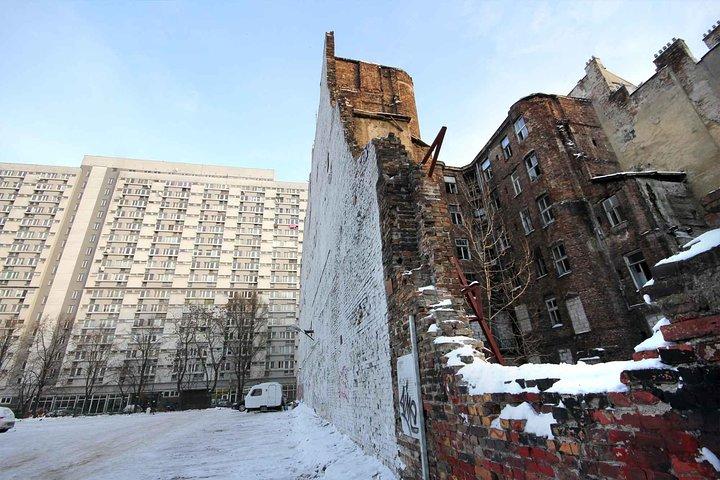
À Waliców Street, voyez une maison en ruine souvent désignée comme le dernier « fantôme » visible du ghetto. Un fragment du mur du ghetto est également conservé ici, offrant un puissant rappel visuel de la destruction et de la perte.
À la rue Chłodna, découvrez le pont en bois construit en 1941 pour relier les deux parties séparées du ghetto. Le pont s'élevait au-dessus du trafic de rue actif, permettant aux tramways et aux véhicules Allemands de passer en dessous. Des photographies d'archives aident à illustrer cette structure extraordinaire.
Continuez jusqu'à Muranów, un quartier résidentiel d'après-guerre construit directement sur les décombres du ghetto détruit. Bien qu’il semble s’agir d’un quartier typique, le sol en dessous recèle des couches de l’histoire de la guerre révélées par les explications de votre Guide.
Visitez le Monument aux Héros du Ghetto, situé près du site des premiers affrontements armés de l'insurrection du Ghetto de Varsovie en 1943. La zone symbolise également le souvenir de l'après-guerre et la réconciliation à travers des événements organisés au cours des dernières décennies.
Arrêt devant le musée POLIN d'histoire des Juifs polonais, construit sur l'ancien terrain du ghetto. Le nom du musée fait référence à une légende liée à la colonisation juive en Pologne. L'entrée est facultative et non incluse dans le prix de la visite.
À Mila 18, découvrez le bunker utilisé par les résistants juifs lors du soulèvement de 1943. Lorsqu'ils furent découverts par les forces nazies Allemandes, beaucoup de ceux qui se cachaient à l'intérieur choisirent la mort plutôt que la capture. Leurs restes sont enterrés sous le site.
La visite se termine sur la Umschlagplatz, l'ancien point de déportation où les Juifs ont été transportés au camp d'extermination de Treblinka. Aujourd'hui, le mémorial de la rue Stawki rappelle solennellement le dernier chapitre de la vie juive à Varsovie en temps de guerre.
Points forts
Ce qui est inclus
Lieux et horaires de prise en charge
Un service de prise en charge depuis les hôtels, Airbnb et les appartements est disponible jusqu'à 3 kilomètres du centre-ville. Si votre hôtel/appartement est plus éloigné ou inaccessible en voiture, notre conseiller vous proposera le point de rendez-vous le plus proche et le plus confortable. Veuillez noter que le transfert depuis et vers l'hôtel compte dans le temps total de la visite. Par conséquent, il est parfois préférable de rencontrer le guide dans le centre-ville plutôt que de passer du temps à transférer depuis le lieu de prise en charge éloigné.
Avis des voyageurs
Informations importantes
- Animaux d'assistance acceptés
- Transports en commun disponibles à proximité
- Sièges enfants avec besoins spéciaux disponibles
- Convient à toutes les conditions physiques
- Cette visite peut être réservée instantanément en ligne pour les adultes et les enfants de plus de 150 cm (4 pi 9 po). Si vous souhaitez réserver la visite pour un enfant de moins de 150 cm, veuillez contacter le prestataire à l'avance pour vérifier la disponibilité des rehausseurs de sièges, obligatoires en vertu de la loi polonaise.
- Chaque minibus peut accueillir jusqu'à 8 passagers, et une flotte de 5 minibus est disponible.
- Les véhicules sont utilisés principalement pour les transferts entre les lieux, avec des segments de marche à chaque arrêt. Veuillez porter des vêtements confortables et des chaussures adaptées.
- Veuillez noter que les minibus vintage classiques ne sont pas équipés de climatisation et que certains ne sont pas équipés de ceinture de sécurité (ce qui est autorisé pour les véhicules historiques). Tous les véhicules sont équipés de chauffage pour la saison hivernale.
Avis(13)
Tom (Tomek) was an excellent guide! We learned so much from him on our three hour walking tour. He made the Jewish ghetto more real for us by showing us black and white photos of the war period verses what is there today. JayWay had suggested this tour for us, and I argued at the time that I could do it on my own. In hindsight, I was glad to meet Tom and listen to his detailed explanations rather than reading from my guidebook.
The tour we had with Konrad was one of the absolutely best tours we have ever had on any trip. Konrad was extremely knowledgeable about the history of Jews in Warsaw, brought us to locations throughout the city to show us specifically some of the history of our people in the area and even had actual historical pictures of the areas he was showing us. My wife and I learned a phenomenal amount of history from that tour and we would both very highly recommend it.
My husband and I took an anniversary trip to Poland and had the best time! While we were in Warsaw, we had the best tour guide, Konrad! We were so lucky we got to have him for both our Jewish History Tour and our WWII buffs tour. HE WAS AMAZING! We were able to go around the city in a mini bus but also walk around and show us all the major sites of where things were before they were destroyed and are now rebuilt. He has such a wealth of knowledge being born and raised in Warsaw that it cannot be beat. He even went above and beyond and showed us local restaurants, away from tourists, where locals hangout, drink, and drink. For anyone who is considering any tours in Warsaw, request Konrad, you will not be disappointed, gain so much knowledge, and have a great time!
Konrad is a wonderful tour guide - he’s very knowledgeable, polite and helpful. We learned a lot and highly recommend him!
My husband and I were lucky enough to have Tom as our tour guide and driver on this full day exploration of Jewish Warsaw and Treblinka. Tom gave us a full visit of ghetto sites, both south and north. Although we knew about the ghetto uprising, being in the locations brought the experience to life . Tom has a wealth of information and photos from the past to illustrate places and events that we could not see with our eyes but could now visualize at those locations. We then drove to Treblinka and felt the weight of this terrible place and learned more from Tom.
The guide is knowledgeable about the ghetto and its history. However, the narrative presented reflects a Polish perspective, emphasizing that 3 million Poles killed were "coincidentally" Jewish, while also suggesting that Jews were seen as communist sympathizers, leading to local resentment. This perspective aligns with a typical antisemitic narrative. The true victims of the Holocaust were the Jews—not the Poles, who, while they suffered, were also perpetrators in some cases. This distortion of history is similar to how Hamas terrorists attack Jews and then portray themselves as victims. The tour felt like an official propaganda session that we paid for. Additionally, the 3-hour duration was quite intense for such a heavy and difficult subject, especially when mixed with biased messaging. That said, despite these issues, I would recommend the tour.
Dear Elazar, My name is Marcin, and I was your guide that day. Thank you for sharing your emotions and opinions about our tour. Meeting you and your group was a meaningful experience, and I believe we all learned something from our discussions. My goal is always to provide accurate information and context, allowing my guests to understand these tragic events more deeply. I’m sorry to hear that parts of the presentation felt unbalanced or biased from your perspective. Throughout the tour, I aimed to illustrate the fate of Polish Jews, particularly during the Second World War, when our country was attacked and occupied by both Nazi Germany and the communist Soviet Union. It’s also the story of Polish Catholics and others of various faiths who bravely helped, such as Irena Sendler, as well as those who regrettably betrayed and collaborated with the Nazi regime. I also covered the tragic pogroms, the role of the "Polish Blue Police" in Warsaw, and the "Jewish Police" formation in the Ghetto. However, as it was an exceptionally cold day, I noticed some group members were unprepared for the weather. We shortened certain parts for everyone’s comfort, and I observed some people stepping away or unable to hear the full explanation—this may have resulted in missing or misunderstanding parts of the narrative. I sincerely regret if any part of the tour’s content or delivery made it seem as though I was downplaying Jewish suffering or promoting biased perspectives. I did not say that “3 million Poles killed were "coincidentally" Jewish”; this had to be the misunderstanding. German Nazis murdered 3 million Polish Jews during the Holocaust and around 2 million Polish Catholics, other faiths and minorities. I intended to emphasise that they were all citizens of Poland (before WWII). It also came to my attention that during a conversation in the car, someone from your group mentioned that “all the Poles were happy when the Jews were murdered.” This statement is deeply troubling, as it generalises and misrepresents the complexity of Polish attitudes during the war. While there were undoubtedly collaborators and those who committed terrible acts, there were also people who risked their lives to save their Polish Jewish neighbours. I stand firmly against any form of antisemitism or hate speech. My mission is to illuminate the complex and often painful history of wartime Warsaw, including acts of heroism, resistance, collaboration, and tragedy. I regret that the tour left you feeling it was “official propaganda”; I always intend to present history responsibly and comprehensively. Thank you once again for your feedback. It helps me develop and ensures I honour the memory of all who suffered during this tragic chapter of history. Sincerely, Marcin Grabowski
It has been a very interesting and amazing tour, I recommend it. The guide, Karol, was very passionate about the impact of the Jewish community and culture on the city. The historical van is a fun addiction to the tour.
Marcin was very interesting and friendly! He knows a lot about history, Jewish history to be specific. This is a small price to pay to access to all of his knowledge about the past of this communauty. He was in time at my hôtel with his retro minibus Zug (I loved Zug!) and drove me to several places in Warsaw. He even showed me pictures of the past when we were there. Awesome expérience: I do think this activity should be on every "things to see in Warsaw". I highly recommand it to everyone who wants to know more about the dark past of the Jewish community!
Must do Jewish Heritage Tour! From my first email to Marcin and all the planning in between, everything was great. Marcin promptly answers emails and helps with the planning stages . Our tour guide Mariusz was fantastic. We happened to have our scheduled tour on the anniversary of the 80th anniversary of the Warsaw Ghetto Uprising, and with Mariusz’ planning everything went smoothly. Our driver Matthiew navigated to streets flawlessly. Mariusz was extremely knowledgeable. He took us to a great little local spot for lunch in Praga. If you’re looking for a tour in Warsaw I highly recommend Warsaw Behind the Scenes.
Excellent tour and guide. Very interesting, Informative and professional. Would definitely recommend Martin as a tour guide.