Route Aymara Puno Chucuito Aramumuro Molloco waruwaru y juli




Description
elTours of the Aymara Route offer a mystical alternative and less saturated than the classic visits, to the islands of Lake Titicaca, allowing them to connect with the living history of Puno in a deeper way. These are the main reasons 1. Connection to the "Unknown" and Mystical Unlike other destinations, the Aymara Route includes Aramu Muru, considered a "dimensional portal". Tourists today seek spiritual and meditative experiences that they do not find on conventional tours. 2. Exclusivity and Authenticity Ancient Legacy: Visit the Inca Uyo (Temple of Fertility) in Chucuito or the Waru Waru (pre-Inca agricultural laboratories) 3. Unique Architectural Variety Square chullpas in Molloco to the majesty of the "Roma of America" in Juli, 4.Full Day Tour: Ideal for those who have already visited the Uros and taquile are looking to take advantage of their second or third day in Puno with a full day activity (8:00 AM - until 15:00 pm to 15:30 PM approx.).
Tour Options
Itinerary
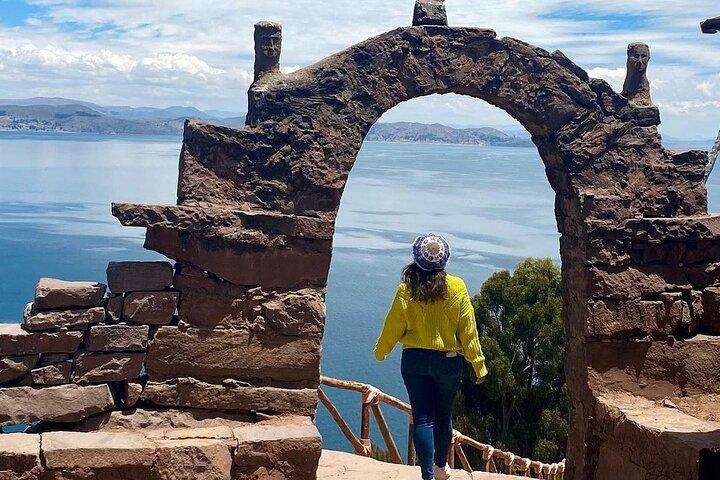
The Inca Uyo archaeological site, a rectangular construction with stone walls. At the time of the arrival of the Spaniards it was partially buried, under construction, the earth filling allowed access to the top of the wall of the stones that were carved, a few meters from the construction is a significant group of stones in its carving phase. Recently, fungus-shaped monoliths, which some interpret as phalluses, have been brought inside the building. It is actually a ceremonial temple dating back to pre-Hispanic times.
The Waru Waru (or lorries) in Acora, Puno, are a pre-Hispanic agricultural system of elevated fields designed to grow in the flooded pampas of the Altiplano, more than 3,800 m above sea level. the technique is to excavate canals and use the extracted soil to create elevated round rectangular platforms (farm beds). Its effectiveness is based on: Thermoregulation: Water from canals absorbs solar heat during the day and releases it at night, creating a microclimate that protects crops from extreme frost (which can drop to -20 °C). Water management : The canals act as reservoirs during droughts and as drainage during times of flooding, maintaining the humidity necessary for the plant. Fertility : The mud accumulated at the bottom of the canals is extracted periodically to fertilize the growing platforms naturally. , this technology to produce "superfoods" such as native potato, quinoa and cañihua without the need for agrochemicals.
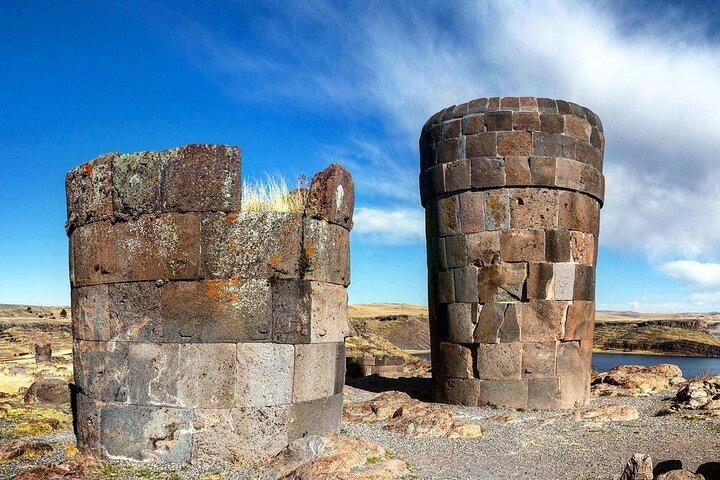
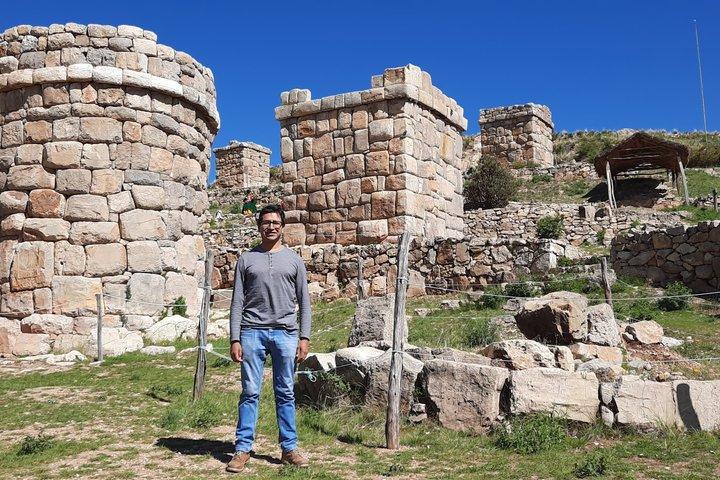
Molloco Archaeological Site, an ancient necropolis located in the district of Ácora, near Puno, Peru. It is famous for its pre-Inca and Inca chullpas (funeral towers), which are evidence of the Lupaca and Pucará cultures. Molloco Archaeological Site Location: It is located approximately 36 kilometers south of the city of Puno, in the community of Molloco, district of Ácora. Funeral Structures : The site features about ten visible pre-Hispanic chullpas, with square and circular shapes. Many of them have protruding ledges and entrances directed toward the sunrise, reflecting ancestral beliefs about life after death. There are also about 20 underground cistas (graves) on the hillside, some protected with ichu (local pasture). Cultural Importance: Molloco was a necropolis used by the Lupaca cultures and later by the Incas to bury high-ranking authorities. Archaeological findings
l Portal de Aramu muru, or Ajayu Marka (Amara: Ajayu marka) and other times called Willka Uta is a historical-mythological place located in the southern tip of the district of Ilave in the province of El Collao in the Department of Puno, Peru.1] It is located halfway between the towns of Ilave and Juli on the national route PE-3S not far from Lake Titicaca. Etymology Ajayu Marka is composed of two Aymara words: Willka :'sun' Uta :'door' The portal of Aramu muro is square in shape, 7 meters high by 7 meters high carved into the rock, with a smaller trapezoidal niche in the center of the base that measures 2 meters high.[1]2] So far no serious archaeological study has been carried out that could reveal the date of when the first settlers began to consider this place sacred. It is taken into account that many pre-Inca cultures inhabited the Peruvian highlands as are the pukinas, lupacas and Aymaras.
Juli, located on the shores of Lake Titicaca in Puno, Peru, is nicknamed the "Little Rome of America" for its immense historical and religious colonial wealth. Founded by Dominicans and consolidated by Jesuits in the 16th century, it stands out for its four imposing mixed-race baroque temples, altars, viceregal art and for having hosted one of the first printing presses of the New World. Main features of the "Little Rome of America": Half-Blood Baroque Historical Importance: It functioned as a key evangelization center where Jesuits learned Aymara and Quechua. Natural Environment : Located at 3,884 m above sea level, surrounded by four sacred hills (apus) and close to Lake Titicaca. The city is considered a jewel of the highlands that preserves the splendor of colonial times through its architecture and traditions.
Highlights
What's included
Pickup Locations & Times
hotel GHL, Hotel Sonesta inn del Inca, Hotel premium Andean house, lake Titicaca hotel, pay 25 soles or 8 dollars to the person who collects it
Traveller Ratings
Important Information
- Service animals allowed
- Public transportation options are available nearby
- Infants are required to sit on an adult’s lap
- Suitable for all physical fitness levels
Reviews(25)
Excellent travel experience and very good drone videos and photographs. The guide was very attentive, kind, and a good photographer. I recommend it. Only punctuality was lacking at the moment of picking me up from my hostel to the transport.
The times and places to visit were met; the guide Lino knows the tour sites well and was always attentive to ensure we had a good time. I recommend him.
The tour is not bad at all; some places are better and some are less good, but with the group, the experience, and Lenin's guidance, it was very fun.
The guide (Lenin) was very good, and he even recorded all of us with a drone to see the circular crops. Just to mention, I would have liked to spend a little more time at each of the visited places, even if it meant returning a bit later.
It was a pleasant experience with this agency and the travel guide. Highly recommended.
An excellent walk, he explained everything well.
Very good guide, and above all, he was quite patient and helped us with the photos.
I had a wonderful experience, excellent guide, with a lot of experience and knowledge. I definitely recommend it!
Very good experience, very professional tourist with explanation of all the places visited, his person very friendly.
We had an amazing tour of the Portal de Aramu Muru with Lenin. He didn't rush us and even took us on an extra hike so we could take star photos from higher up. It was an amazing experience!