Resisting the Holocaust — Berlin's Hidden Heroes
Description
Most people know the broad facts of the Holocaust. What they don't know is what it took to resist it. This expert-led walking tour explores Berlin's former Jewish quarter, tracing the destruction of a community and the extraordinary individuals who chose to fight back. From the New Synagogue — saved on the night of Kristallnacht by a police officer who refused his orders — to Otto Weidt's Workshop, where a factory owner protected his blind and deaf Jewish workers from the Gestapo. From the Women's Protest at Rosenstrasse — the only successful mass protest against a Nazi deportation order — to the Trains to Life, Trains to Death memorial at Friedrichstrasse station. Three hours. Maximum 15 guests. A discussion, not a presentation. Berlin's only specialist WWII tour company. Expert historian guide. Featured on National Geographic and the Discovery Channel.
Tour Options
Itinerary
Start at the symbolic heart of Berlin's pre-war Jewish community. Learn how this majestic building, nearly destroyed during Kristallnacht, was saved by a local police officer who refused his orders.
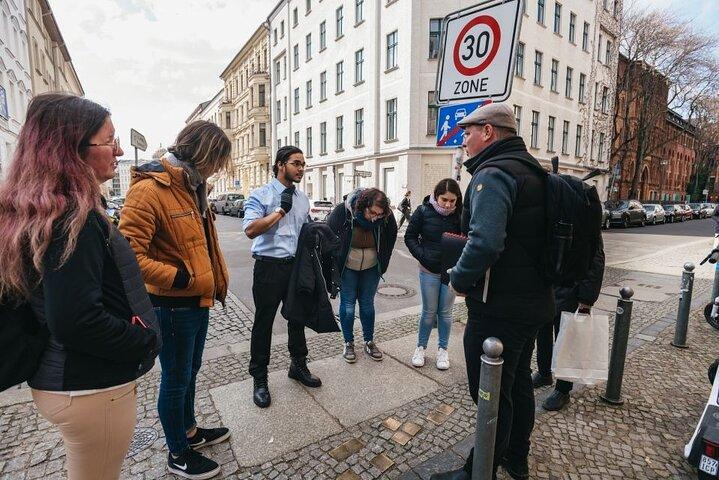
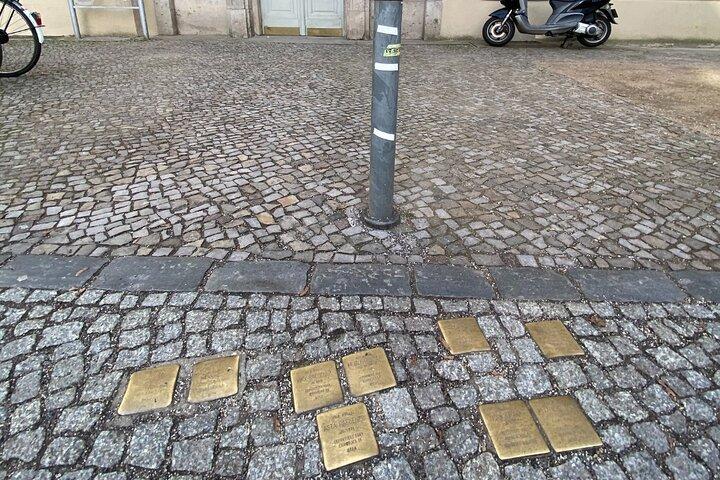
Stolpersteine — Stumbling Stones Pause at the brass stones embedded in the pavement, each marking the last known address of a Holocaust victim. Over 70,000 across Europe — the largest decentralised memorial in the world.
Founded in 1779 — Berlin's first free Jewish school. By 1942 it had become a Nazi transit camp. Hear the story of its last headmaster and the fate of those held here before deportation.
Between 1672 and 1827, some 12,000 Jewish community members were buried here. On the orders of the Gestapo, the SS destroyed the cemetery in 1943, smashing thousands of gravestones, throwing away remains and playing football with skulls. In April 1945 burials once again took place. Almost 2500 German soldiers and Berlin civilians killed during the fighting or shot by the SS for hanging white flags from their windows are buried in mass graves.
tand outside the workshop where Otto Weidt spent years protecting his blind and deaf Jewish workers — falsifying documents, bribing Gestapo officials, and creating hiding places. One of Berlin's most extraordinary stories of individual resistance.
Stand where German women defied the Nazi regime in 1943 to save their Jewish husbands. For seven days they refused to leave. Their husbands were released. The only successful mass protest against a Nazi deportation order in the history of the Third Reich.Outraged, the wives of those detained numbering in the hundreds gathered to protest. Despite periodic threats of being shot if the women did not disperse the women would scatter briefly, only to return in larger numbers to continue protesting. As pressure mounted Goebbels authorized the prisoner's release.
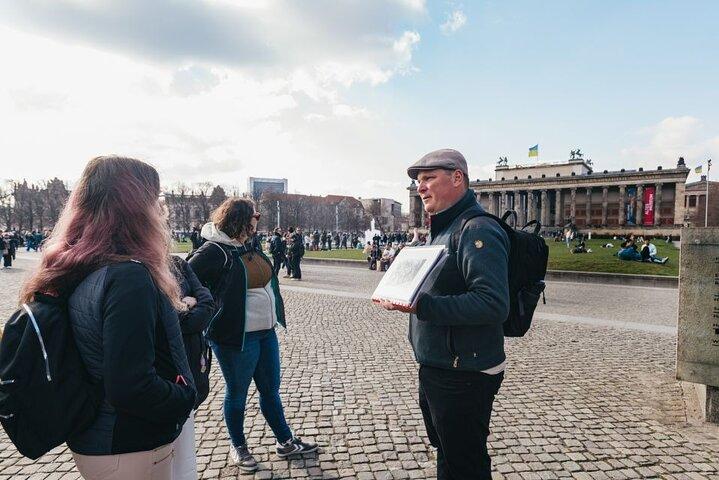
This cluster of buildings on Museum Island traces the transformation of public space under the Nazi regime — from civic and cultural institutions into instruments of propaganda and state control.One week after Hitler's appointment as Chancellor 200,000 Berliner's protested the new Government. Strict regulations imposed by the Nazi's over the coming month's restricted Germans' right to protest, hefty fines and arrests made protesting the Nazi regime very dangerous. In 1934, the Lustgarten was paved over to make way for Nazi propaganda rallies, swearing-in ceremonies and military parades.
The magnificent Zeughaus is the oldest building along Unter den Linden constructed in 1730 as an artillery arsenal. On March 21, 1943, the Zeughaus was chosen to exhibit captured Soviet weapons. Major General Rudolf Christoph Freiherr von Gersdorff, a member of the Wehrmacht resistance, was chosen to lead the exhibit. Despite 27 failed assassination attempts to kill Adolf Hitler. Gersdorff was resolute to succeed and agreed to blow himself up with the Führer. With two concealed Bristish clam mines, he planned to throw himself around Hitler in a death embrace that would blow them both up. A detailed coup d'état was in place and ready to go, learn what happens next on this tour.
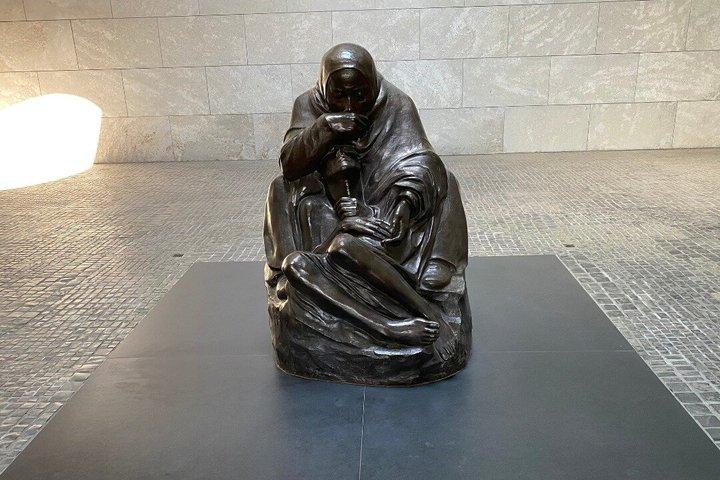
Germany's central memorial to the victims of war and tyranny. A single sculpture. An empty room. The silence here is deliberate.
On 10 May 1933, members of the Nazi German Student Union and their professors gathered here in Bebel Platz adjacent the historical and prestigious Humboldt University. In a nationwide action “against the un-German spirit”. Students burned upwards of 25,000 volumes of books that were deemed "un-German".
End the tour at Friedrichstrasse station — at the memorial to the Kindertransport children. The same station that sent children to safety sent others to their deaths. This is where the question asked at the start of the tour comes back around. Designed by sculptor Frank Meisle, himself among those rescued by the Kindertransport travelling from here to England in 1939.
Highlights
What's included
Traveller Ratings
Important Information
- Wheelchair accessible
- Infants and small children can ride in a pram or stroller
- Service animals allowed
- Public transportation options are available nearby
- Transportation options are wheelchair accessible
- All areas and surfaces are wheelchair accessible
- Suitable for all physical fitness levels
Reviews(22)
This tour through the old Jewish Quarter of Berlin, focusing on personal Holocaust stories using specific locations as backdrops, was excellenty done. The guide was (whose name I've unfortunately forgotten, was very knowledgeable, personable and intersting. It was apparent that he was intetsted in the subject matter and not just reciting a memorized script. I highly recommend this tour. I also recommend going back after the tour to visit the Jewish Center Museum, which is basically the New Synagogue, which was partially destroyed by the Nazis on Kristalnacht on November 9, 1939.
Scott was one of the best tour guys Iwe have ever had. He encourages conversation and questions with his incredible knowledge. We are Holocaust educators, and we were very impressed with his depth of knowledge. In fact, this experience added to our knowledge.
Our guide, Jochen, was fantastic. We attended the “Holocaust & Nazi Resistance” tour. We had an insightful time being guided around Berlin at a comfortable pace and it was clear by the care taken of the information that he held the Jewish community in Berlin and beyond in high regard - he was really conscious of his language when speaking about Jewish people and had a clear passion for the topics discussed. We asked Jochen follow up questions around different parts of Berlins history we were particularly interested in learning (for us, this was about Berlins Queer History), he took time to explain to us different anecdotes, show us images, and gave recommendations in Berlin and to research. Again, Jochen provided really reflective and important information to us. I would highly recommend this tour to anyone interested in learning Berlins history.
Very informative and moving tour! Highly recommended! Johan was a great guide. We learned a lot. Thank you!
A very important tour and deeply impactful. Though it was a cool day, our tour guide brought focus, energy, and personability to this experience.
I did the Sachsenhausen Concentration Camp & Battle of Berlin tour. If you are lucky enough to have Steve as your guide, you are in great hands. His knowledge of the Third Reich and his ability to communicate complex topics is second to none. Thanks to Matt and Steve for putting off a world class experience.
Highly recommend. Jochen (spelling) was a wonderful and very informative guide! I have a degree in Holocaust studies and he really knew his stuff! Would take this tour again if I come back to Berlin.
Our tour guide Jochen was so knowledgeable and had a deep understanding of the history of the area. The tour was approx 3 hours and he was very thorough in answering everyone's questions. We learned so much and we very moved by standing in the places where so many Jewish people were 'disappeared'. I would highly recommend this tour. You will learn a lot. It's a very easy pace. As I walk though Berlin I know notice 'stumbling stones' thorought the city.
We were around many places in Berlin - and got a good knowledge / insight into - the living conditions / conditions the Jews lived under before - during and after World War II. The knowledge and places we would not have found ourselves - even my teenager thought it was an interesting trip. For example, we heard about the first female rabbi and her fate - as well as about the Germans who in various ways (here we visited places where the events took place)) put their own lives at stake to help the persecuted. Our guide was welcoming, skilled, and shared his knowledge in easy to understand English.
Scott gave an excellent tour. We received a presentation on the history before 1900 to the 1950’s. He gave the antecedents to the Holocaust going back to pre WW I. He combined history, culture and insights that brought Berlin into focus for us.