Private Petrópolis -Imperial Museum,dummont house,Cristal Palace,S.Pedro Church
Description
Get to know the history and beauty of Petropolis with transportation and professional guide with all the necessary information for your entertainment and culture. With the royal family residing in Rio de Janeiro, many trips were made crossing the interior of the present state of RJ, In one of these voyages made by Dom Pedro I in 1822, which traveled from Rio de Janeiro to the Golden Path in Minas Gerais, the emperor lodged at the Padre Correia farm in the region. The enchantment was immediate, and there began a love story between Dom Pedro I and the region of Petropolis, which shortly afterwards acquired the then Fazenda do Córrego Seco, which would be called "Petropolis.".
Tour Options
Itinerary
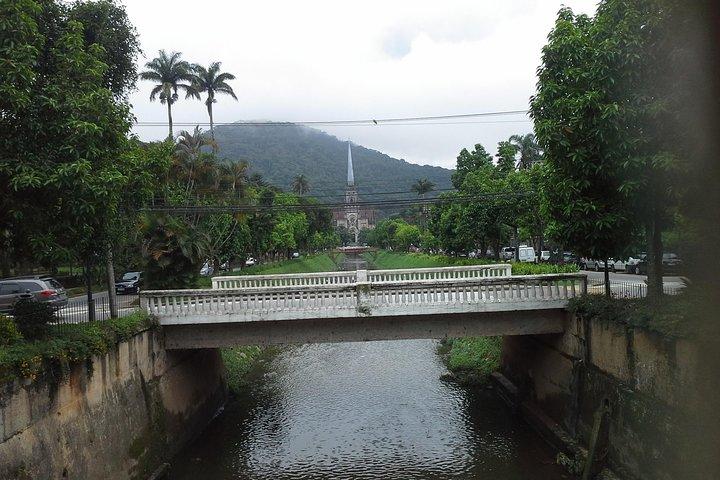
Originally, the Mother Church of Petrópolis was a modest building located in front of the Imperial Palace, but the construction of a new Matrix was already foreseen, in the present place, in the urbanization plan of Petrópolis, dated 1843, written by Major Júlio Frederico Koeler. Facade of the cathedral. In the 1870s the construction of the new church was reconsidered, thanks to the interest of Dom Pedro II and his daughter, Princess Isabel. In 1871 the construction of a new Matrix was officially decided, but it would take time to materialize. In 1876 the Italian architect Federico Roncetti presented / displayed a project in neo-Renaissance style, that was refused. The current building of the cathedral began to be built only in 1884. The project was commissioned from the Bahian engineer and architect Francisco Caminhoá, who conceived a neo-Gothic style building, very fashionable at the time, especially inspired by the old cathedrals of northern France. The work was carried out by Manuel Pereira Jerônimo's contractor, the son of one of the first families to settle in the city, from Pico Island in the Azores. The construction of the cathedral did not stop after the Proclamation of the Republic and followed until 1901, when the works enter a period of paralysis. Under the command of engineer Heitor da Silva Costa, the work entered a second phase of intense activity in 1918. Finally, on November 29, 1925, the new headquarters of Petrópolis was inaugurated after 37 years of work. The building, however, was not finished, lacking the main façade and the tower, and much of the interior decoration. The works of the facade only began in 1929 and reached rosette level in the 1930s. The tower would only be built between 1960 and 1969. Interior of the Cathedral. In 1920 the decree banning the Imperial Family of Brazil was annulled, and as early as 1921 the remains of Dom Pedro II and D. Tereza Cristina were brought from the Monastery of São Vicente de Fora, in Lisbon, to Rio de Janeiro, where were housed in the Metropolitan Cathedral. In 1925 the remains were transferred to the sacristy of the cathedral of Petropolis. Finally, on December 5, 1939, President Getúlio Vargas and other authorities inaugurated the Imperial Mausoleum, where the Emperor and Empress were finally transferred. In 1971, Princess Isabel and her husband, Count D'Eu were buried in the mausoleum.
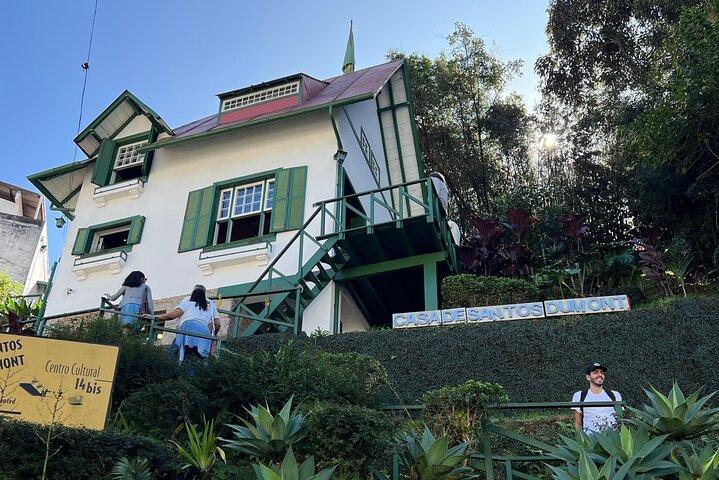
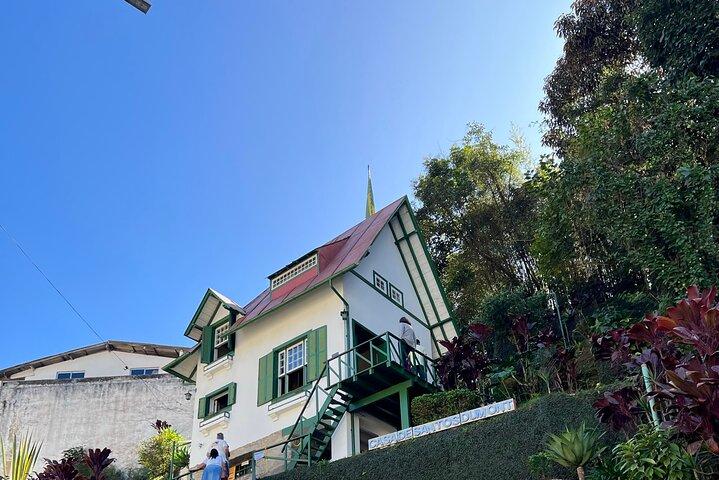
in the state of Rio de Janeiro, Brazil. The house of Santos Dumont in Petrópolis is a picturesque residence embedded in a steep locality in the city. Santos Dumont received the invitation to summer in Petrópolis of Princess Isabel, during the golden season of the city during the Empire, and when accepting the invitation decided to build a house that would meet their needs. The street chosen today is called Rua do Encanto and in Petrópolis, the house was nicknamed "A Encantada". The house has some peculiarities, like one of its last inventions that is the shower with hot water, the only one of Brazil at that time, being heated to alcohol, and also the external staircase where one can only start to climb with the right leg, and the internal that can only be raised with the left leg, and the very architecture of the house where no partitions are used between the rooms. The house has three floors, plus an observatory, over the roof.
It was founded in 1853 in the city of Petrópolis, state of Rio de Janeiro, by the German settler Henrique Kremer, then artist with the name of Bohemia brewery. When he died in 1865, the company was left with his heirs, who renamed it Augusto Kremer & Co.. Shortly after a decade with the separation of the partners, the company was in charge of Frederico Guilherme Lindscheid. At the time of its foundation, Bohemia preserved the characteristics of the German beers of the time, with an initial production of six thousand bottles per month. The product was distributed through wagons, cars pulled by animals etc., and sales were made directly. Later, sales were made through dealers in the region of Petrópolis, a mountain region of the state of Rio de Janeiro. Over time, the bitter and strong characteristics of the German beers were being altered to conform to the market of the time and with the competing brands, and the flavor became lighter and less bitter, reaching the point of how it is sold today. With the control in the hands of Frederico, the company changed its name to Imperial Fábrica de Cerveja Nacional and, with his death in 1898, his daughter who was married to Herique Kremer Jr., the grandson of the founder of the company, created the Companhia Cervejaria Bohemia. In 1960 the company was bought by Companhia Antarctica Paulista, with production at the time of ten thousand dozen per month. Currently part of AmBev. In 2002, dark bohemia, Schwarzbier type beer, was launched using rare malts imported from Munich. The difference is a unique color, a special, softer, more inviting flavor and a velvety, full-bodied, creamy froth. In 2003, the Bohemia Weiss was launched. It was also launched the bohemia royall ale, a beer with English recipe, high fermentation and high alcohol content (6%), which results in a strong and strong flavor. In 2005, it was launched the bohemian confraternity, an abbey beer. In 2012, Bohemia reopens the Petrópolis factory remodeled and functioning as a kind of museum and beer memorial, with games and equipment that participant interacts with the factory and shares in their social networks.
The pre-assembled structure was commissioned by the Count d'Eu, being built in the workshops of the Saint-Souver Lés Arras Corporation in France. The structure is inspired by the Crystal Palace in London, and the Crystal Palace of Oporto. The Count's intention was to give Princess Isabel to cultivate her vegetables. In 1938, the Palace was covered with tin sheets and bricks to house the Historical Museum of Petropolis, which would later be transferred to where the Imperial Museum of Petropolis now operates. In 1967 the palace was dropped by the National Historical and Artistic Heritage Institute, but it remained covered. Walls similar to the original ones were placed in the year of the celebration of the centenary of the palace, in 1984. The Crystal Palace is used for exhibitions and events, such as the Bauernfest, annual feast in honor of the German settlers of Petropolis. Today the palace walls are covered in glass, and as seen above works for historical events.
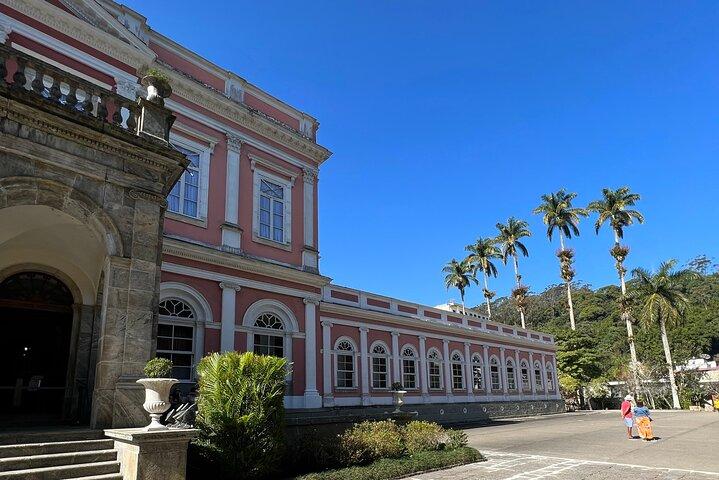
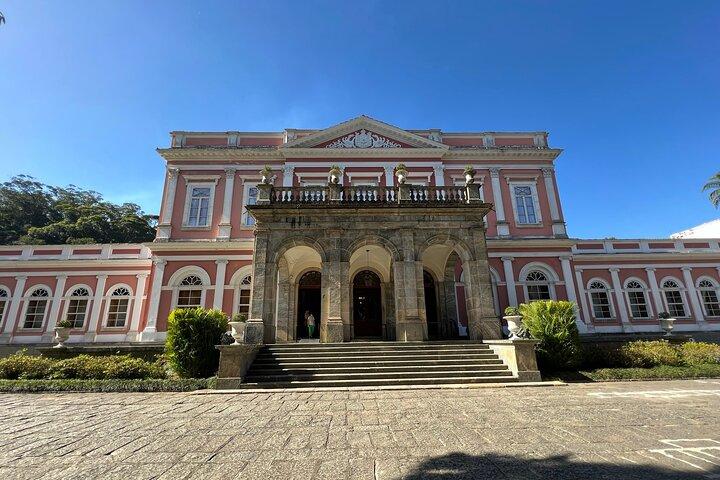
In 1822, Dom Pedro I, traveling to Vila Rica, Minas Gerais, to seek support for the movement of the Independence of Brazil, was enchanted with the Atlantic Forest and the mild climate of the mountain region. He stayed at Fazenda do Padre Correia and even made an offer to buy it. Faced with the owner's refusal, Dom Pedro bought the Fazenda do Córrego Seco in 1830 for 20 contos de reis, thinking of transforming it one day into the Palace of Concordia. The successive political crisis in Portugal and the internal dissatisfaction were decisive for his return to the native land, where he would die without returning to Brazil. The Fazenda do Córrego Seco was left as an inheritance for his son, Dom Pedro II, who would build his favorite summer residence there. At the behest of Dom Pedro, the beautiful neoclassical building was constructed, where the Imperial Museum now operates, which began in 1845 and was completed in 1862. To begin construction, Pedro II signed a decree on March 16, 1843, creating Petropolis. A large number of European immigrants, mainly Germans, under the command of the engineer and superintendent of the Imperial Treasury, major Julius Friedrich Koeler, was in charge of raising the city, building the palace and colonizing the region. Constructed with resources from the emperor's personal endowment, the building had the original design elaborated by Koeler himself and, after his death, was modified by Cristoforo Bonini, who added the granite portico to the central body. To conclude the work, important architects connected to the Imperial Academy of Fine Arts were hired: Joaquim Cândido Guillobel and José Maria Jacinto Rebelo, with the collaboration of Manuel de Araújo Porto Alegre in decoration. The complex was enriched, still in the 1850s, with the garden planned and executed by the landscaper Jean-Baptiste Binot, under the guidance of the young emperor. The vestibule floor, in Carrara marble and black marble from Belgium, was laid in 1854, and the floors and frames made of hardwoods, such as jacaranda, cedar, pau-satin, pink and vigna, from the various provinces of the Empire.
his Norman style is characteristic of European casinos that were successful in Normandy before World War II, and the interior recalls scenarios of American films, hence the style in Brazil. The environments were decorated by Doroth Draper, set designer of Hollywood's famous films. In an area of 50,000m2, Quitandinha was built to be the "Game Capital Bank in Brazil". Marble bathrooms, chandeliers with crystal pendants and a lighting system that would be enough to illuminate a city of 60,000 inhabitants. Its halls can house up to 10,000 people simultaneously. The summit of the Mauá Hall is the largest in the world, 30m high and 50m in diameter, compared to the bell tower of St. Peter's Cathedral in Rome; the Teatro Mecanizado with three rotating stages has a capacity for 2,000 people. The lake is shaped like the map of Brazil with the lighthouse on the island of Marajó. Guests at Hotel Quitandinha were millionaires, actresses, vedetes, politicians who wanted to get the most out of living well. On May 30, 1946, the Pres. Dutra banned the game in the country and thus, Quitandinha ended up not being able to survive as a hotel, its apartments were little by little being sold and from January 1989 was restored and currently the social part is used for congresses, events, shows and fairs .
Highlights
What's included
Pickup Locations & Times
I can include places like other hotels, houses or meet point
Traveller Ratings
Important Information
- Infants are required to sit on an adult’s lap
- Suitable for all physical fitness levels
Reviews(14)
Ederson gave great knowledge to me throughout the tour and I felt vastly more knowledgeable about the cities history by the time I left. He took his time and made sure I had a thorough experience. Amazing driver and awesome experience, highly recommended.
Ederson is very passionate about the history and culture, he showed us the landscape changes through historical paintings at the imperial museum, very interesting and informative.
Thank you so much for your kind words and for taking the time to share your experience! I'm thrilled to hear that you enjoyed the tour and found the historical insights engaging and informative. It’s always a pleasure to share the rich history and culture of Petrópolis with our guests. Your recommendation means a lot to us, and we hope to welcome you back for more unforgettable experiences in the future!
This was one of the best tours we took while in Rio. The guide was great and gave us lots of information everywhere we went. The Palace that we visited was simply amazing. The views on the trip to Petropolis were wonderful and the extra little sites were also great to visit. The Lunch was soooo good. Thank you for a great experience.
Thank you for your wonderful review! I'm delighted to hear that you enjoyed the tour in Rio and had such a memorable experience. It’s fantastic that you appreciated the information provided by the guide, the incredible Palace, and the beautiful views on the way to Petrópolis. I'm also glad you loved the extra stops and the delicious lunch. Thank you for choosing our tour, and I hope to welcome you again in the future!
Ederson was extremely knowledgeable about the history of petropolis! He was also very friendly and made the tour flexible to our needs! I would highly recommend touring petropolis with him! We felt like we saw all the main highlights while also getting to see a few hidden gems.
Thank you so much for your kind words! I’m thrilled to hear that you enjoyed the tour in Petrópolis and appreciated the historical insights. It was a pleasure to guide you through the city's main highlights and share some hidden gems along the way. I always aim to make the experience as personalized and flexible as possible, and I’m glad it met your expectations. I hope to see you again for another adventure soon!
Nice experience. Very enthusiastic and knowledgable guide. A great opportunity to learn basics of Brazilian history.
Agradecemos muito pelo seu review! Estamos felizes em saber que você teve uma experiência agradável conosco e que nosso guia foi entusiástico e bem informado. Nosso objetivo é proporcionar aos nossos visitantes uma ótima oportunidade de aprender sobre a história do Brasil. Esperamos que você tenha obtido uma base sólida na história brasileira durante o seu passeio conosco. Se você tiver alguma outra pergunta ou desejar saber mais, não hesite em entrar em contato. Estamos sempre aqui para ajudar. Esperamos recebê-lo novamente no futuro para continuar explorando e aprendendo mais sobre este fascinante país. Obrigado por escolher nossa excursão e por compartilhar sua experiência conosco! Atenciosamente, Trip in Rio
Very complete tour with Quitandinha Palace, chocolate factory, cathedral, Princess Isabel's house, Santos Dumont's house, imperial museum and Crystal Palace. Very attentive and knowledgeable guide. I recommend the tour. Great.
Fico muito satisfeito em saber que você desfrutou de um passeio tão completo por Petrópolis, que incluiu tantos locais interessantes, como o Palácio da Quitandinha, a fábrica de chocolate, a catedral, a casa da Princesa Isabel, a casa de Santos Dumont, o Museu Imperial e o Palácio de Cristal. O fato de o guia ter sido atencioso e bem informado certamente contribuiu para uma experiência ainda mais memorável. Obrigado por recomendar o passeio e por compartilhar sua avaliação positiva. Se tiver mais perguntas ou precisar de mais informações, não hesite em perguntar.
Very patient and knew a lot, he explained everything to me and took me at my own pace, the places we visited are great and the transportation was very comfortable with air conditioning, I recommend it 100%
¡Qué maravilloso saber que tuviste una excelente experiencia durante tu tour privado a Petrópolis, visitando el Museo Imperial, la Casa de Dumont, el Palacio de Cristal y la Iglesia de San Pedro! Tu guía mostró paciencia y conocimiento, explicando todo en detalle y adaptándose a tu ritmo. Los lugares visitados suenan fantásticos, y un transporte cómodo con aire acondicionado es siempre un plus. ¡Gracias por recomendarlo al 100%! Tu opinión será útil para otros viajeros.
We enjoyed a full day trip with Ederson Oliveira. He is very knowledgeable about the history of Brazil in general and Rio and Petropolis in particular. Among places we visited were Quitandinha palace, St. Peter’s Cathedral, Imperial Palace, Chrystal Palace. By the end of the day we learned a lot of interesting facts about the royal family and various historical events that shaped Brazil in the 19th century. Ederson is a very friendly, accommodating and well informed a type of a guide one would like to have in an unfamiliar place. We are happy that we decided to explore Petropolos, specifically with Ederson. 5 stars, highly recommended, thank you very much, Ederson.
Dear Katya, Thank you very much for your kind words! It was an absolute pleasure to be your guide and share the fascinating history of Brazil with you during our day trip. I'm thrilled that you enjoyed the tour and found it informative. Exploring Quitandinha Palace, St. Peter's Cathedral, Imperial Palace, and Crystal Palace with you was a fantastic experience, and I'm delighted to hear that you had a great time. Your 5-star review means a lot to me, and I genuinely appreciate your recommendation. If you ever return to Petropolis or have more questions about Brazilian history, please don't hesitate to reach out. I'd be more than happy to assist you again. Thank you for choosing me as your guide, and I hope to see you again in the future! Warm regards, Ederson Oliveira
Ederson is an excellent guide, speaks perfect English, is very professional and a very nice person to tour with. I strongly recommend him as a guide in Rio!
Thank you so much for your kind words and strong recommendation! I'm delighted to hear that you had a positive experience touring with me. Providing a professional and enjoyable experience is a top priority for me. I'm thrilled that you found my English proficiency and personality to be valuable aspects of the tour. Your feedback is greatly appreciated, and I'm excited to continue showcasing the best of Rio de Janeiro to visitors like you. Looking forward to the opportunity to guide you again in the future!
One of the best vacation trips I have ever made! Highlight to the company of our guide EDERSON, with the best ideas for photo, all the patience and disposition of the world! Creativity, good humor and good will are his trademark, which made our experience in Rio even more wonderful!
Muito obrigado pelas descrição de meu trabalho! Fico agradecido e espero que venha ao Rio novamente muito e breve!