Nagasaki Half-Day Private Tour with Government-Licensed Guide
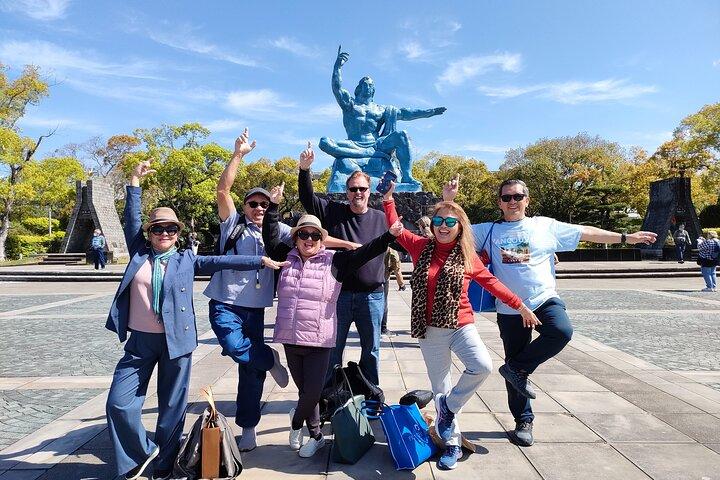


Description
Explore Nagasaki with a government-licensed and experienced English-speaking guide! Your guide will help you efficiently enjoy a full-day walking tour of Nagasaki and introduce both modern and traditional sides of this dynamic and ancient Japanese city. Your guide will pick you up in the morning at your hotel in Nagasaki and take you to visit Nagasaki's famous sites. Along with atomic bombing of Nagasaki during WWII, this city's history features many prominent events. You can learn about this and other interesting aspects during this Half-day walking tour accompanied by your private guide. Note*1: You cannot visit all the sites on the itinerary. You must choose at maximum 3 sites to visit and inform your guide of your choices. Note*2: The National Government Licensed Guide Interpreter certification is issued by the Japanese government requires a good knowledge and understanding of Japanese culture and history.
Tour Options
Itinerary
The Nagasaki Peace Park (平和公園, Heiwa Kōen) is a tranquil space that commemorates the atomic bombing of Nagasaki on August 9, 1945, which destroyed a significant portion of the city and killed tens of thousands of inhabitants. The complex is comprised of two parks and a memorial museum. In the center of the complex is the Hypocenter Park with a simple, black monolith that marks the explosion's epicenter. Not far from it stands a damaged pillar of the former Urakami Cathedral which was destroyed in the blast. Furthermore, there is an area that allows visitors to take a look at a layer of soil below the park's surface where broken roof tiles, bricks and pieces of glass remain from the explosion.
Mount Inasa (稲佐山, Inasayama) is a 333 meter high mountain close to Nagasaki's city center. The summit can be reached by ropeway, bus or car and offers great views over the city. In fact, the night views from Mount Inasa are ranked among Japan's three best night views besides the views from Mount Hakodate and Mount Rokko. Several television and radio antennas and an observation deck with restaurant are located at the summit.
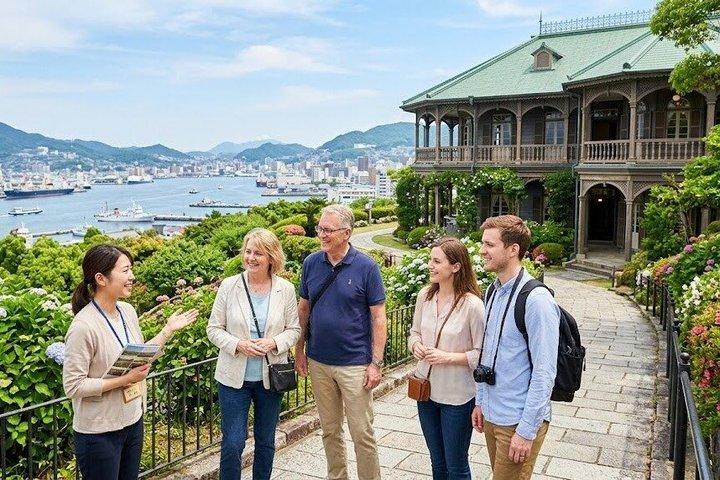
Glover Garden (グラバー園, Glover-en) is an open air museum in Nagasaki that exhibits mansions of several of the city's former foreign residents and related buildings. It is located on the hill where Western merchants settled down after the end of Japan's era of seclusion in the second half of the 19th century. The main attraction of the garden is the Former Glover House, the oldest Western-style wooden building in Japan. Thomas Glover (1838-1911) was a Scottish merchant who moved to Nagasaki after the opening of its port to foreign trade in 1859. He later assisted some of the revolutionaries who would eventually overthrow the Tokugawa Shogunate in the Meiji Restoration. Active in various industries, including shipbuilding and mining, Glover features prominently in the early history of Japan's industrialization.
Sofukuji Temple (崇福寺, Sōfukuji) is a temple in Nagasaki belonging to the Obaku school of Zen Buddhism. Originally built in 1629 for Nagasaki's Chinese residents, the temple is constructed in a Chinese architectural style and feels somewhat different to other temples in Japan. Sofukuji is built along the slope of a hill. At the bottom stands the temple's two-stories tall entrance gate, Ryugumon (lit. Gate of the Dragon Palace). Like the rest of the temple, it is painted bright red. The gate was originally built in 1673, but was destroyed several times by fire and storms before the most recent reconstruction was completed in 1849.
Dejima (出島) was a man-made island in the port of Nagasaki, constructed in 1636 to segregate Portuguese residents from the Japanese population and control their missionary activities. A few years later, the Portuguese were expelled from Japan, and the Dutch Trading Station, formerly located in Hirado, was moved to Dejima. The Dutch were restricted to Dejima during Japan's two centuries of isolation as the only remaining Westerners allowed in the country. Today, Dejima is not an island anymore, as the surrounding area has been reclaimed in the 20th century. However, a number of Dejima's historical structures remain or have been reconstructed in the area, including various residences, warehouses, walls and gates. The ultimate goal is to convert Dejima back into an island by digging canals around all its four sides.
Urakami Cathedral (浦上天主堂, Urakami Tenshudō) is a Catholic church in Nagasaki with a tragic yet interesting history. Today a working church housed in a large, European-style, red brick building, the cathedral is home to various relics that survived the atomic bombing.
Nagasaki Museum of History and Culture (長崎歴史文化博物館, Nagasaki Rekishi Bunka Hakubutsukan) is a well-executed, modern museum dedicated to Nagasaki's history as one of Japan's major international trading ports. The fairly large, permanent exhibition is spread over two floors and is comprised of various sections, each focusing on a different facet of Nagasaki's rich history. During the Edo Period the Japanese government adopted isolationism, effectively cutting the country off from the rest of the world. At this time, Nagasaki became one of the only ports where international trade was permitted, namely with the Chinese and Dutch. This temporarily made the city Japan's main window to the outside world and allowed a rich economy, culture and history to flourish.
A Gokoku Shrine is a shrine dedicated to the spirit of those who died for the nation. Before World War II, they were under the jurisdiction of the Ministry of the Interior, but after World War II they are administered by an independent religious corporation.
Oura Church (大浦天主堂, Ōura Tenshudō) is a Catholic church in Nagasaki. Built towards the end of the Edo Period in 1864 by a French missionary for the growing community of foreign merchants in the city, it is considered the oldest standing Christian church in Japan.
Kofukuji Temple (興福寺, Kōfukuji) is the oldest and one of the most important Chinese-founded temples in Nagasaki. Located in the city's Teramachi ("Temple Town") district, it is the birthplace of the Obaku school of Zen Buddhism in Japan and has many interesting features. The temple was established around 1620 by a Chinese monk at a time when large numbers of Chinese merchants were coming to Nagasaki to trade. The complex was originally set up as a place to pray for safe sea travel for the merchants, and the construction is heavily influenced by Chinese architectural styles, making it feel different to other temples in Japan.
Nagasaki Confucius Shrine (孔子廟, Kōshi-byō) is one of only a handful of shrines dedicated to the revered Chinese philosopher Confucius in Japan. The shrine was built in 1893 by Nagasaki's Chinese community. The colorful, atmospheric shrine also contains a museum at the rear of the grounds. A small garden with a bridge and pond greets visitors at the entrance. The ornate Chinese-style buildings are adorned with yellow roofs. Flanking the shrine's courtyard stand the 72 sages, life-size stone statues that weigh around two tons each and depict Confucius' disciples. The shrine encourages visitors to find among the statues one that resembles a relative.
Oura Church (大浦天主堂, Ōura Tenshudō) is a Catholic church in Nagasaki. Built towards the end of the Edo Period in 1864 by a French missionary for the growing community of foreign merchants in the city, it is considered the oldest standing Christian church in Japan.
The Twenty Six Martyrs Monument and adjacent museum (二十六聖人記念館, Nijūroku Seijin Kinenkan) in Nagasaki are dedicated to the twenty six Christians who were executed here on February 5, 1597. They included both foreign missionaries and Japanese laymen. Missionary activities were prohibited at the time, and Japan's ruler Toyotomi Hideyoshi staged the execution as a warning. The monument is located in a small park on a hill not far from Nagasaki Station and offers nice views over the city. A straight red line runs from the monument across the park's plaza in the direction of the Oura Church on the opposite side of the city. Oura Church is also dedicated to the 26 martyrs. The museum behind the monument is devoted to the memory of the martyrs and to Christianity in Japan in general. Its interior is reminiscent of a church with stained-glass windows, making for atmospheric viewing of the exhibits. On display are artifacts related to Christianity in Japan, including old documents, statues and jewelry. Explanations of many of the pieces are in English.
The Dutch Slope (オランダ坂, Oranda-zaka) is a stone-paved street leading up a hillside in Nagasaki where many foreign traders resided after the opening of the city's port to foreign trade in 1859. Because the Dutch were the only Westerners allowed in the country for the preceding two centuries, "Dutch" referred to everything Western for a while. A few former residences remain in the area today. Among them, the Higashi Yamate 13 is open to the public. Once home to a well-to-do European family, this old Western-style house has been well preserved, with much of the old furniture and room layouts remaining. There is a balcony upstairs where nice views can be had of the surrounding area. A cafe is located on the ground floor.
Meganebashi (眼鏡橋, lit. Spectacles Bridge) is the most remarkable of several stone bridges that span the Nakashima River in downtown Nagasaki. The bridge, which gets its name from the resemblance it has to a pair of spectacles when reflected in the river water, is a popular tourist attraction and is designated as an important cultural property. The bridge was originally built in 1634, its construction overseen by the Chinese monk who would go on to become the resident priest of Kofukuji Temple, which is located a short walk away. The bridge, along with many of the others along the river, was badly damaged by floodwaters in 1982, but has since been repaired with recovered stones. There is a stone walkway along the river bank that makes for a pleasant stroll with nice views of the water and bridges. The walkway has a tranquil atmosphere and is accessed by steps from street level positioned at various points along the river.
The Nagasaki Atomic Bomb Museum(長崎原爆資料館), located near the hypocenter of the August 9, 1945 bombing, documents the devastation caused by the atomic bomb and the city’s recovery. The museum features artifacts such as a melted rosary, a clock stopped at 11:02 a.m., and personal belongings of victims. Through photographs, survivor testimonies, and exhibits, it conveys the horrors of nuclear warfare and promotes peace. Facilities include audio guides, a library, a video room, and barrier-free access. The museum serves as a powerful reminder of the consequences of war and the urgent need for nuclear disarmament and lasting global peace.
Highlights
What's included
Pickup Locations & Times
This private tour is a walking day tour. A private vehicle is not included. Public transportation or local taxis maybe used to transfer between sites. Exact transportation costs can be discussed with the guide after a reservation is finalized. Please have Japanese Yen on hand for your transportation costs. If you wish to arrange for a private vehicle, please contact us directly. All Private vehicles must be booked 5 days in advance. Maximum number of passengers: 7. ※This tour is designed for Nagasaki port meet up and end; meet-up/end at Sasebo Port is not available.
Traveller Ratings
Important Information
- Service animals allowed
- Public transportation options are available nearby
- Infants and small children can ride in a pram or stroller
- All areas and surfaces are wheelchair accessible
- Transportation options are wheelchair accessible
- Wheelchair accessible
- Suitable for all physical fitness levels
- This is a walking & public transport tour. Pick up is on foot.
Reviews(61)
This is a recommended activity for anyone interested in looking at a range of sights in Nagasaki. As it is a half day you will choose from a set of offerings. We chose the Peace museum and the Peace Park (areas with remnants and statues to the bomb), cable car and then walk through Chinatown where we had lunch to finish. As it was nearby we also walked through the oldest shopping street to spectacle bridge- named as such for the reflection it makes on the water. Our guide was the wonderful and informative Yoshi-san. In between the destinations and while walking through them, we had a constant stream of information and question and answers so we learnt a number of things along the way. Highlights at the park are ground zero above where the bomb exploded, the remnants of a Christian church, a range of sculptures donated by various countries, a cross section of what the ground actually looked like after the blast and the small bomb shelters people dug out of the ground for protection. At the start of the museum walk you are confronted with an actual clock that stopped at 11:02. It somewhat sets the tone for what follows. At the end, where there are accounts from survivors, you will see a photo now famed as “The boy from Nagasaki”. It is a poignant ending to the whole display…do research the story if you are not familiar with it. The cable car ride is a worthy addition as you get to see all of Nagasaki and the landmarks you previously walked through. In order to move quickly through the destinations we choose to travel by taxi …about yen 1400 each trip. Lunch in Chinatown was a recommendation from Yoshi-san for one of the local specialities - Champon and Sara Udon. Both are a chinese-style noodle served in a rich, creamy broth - one in soup and one with crispy noodles. After lunch we walked through the oldest shopping street and then to spectacle bridge. We did this in early June so rain weather can be a factor - we were fortunate to have a warm day, although it rained the next. As we had also done the Hiroshima tour it was still an appreciated difference…noting that there as are way less tourists as I think most just go for the Hiroshima trip.
Thank you so much for your wonderful and detailed review! It was an absolute pleasure guiding you through Nagasaki. I am delighted to hear that you enjoyed our half-day itinerary, from the moving experience at the Peace Park and Museum to the panoramic views from the cable car, and our walk to the Spectacle Bridge. I’m also thrilled that you enjoyed the Champon and Sara Udon in Chinatown! They are truly the taste of Nagasaki, and I always love introducing them to my guests. While Hiroshima is deeply significant, Nagasaki indeed has its own unique atmosphere and history, and I am so glad you were able to experience that difference. We were certainly blessed with beautiful weather that day! Thank you again for choosing my company. I wish you all the best in your future travels! Warm regards, Yoshi
Our tour experience was led by Yoshi. She was professional, knowledgeable and fun. She was also very patient. Our visit to the Atomic Museum was longer than any of us anticipated. There is so much information, photos and personal testimony, I could have stayed longer. What we appreciate about having a local guide is the stories which set the context. Yoshi talked of people she knew who were survivors. The challenges after the bombing. She took us outside to Nagasaki Peace park - showed us places (the bomb shelter holes) that we would have missed had she not been with us. She explained the history of Nagasaki. Even took us to the sculpture in the park donated by the government of Aotearoa. We then headed to Inasa-yama ropeway. Again she explained various landmarks, associated histories and random facts. Lastly she guided us to a restaurant in China town to try Champon and sara-udon. Delicious!!! She also directed us toward local landmarks (Megane-bashi). This was incredible value for a half day tour. It was longer than half a day really. I think this tour is worth doing for all the reasons mentioned above.
Thank you so much for taking the time to write such a thoughtful and wonderful review! I am deeply moved by your words. It was an honor to guide you and share not only the history of Nagasaki but also the personal stories of the survivors. It means a lot to me that you took the time to deeply engage with the exhibits at the Peace Museum and that we could visit the sculpture from Aotearoa together. I’m also so glad that we could explore Mount Inasa, catch the views, and that you enjoyed the Champon and Sara Udon in Chinatown! Thank you for your patience and for being such wonderful, curious guests. I wish you all the very best in your future travels! Warm regards, Yoshi
Knowledgeable guide and great trip
Hiro buideldier us and hé was very informative, hé knel a lot and het was a very Nice person to travel with. We can sincerely reconventie Hiro to guide you in Kumamoto.
Thank you very much for the comment. I also enjoyed the tour with you! Please have a safe trip. Hiro
Walked and toured at our pace. Some stairs and slopes to negotiate. Guide was friendly and knowledgeable.
We appreciate your kind feedback and our guides do too! We are very happy to hear that you enjoyed the tour with your guide. We look forward to your next visit to Japan! Japan Guide Agency
We had a very interesting and sobering visit to Nagasaki today. Rikako was our guide and she showed us many places of interest that we never would have found ourselves. The atomic bomb museum is a must for anyone that visits Nagasaki. It lays out in detail the truth of what happened at 11:02am on 9th August 1945. Rikako also shared with us some very moving stories about people in her family who experienced the bomb - the hibakusha. When then had some light refreshments at a delightful shop in the city centre. Thank you Rikako for a wonderful day.
Thank you for taking your time to write this such a wonderful review! It was a very good opportunity for me to share my family's atomic bomb experience with you. It is truly appreciated that you remembered and mentioned "Hibakusha". I also enjoyed the refreshment with you and that is my favorite store. Wish your health and happiness from Nagasaki. I'm looking forward to seeing you again someday. Rikako
Our guide Junichi Matsumoto was very good. He texted us several times before the trip. Met us at the terminal and took us to many places we would not have found on our own.
Dear Chuck, Thank you for your review. I apologize for the very late reply. It ended up being a somewhat tight schedule, but I'm glad if you have enjoyed the tour. I am happy that I was able to be of help. Kind regards, Junichi Matsumoto
Our personal tour with Yoshi-san was amazing. Yoshi has a superior command of the English language, and is very generous allowing us to practice our Japanese with her. She has extensive knowledge of Nagasaki’s popular sights, and provided an educational and personal insight surrounding the events before and after the atomic bombing of Nagasaki. We are thankful for her expert guidance as well as her charming personality! Many thanks, Yoshi-san! Doug and Paulette
Thank you so much for your kind words! It was truly a pleasure guiding you around Nagasaki. I’m delighted to hear that you enjoyed our time together and found the historical insights meaningful. I also had a wonderful time practicing Japanese with you two—your enthusiasm was inspiring! Nagasaki has many more stories to tell, and I would love to welcome you back anytime. Thank you again for taking time for your time and kind review. Yoshi
Tour guide spoke very broken English, hard to understand her. Although she was very sweet, she also needed to speak up as it was hard to hear her. Her visual aids were very worn and torn and looked very unprofessional.
Thank you very much for your review. We understand that you also were mislead by viator to believe that this tour came with a vehicle, which we are sorry that this caused you troubles. We will speak with the guide about the tour and check her materials. Japan Guide Agency
Hiromi was a wonderful guide. She knew an amazing amount about Nagasaki, its history and traditions, as she had grown up there.
Thank you for your heartwarming comments. I was so happy to have spent a wonderful day with you. I was inspired to train my body to be healthy like two of you. Please enjoy the rest of your travel.