Nagasaki Full-Day Private Tour with Government-Licensed Guide



Description
Explore Nagasaki with a government-licensed and experienced English-speaking guide! Your guide will help you efficiently enjoy a full-day walking tour of Nagasaki and introduce both modern and traditional sides of this dynamic and ancient Japanese city. Your guide will meet you at your hotel in Nagasaki and take you to visit Nagasaki's famous sites. Along with atomic bombing of Nagasaki during WWII, this city's history features many prominent events. You can learn about this and other interesting aspects during this full-day walking tour accompanied by your private guide. Note*1: You cannot visit all the sites on the itinerary. You can choose up to 4 sites to visit. You must inform your guide of the sites you wish to visit. Note*2: The National Government Licensed Guide Interpreter certification is issued by the Japanese government requires a good knowledge and understanding of Japanese culture and history.
Tour Options
Itinerary
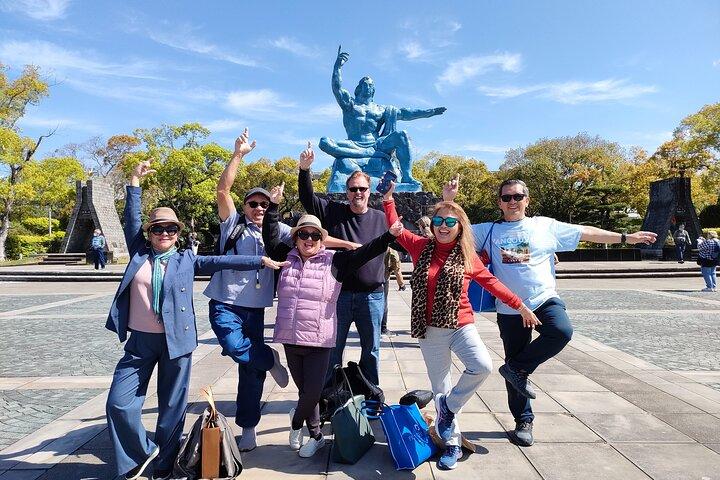
The Nagasaki Peace Park (平和公園, Heiwa Kōen) is a tranquil space that commemorates the atomic bombing of Nagasaki on August 9, 1945, which destroyed a significant portion of the city and killed tens of thousands of inhabitants. The complex is comprised of two parks and a memorial museum. In the center of the complex is the Hypocenter Park with a simple, black monolith that marks the explosion's epicenter. Not far from it stands a damaged pillar of the former Urakami Cathedral which was destroyed in the blast. Furthermore, there is an area that allows visitors to take a look at a layer of soil below the park's surface where broken roof tiles, bricks and pieces of glass remain from the explosion.
Mount Inasa (稲佐山, Inasayama) is a 333 meter high mountain close to Nagasaki's city center. The summit can be reached by ropeway, bus or car and offers great views over the city. In fact, the night views from Mount Inasa are ranked among Japan's three best night views besides the views from Mount Hakodate and Mount Rokko. Several television and radio antennas and an observation deck with restaurant are located at the summit.
The Nagasaki Kunchi (長崎くんち) is the festival of Suwa Shrine, held annually in Nagasaki on October 7-9. The festival has been celebrated for about 400 years and incorporates different aspects of Chinese and Dutch cultures, which have played a role in the city's history. The festival's name is believed to come from ku-nichi ("9th day"), the ninth day of the ninth month of the lunar calendar. The festival's highlights are the dance and show performances by groups representing Nagasaki's various city districts. Each district (odori-cho), participates only once every seven years, so this festival remains fresh to even the regular viewer.
Glover Garden (グラバー園, Glover-en) is an open air museum in Nagasaki that exhibits mansions of several of the city's former foreign residents and related buildings. It is located on the hill where Western merchants settled down after the end of Japan's era of seclusion in the second half of the 19th century. The main attraction of the garden is the Former Glover House, the oldest Western-style wooden building in Japan. Thomas Glover (1838-1911) was a Scottish merchant who moved to Nagasaki after the opening of its port to foreign trade in 1859. He later assisted some of the revolutionaries who would eventually overthrow the Tokugawa Shogunate in the Meiji Restoration. Active in various industries, including shipbuilding and mining, Glover features prominently in the early history of Japan's industrialization.
Sofukuji Temple (崇福寺, Sōfukuji) is a temple in Nagasaki belonging to the Obaku school of Zen Buddhism. Originally built in 1629 for Nagasaki's Chinese residents, the temple is constructed in a Chinese architectural style and feels somewhat different to other temples in Japan. Sofukuji is built along the slope of a hill. At the bottom stands the temple's two-stories tall entrance gate, Ryugumon (lit. Gate of the Dragon Palace). Like the rest of the temple, it is painted bright red. The gate was originally built in 1673, but was destroyed several times by fire and storms before the most recent reconstruction was completed in 1849.
Dejima (出島) was a man-made island in the port of Nagasaki, constructed in 1636 to segregate Portuguese residents from the Japanese population and control their missionary activities. A few years later, the Portuguese were expelled from Japan, and the Dutch Trading Station, formerly located in Hirado, was moved to Dejima. The Dutch were restricted to Dejima during Japan's two centuries of isolation as the only remaining Westerners allowed in the country. Today, Dejima is not an island anymore, as the surrounding area has been reclaimed in the 20th century. However, a number of Dejima's historical structures remain or have been reconstructed in the area, including various residences, warehouses, walls and gates. The ultimate goal is to convert Dejima back into an island by digging canals around all its four sides.
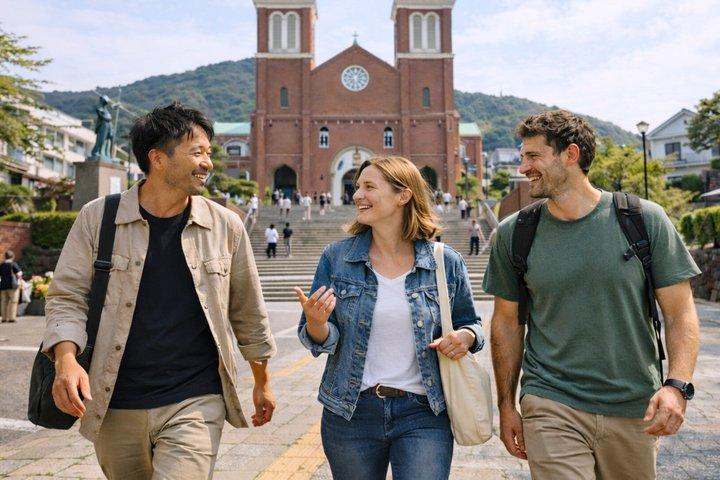
Urakami Cathedral (浦上天主堂, Urakami Tenshudō) is a Catholic church in Nagasaki with a tragic yet interesting history. Today a working church housed in a large, European-style, red brick building, the cathedral is home to various relics that survived the atomic bombing. The atomic bomb was dropped on Nagasaki on August 9, 1945 and almost completely destroyed the church which stood only 500 meters from the hypocenter. A group of charred stone saints were left in place and still stand before a decimated wall in front of the cathedral. There are also other relics inside, including the surviving head of a Saint Mary statue recovered after the blast, and one of the church's original bells. The modern incarnation of the cathedral was completed in 1959.
Nagasaki Museum of History and Culture (長崎歴史文化博物館, Nagasaki Rekishi Bunka Hakubutsukan) is a well-executed, modern museum dedicated to Nagasaki's history as one of Japan's major international trading ports. The fairly large, permanent exhibition is spread over two floors and is comprised of various sections, each focusing on a different facet of Nagasaki's rich history. During the Edo Period the Japanese government adopted isolationism, effectively cutting the country off from the rest of the world. At this time, Nagasaki became one of the only ports where international trade was permitted, namely with the Chinese and Dutch. This temporarily made the city Japan's main window to the outside world and allowed a rich economy, culture and history to flourish.
Kofukuji Temple (興福寺, Kōfukuji) is the oldest and one of the most important Chinese-founded temples in Nagasaki. Located in the city's Teramachi ("Temple Town") district, it is the birthplace of the Obaku school of Zen Buddhism in Japan and has many interesting features. The temple was established around 1620 by a Chinese monk at a time when large numbers of Chinese merchants were coming to Nagasaki to trade. The complex was originally set up as a place to pray for safe sea travel for the merchants, and the construction is heavily influenced by Chinese architectural styles, making it feel different to other temples in Japan. The temple grounds contain a number of buildings, including the main hall, originally built in 1632, which serves as a fine example of Chinese-style architecture of the time. A celebrated, large glass lantern imported from China, hangs from the roof of the main hall. There are various other interesting halls and structures around the grounds with explanatory signs in English.
Nagasaki Confucius Shrine (孔子廟, Kōshi-byō) is one of only a handful of shrines dedicated to the revered Chinese philosopher Confucius in Japan. The shrine was built in 1893 by Nagasaki's Chinese community. The colorful, atmospheric shrine also contains a museum at the rear of the grounds. A small garden with a bridge and pond greets visitors at the entrance. The ornate Chinese-style buildings are adorned with yellow roofs. Flanking the shrine's courtyard stand the 72 sages, life-size stone statues that weigh around two tons each and depict Confucius' disciples. The shrine encourages visitors to find among the statues one that resembles a relative.
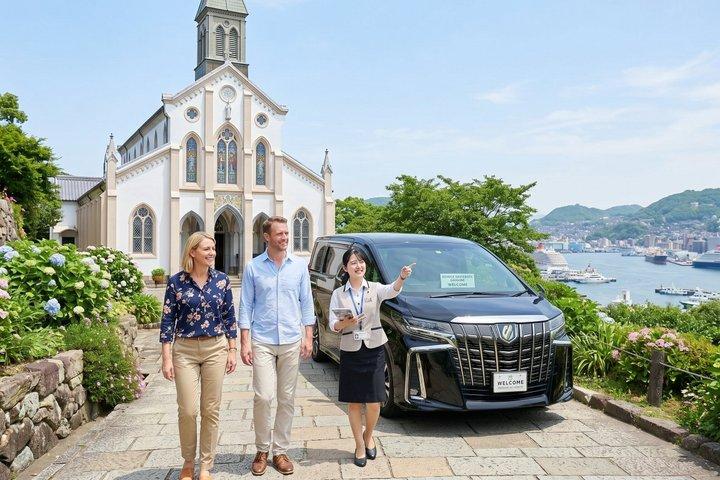
Oura Church (大浦天主堂, Ōura Tenshudō) is a Catholic church in Nagasaki. Built towards the end of the Edo Period in 1864 by a French missionary for the growing community of foreign merchants in the city, it is considered the oldest standing Christian church in Japan. Oura Church is dedicated to the memory of the 26 Christians who were executed in the city in 1597. Today, the working church stands as an attractive example of contemporary European architecture, drawing many visitors. The church was the first Western-style building in Japan to be designated as a national treasure. The steep admission fee includes entrance to a museum about the history of Christianity in Japan. Located in attractive old buildings to the right of the church is the Christian Museum.
Kofukuji Temple (興福寺, Kōfukuji) is the oldest and one of the most important Chinese-founded temples in Nagasaki. Located in the city's Teramachi ("Temple Town") district, it is the birthplace of the Obaku school of Zen Buddhism in Japan and has many interesting features. The temple was established around 1620 by a Chinese monk at a time when large numbers of Chinese merchants were coming to Nagasaki to trade. The complex was originally set up as a place to pray for safe sea travel for the merchants, and the construction is heavily influenced by Chinese architectural styles, making it feel different to other temples in Japan.
Nagasaki Confucius Shrine (孔子廟, Kōshi-byō) is one of only a handful of shrines dedicated to the revered Chinese philosopher Confucius in Japan. The shrine was built in 1893 by Nagasaki's Chinese community. The colorful, atmospheric shrine also contains a museum at the rear of the grounds. A small garden with a bridge and pond greets visitors at the entrance. The ornate Chinese-style buildings are adorned with yellow roofs. Flanking the shrine's courtyard stand the 72 sages, life-size stone statues that weigh around two tons each and depict Confucius' disciples. The shrine encourages visitors to find among the statues one that resembles a relative.
Oura Church (大浦天主堂, Ōura Tenshudō) is a Catholic church in Nagasaki. Built towards the end of the Edo Period in 1864 by a French missionary for the growing community of foreign merchants in the city, it is considered the oldest standing Christian church in Japan. Oura Church is dedicated to the memory of the 26 Christians who were executed in the city in 1597. Today, the working church stands as an attractive example of contemporary European architecture, drawing many visitors. The church was the first Western-style building in Japan to be designated as a national treasure. The steep admission fee includes entrance to a museum about the history of Christianity in Japan. Located in attractive old buildings to the right of the church is the Christian Museum. Included in the admission fee, the museum contains various exhibitions pertaining to the history of Oura Church and Christianity in the region and across Japan, with various artifacts and old documents on display. Explanations are predominantly in Japanese.
The Twenty Six Martyrs Monument and adjacent museum (二十六聖人記念館, Nijūroku Seijin Kinenkan) in Nagasaki are dedicated to the twenty six Christians who were executed here on February 5, 1597. They included both foreign missionaries and Japanese laymen. Missionary activities were prohibited at the time, and Japan's ruler Toyotomi Hideyoshi staged the execution as a warning. The monument is located in a small park on a hill not far from Nagasaki Station and offers nice views over the city. A straight red line runs from the monument across the park's plaza in the direction of the Oura Church on the opposite side of the city. Oura Church is also dedicated to the 26 martyrs. The museum behind the monument is devoted to the memory of the martyrs and to Christianity in Japan in general. Its interior is reminiscent of a church with stained-glass windows, making for atmospheric viewing of the exhibits. On display are artifacts related to Christianity in Japan, including old documents, statues and jewelry. Explanations of many of the pieces are in English.
The Dutch Slope (オランダ坂, Oranda-zaka) is a stone-paved street leading up a hillside in Nagasaki where many foreign traders resided after the opening of the city's port to foreign trade in 1859. Because the Dutch were the only Westerners allowed in the country for the preceding two centuries, "Dutch" referred to everything Western for a while. A few former residences remain in the area today. Among them, the Higashi Yamate 13 is open to the public. Once home to a well-to-do European family, this old Western-style house has been well preserved, with much of the old furniture and room layouts remaining. There is a balcony upstairs where nice views can be had of the surrounding area. A cafe is located on the ground floor.
Meganebashi (眼鏡橋, lit. Spectacles Bridge) is the most remarkable of several stone bridges that span the Nakashima River in downtown Nagasaki. The bridge, which gets its name from the resemblance it has to a pair of spectacles when reflected in the river water, is a popular tourist attraction and is designated as an important cultural property. The bridge was originally built in 1634, its construction overseen by the Chinese monk who would go on to become the resident priest of Kofukuji Temple, which is located a short walk away. The bridge, along with many of the others along the river, was badly damaged by floodwaters in 1982, but has since been repaired with recovered stones. There is a stone walkway along the river bank that makes for a pleasant stroll with nice views of the water and bridges. The walkway has a tranquil atmosphere and is accessed by steps from street level positioned at various points along the river.
The Nagasaki Prefectural Art Museum (長崎県美術館, Nagasaki-ken Bijutsukan) is a modern and spacious complex attractively located by the port of Nagasaki. The museum, which was designed by famous architect Kuma Kengo, opened in 2005 and contains permanent collections of art related to Nagasaki as well as a large collection of Spanish art. In addition, it also hosts temporary exhibitions. Made using glass and rock, the museum is airy and bright and contains multiple exhibition galleries. The Suma Collection features Spanish art ranging from medieval to contemporary works and contains pieces from legendary artists including Picasso. It is named after Suma Yakichiro who started the collection while serving as a diplomat in Spain during the 1940s. Another collection is dedicated to art relating to Nagasaki, including works produced by local artists. One more appealing feature of the museum is its roof garden. The garden is made up of lawn space separated by a paved walkway. There are also a couple of seating areas with nice views of the port and city. The roof garden can be accessed from both inside and outside the museum, meaning that it is not exclusively open to museum patrons.
The Nagasaki Atomic Bomb Museum(長崎原爆資料館), located near the hypocenter of the August 9, 1945 bombing, documents the devastation caused by the atomic bomb and the city’s recovery. The museum features artifacts such as a melted rosary, a clock stopped at 11:02 a.m., and personal belongings of victims. Through photographs, survivor testimonies, and exhibits, it conveys the horrors of nuclear warfare and promotes peace. Facilities include audio guides, a library, a video room, and barrier-free access. The museum serves as a powerful reminder of the consequences of war and the urgent need for nuclear disarmament and lasting global peace.
Highlights
What's included
Pickup Locations & Times
This private tour is a walking day tour. A private vehicle is not included. Public transportation or local taxis maybe used to transfer between sites. Exact transportation costs can be discussed with the guide after a reservation is finalized. Please have Japanese Yen on hand for your transportation costs. If you wish to arrange for a private vehicle, please contact us directly. All Private vehicles must be booked 5 days in advance. Maximum number of passengers: 7. ※This tour is designed for Nagasaki port meet up and end; meet-up/end at Sasebo Port is not available.
Traveller Ratings
Important Information
- Service animals allowed
- Public transportation options are available nearby
- Infants and small children can ride in a pram or stroller
- All areas and surfaces are wheelchair accessible
- Transportation options are wheelchair accessible
- Wheelchair accessible
- Suitable for all physical fitness levels
- This is a walking & public transport tour. Pick up is on foot.
Reviews(85)
Had a very nice experience. Coco was very informative and took us to the places we wanted too see.. definitely recommend
Thank you for your review! I am truly happy that you enjoyed the tour. Wish you all the best and have a nice trip! Rikako (Coco)
Junichi was a great tour guide. He met us at the cruise port and customized the tour for our family interests. We started the day at Glover gardens and got to learn how Japanese industry evolved. We experienced local lunch in Chinatown and ended the day at the Atomic bomb museum and peace park.
I am truly delighted to have received such a positive review. Although the forecast called for cloudy or rainy weather that day, the weather turned out to be surprisingly sunny, so I feel sorry you got sunburned. In any case, I’m glad I could help your family create some wonderful memories on that day. Please do come back to Japan again if you have the chance. Once again, I would like to express my sincere gratitude to you and your family. Arigatou gozaimasu ! - Junichi
We had a wonderful tour of the city of Nagasaki. It was a very great value for the duration of the tour. Our tour was for six hours. Coco was super informative and extremely accommodating to our family. We definitely recommend this tour.
Thank you for your review! I enjoyed talking about cosmetics with you. I'm very happy you enjoyed shopping. Wish you all the best and have a safe trip! Rikako (Coco)
We had a wonderful tour with Junichi! I booked this private tour for me and family instead of following the cruise ship group. Junichi took us to so many places and had great knowledge about all of them. Junichi was also able to cater the tour to the places we wanted to see and also recommended some other spots not on our list too! We moved around the city by tram which was a great way to get around. In addition, we made a few stops for bao buns, souvenirs, ice cream, and match. Would highly recommend this private tour to anyone wanting a personalized experience of Nagasaki. It was well worth the money!
I appreciate you so much for giving me the opportunity to show you around Nagasaki, and for your lovely review. I was able to show you around Glover Garden, Dejima, Chinatown, and the Atomic Bomb Memorial sites within the limited time we had, and I’m glad you enjoyed the souvenir shop we stopped by at the end. It’s wonderful that you, your parents, and your husband are traveling together in Japan. I'm happy I was able to contribute to creating fabulous memories for your family. Once again, I would like to express my deepest gratitude for sharing such a wonderful time with you and your family. Junichi
When traveling by cruise, we always arrange a private tour/experience for our small group only. On this trip, we were a group of six ranging in age from 21 to 70. We were SO LUCKY to meet our fabulous guide Yoshi and get to know her on our trip. Yoshi made the day interesting, educational, and fun for all of us. She shared the love and history for her hometown of Nagasaki, and let us know that she had been to Pearl Harbor to have that perspective. We wanted to travel by street car to have that experience (it was a great way to get around), and Yoshi reviewed the options with us first thing in the morning to plan our day. We went to the Peace garden and museum (only a nominal charge for the museum), the Dutch trading village, an observation town, and the stone bridges. Yoshi took us to the shopping area so we could finish our day there. We almost skipped the peace museum, because we had been to Hiroshima museum already (SO CROWDED), but it was a completely different experience and we all were happy that we did not miss it. At the Dutch village, Yoshi took us to the key things to see there and explained them to us so we maximised our time in Nagasaki. Highly recommend this tour and especially Yoshi as the guide. She was delightful.
Thank you so much for such a wonderful and detailed review! It was an absolute alternative privilege to guide your lovely group of six. I am so glad that we customized the itinerary with the streetcar experience and that you enjoyed the Atomic Bomb Museum—it really is a unique and important place, different from Hiroshima. Sharing the history and beauty of my hometown, Nagasaki, with such engaged guests like you is the best part of my job. Thank you for your kind words about my perspective and guidance. I hope the rest of your cruise was fantastic, and I would love to welcome you all back to Japan someday! Best wishes, Yoshi
Perfectly paced for our group. We saw what most interested us.
Customized to meet our specific interests. A perfect blend of taxi, tram and walking around Nagasaki.
Thank you for the lovely feedback! I had a great time exploring Nagasaki with you. Creating a personalized tour to fit your specific interests is always my favorite part of the job. I'm so glad you enjoyed riding the local tram and walking around the city! Thank you for choosing our company as your guide in Nagasaki, and I hope to see you again someday! Best regards, Yoshi
Hiro is a very knowledgeable and skilled guide. We covered a lot of ground visiting our chosen stops and he maneuvered our group around very efficiently and skillfully. Very nice man and great guide. Highly recommended!
Thank you very much for the comments. I am so glad to hear that you enjoyed the tour. I also enjoyed the tour with you. Please have a safe trip! - Hiro
Really good day out with a local guide, very informative about the different museums and Temples, I had a very enjoyable day. Thank you Coco
Thank you for taking your time to write a review! You liked history, so I really enjoyed talking with you. I was so surprised that I encountered the book, which I was in it!!! I was so happy that I was able to share it with you. I hope you come back to Nagasaki again to look at the Kunchi Festival. It would be very pleasure to guide you again. Safe travels. Wish you all the best from Nagasaki. - Rikako (Coco)
Our guide Yoshiko Hattori is an excellent Nagasaki guide! She is a local, well versed in the area history and navigates around the city with ease. She is fluent in English and fun to be with. She took us to Nagasaki Atomic Bomb Museum, Peace Park, Ground Zero, the Nagasaki Ropeway, the Fuchi Shrine and the Spectacles Bridge. She also suggested an excellent reasonably priced sushi restaurant for lunch. We had a great day with her! Thanks Yoshi!
Thank you so much for your kind review! I truly enjoyed our day exploring the Atomic Bomb Museum, the Spectacles Bridge and so on together. I’m also glad you liked the sushi lunch! It was a pleasure sharing my hometown with you. Please come back to Nagasaki again someday! Best regards, Yoshi