Audio Guided Tour in Padua Baptistery and Museum of the Diocese


Description
The Baptistery of the Cathedral of Padua is part of the UNESCO World Heritage Site together with seven other masterpieces of Paduan art: the site consists of eight religious and secular building complexes within the city walls of Padua, housing a selection of fresco cycles painted between 1302 and 1397 by different artists, for different clients and within buildings with different destinations. Despite this, the frescoes maintain unity of style and content. They include the Scrovegni Chapel and the Church of the Eremitani, the Palazzo della Ragione, the Chapel of the Reggia Carrarese, the Basilica and Convent of St. Anthony, the Oratory of St. George and the Oratory of St. Michael, and the Baptistery of the Cathedral. Taken together, these cycles illustrate how, in the space of a century, the art of fresco painting developed hand in hand with a new creative impetus and a new understanding of spatial representation. Padua is located 30 minutes from Venice.
Tour Options
Itinerary
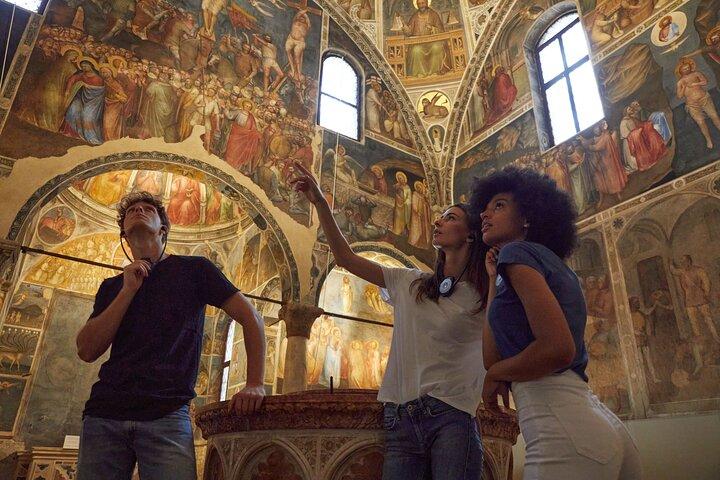
Discover the Baptistery of the Cathedral of Padua through a new exciting visiting experience. The paintings kept in the Baptistery, which represent one of the highest expressions of Italian Fourteenth-century art, were commissioned to the painter Giusto de’ Menabuoi by Fina Buzzaccarini, the wife of Francesco da Carrara called il Vecchio, Lord of Padua. A narrator will guide you as you both enter and explore this extraordinary place of art and worship and will allow you to immerse yourself in the magnificence of its frescoes describing the history of Salvation from the Book of Genesis to the Book of Revelation and up until the Paradise which dominates the dome.
The monumental building complex of Piazza Duomo, which also includes the Cathedral and the Bishop’s palace, testifies to the millennial history and tradition of Christianity in Padua. Inside the palace is the Museum of the Diocese with its majestic Bishops’ Hall which can be visited by taking an unusual guided tour too.
Highlights
What's included
Traveller Ratings
Important Information
- Wheelchair accessible
- Infants and small children can ride in a pram or stroller
- Public transportation options are available nearby
- Transportation options are wheelchair accessible
- All areas and surfaces are wheelchair accessible
- Suitable for all physical fitness levels
Reviews(6)
It was a wonderful experience. The frescoes are beautiful and leave you with deep feelings.
I thought seeing the Scrovegni Chapel made sense, but no. When visiting the Cathedral of Santa Maria de la Asunción I discovered that it had a baptistery with paid access. Without thinking twice I bought the ticket. While waiting for the guided tour to begin, I visited two rooms (museum of the diocese), just in time to enter the baptistry. First you are welcomed into a room where you are welcomed and given an introductory video. The projection is already quite spectacular, with a montage of large screens in different formats and projections on the floor. They give you an audio guide in your language. Then you are brought into the baptistry and that is where you contemplate the majesty of the fresco paintings of Giusto de Menabuoi (XIV century). Inside you still listen to the audio guide that each of the parts and each of the painted scenes are telling you as they are lit up. The experience is amazing. The fusion that is created between architecture, painting and the voice of the audio guide telling you every detail with the lighting makes you gobsmacked. Even my 10-year-old son was shocked. I don't even tell you.
Beautiful frescos Our third time visiting but this time enhanced by the accompanying audio guide Booking system also now control the numbers
To start I have to say that our train was delayed and we missed the start of our audio tour, but thanks to the great kindness of the lady at reception who took us through the exit to the baptistery, we were able to see this wonderful example of Italian art. The audio tour of the baptistery is excellent, lighting up the different biblical scenes in turn and explaining the history and the images of this spectacular building. We hope to revisit later in the year with more time so that we can do the complete tour.
Of stunning beauty. It is inexplicable how in the 12th and 13th century with the means at their disposal, they could do things like this. Almost at the height of Gioto's Scrovegni chapel. All very well explained, identifying characters and representations of paintings.
Very well organized advice to everyone. Perfect audio guides in major languages and equally effective explanations